
ARTISTS’ BOOKS | History & Culture

I labour incessantly: a William Blake to do list
Set of two ruled notepads, twenty pages each, inkjet printed onto 70 lb text weight paper. Created 2019.
8 ½ x 3 5/8”
open edition
Finally a realistic to do list. Each sheet is topped with a (non) motivational phrase by 18th century poet William Blake excusing your inability to accomplish any task. The text is excerpted from a letter to Blake’s long-suffering patron Thomas Butts.
Save one as an artists’ book, use the second, gift the third to excuse an unproductive loved one.
Phrases include:
Time flies
I labour incessantly
I accomplish not one half of what I intend
only now I approach the prospect
my seeming neglect
my want of steady perseverance
labouring
matchless industry
I shall have an opportunity
who shall deliver me
I endeavour
which you may expect soon
which I have nearly completed
Alas! wretched, happy, ineffectual labourer
I, with my whole might, chain my feet to the world of duty
But in vain!
still unfinished, but is in a finishing way
perhaps, or rather certainly
but such as I can be, I will

Nevermore Again: Poe Exhumed
Deluxe edition of 25, 44 pages, 6 1/2 x 4 1/4 x 1/4"
Standard edition of 50, 40 pages, 6 3/8 x 4 1/4 x 1/8”
Chapbook edition of 50, 32 pages, 6 3/8 x 4 1/4 x 1/8”
only two remain of the deluxe edition
created 2010
A criminal undone by his own bravado.
A national hero who has no substance.
A prosperous people believing they are immune to the tragedies befalling their neighbors.
A man leaving for a hike in the hills and coming back with an unbelievable story.
A large swath of society falling for a hoax.
Current events mirror tales written by Edgar Allan Poe over one hundred and fifty years ago. Nevermore Again: Poe Exhumed pairs twelve Poe stories with equally spine-tingling stories from the news. The Premature Burial and the struggling economy, The Balloon Hoax and the hunt for weapons of mass destruction, A Tale of The Ragged Mountains and politicians’ dalliances in the Appalachian Mountains and beyond, William Wilson and genetically modified food, The Black Cat and the bravado of a former Illinois governor, The Man that Was Used Up and the meteoric rise of a former Alaska governor.
The typography and design for Nevermore Again: Poe Exhumed are based on the first edition of Poe’s first published work, Tamerlane and Other Poems. Only twelve copies of this modest pamphlet are known to exist of the fifty printed in Boston in 1827. The Standard Edition is presented in a paper wrapper. The construction is based on the first edition of Tamerlane.
The Deluxe Edition is presented in an early 19th-century-style publisher’s binding with marbled paper by Pamela Smith. The endpapers incorporate the design of the wrapper for the Standard Edition. Both the Standard and Deluxe editions are inkjet printed on Ruscombe Mill pale wove handmade paper. Images of the first edition of Tamerlane and Other Poems on the enclosure courtesy of University of Chicago Library, Special Collections Research Center. The Chapbook is a single-signature pamphlet on French Construction whitewash in wrapper of Bugra.
”Although few people today are likely to confuse Edgar Allan Poe with Nostrodamus or to view his stories and poems as predictions of the future, book artist Karen Hanmer has cleverly and forcefully shown Poe’s relevance to today’s world in “Nevermore, Again: Poe Exhumed.”
By showing--with jarring emphasis--the connection between such Poe masterpieces as “The Premature Burial,” “The Masque of the Red Death,” and “The Black Cat” (fourteen stories and poems are referenced) and modern dilemmas or scandals, Hanmer illustrates that some things never change. Unfortunately. In “Nevermore, Again,” themes of hoax, false assurance and security, loose tongues, overreactions based on fear, and misleading facades with no underlying substance in Poe’s tales are linked to modern incidents such as the Iraqi war, political sex scandals, Internet impropriety, and man-made, technology-driven natural disasters.
As in his own day, Poe is read today for the goose-bumps his stories can raise. As “Nevermore, Again” points out, our modern life can raise even more goose-bumps, with consequences far beyond a disturbed sleep. Perhaps nothing in Poe is--or should be--more disturbing than what we are confronted with in the world around us today. “
William K. Finley
Head, Special Collections & University Archives, Jackson Library, The University of North Carolina at Greensboro

To Serve and Protect: Containers, conveyances, and cosmic happenings
Pigment inkjet prints on Mohawk Superfine. 32 pages. Created 2014.
Edition of 100.
7 x 5 x .25”
Deluxe: Sewn Boards binding, covered in full, custom marbled paper by Pamela Smith, Bugra double folio endsheets. Presented in slipcase with marbled paper accent, numbered 1-40.
Chapbook: Pamphlet in inkjet-printed, flower power paper wrapper by the artist, numbered 41-100.
To Serve and Protect: Containers, conveyances, and cosmic happenings began as a response to the theme “vessel.” Vehicles, containers for food, and other period receptacles provide a framework for the artist’s musings on life in the 1960s and 1970s. Thirteen micro essays touch on the Vietnam War, fashion, the Cold War, cuisine, the economy, the women’s liberation movement, and other issues reflecting Americans’ perseverance, and our often misguided quest for peace and stability.

The Model Architect: The Panic of ’09
Pigment inkjet prints, calf spine, leather label, title and tooling in gold foil, red acrylic ink edges. Marbled paper by Iris Nevins. Created 2010.
14 x 11 x .5”
edition of 30, 48 pages
Please note this piece is made to order and may not be available for immediate delivery. Normal turn-around time is three months.
The Model Architect: The Panic Of ’09 is based on The Model Architect, Samuel Sloan’s 1852 collection of house plans and instructions to contractors. The new work pairs historical text and illustrations from Sloan’s work with contemporary text from the U.S. Department of Housing and Urban Development’s online Guide to Avoiding Foreclosure. The colophon provides commentary by the artist, noting the effects of speculation and financial collapse in her own neighborhood. The book is bound using the drum leaf structure, but is evocative of a mid 19th century binding in its use of materials and decorative elements: leather spine, marbled paper, decorated edge, gold tooling and titling. The large page size mirrors that of Sloan’s work. The Model Architect: The Panic Of ’09 is one of six winners of the Building by the Book competition sponsored Philadelphia Athenaeum and Philadelphia Center for the Book.
From the colophon:
Samuel Sloan’s The Model Architect was published at the mid point of a century marked by cycles of rampant speculation followed by financial collapse. The Panic of 1857 came on the heels of publication of Sloan’s work, and put a halt to the most active portion of his career. This milieu mirrors what has happened in my own neighborhood of modest homes over the past fifteen years. The transformation began with some owners remodeling their kitchen, or adding a family room or bedroom. Then larger additions came. Ultimately, the houses commanded high prices to be sold as teardowns. Huge new houses were built in their places.
The construction proceeded with increasingly grandiose features; portions of the facade faced with thin sheets of stone, wooden garage doors with cast iron-like fittings, decorative copper accents on the roofs, turrets, lions flanking the brick driveways. Now the house across the street, the house next door, and the house next door to that are all in foreclosure, and soon will be uninhabitable. The lawns grow without interruption. Without electricity and heat the basements fill with water, the pipes burst, the mechanicals are destroyed. Few modest, affordable homes remain in the neighborhood.
Star Poems
Pigment inkjet prints hinged with unbacked book cloth. Created 2008.
6.75x5.75x.75" closed, 17.5x 23" open
Edition of 30
Please note this piece is made to order and may not be available for immediate delivery. Normal turn-around time is three months.
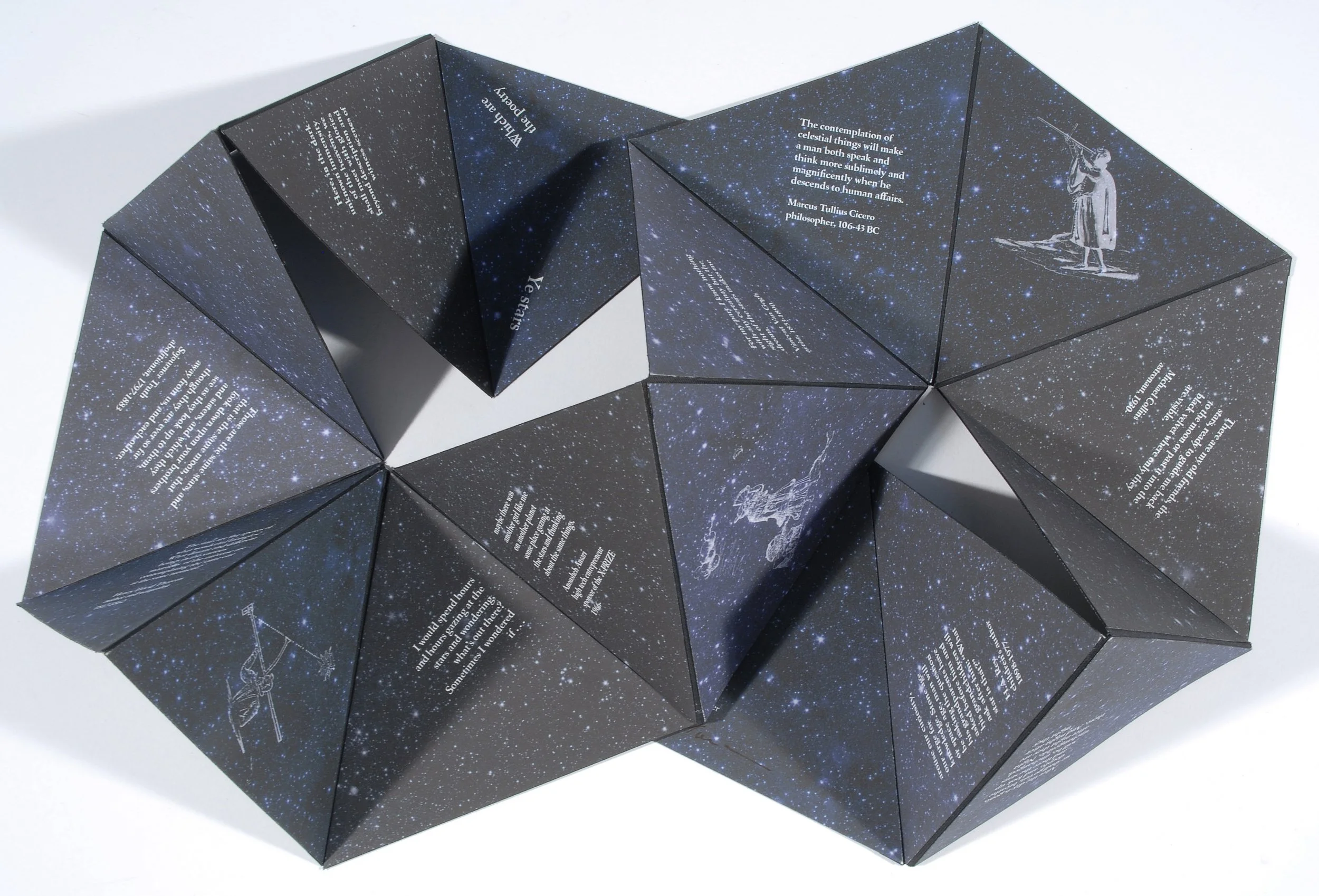
At once vast and minimal, sparse and rich, the night sky has always been a canvas upon which people project their myths and dreams. Star Poems presents quotes that document response to the night sky across the ages by philosophers, artists, and poets from Plato and Byron to contemporary writers, scientists and astronauts. This text is paired with 17th century mythological images of constellation forms and images of early star gazers on a background of a NASA photograph of the Milky Way. The book can be held in the hand and read page by page like a traditional book, can be removed from its jacket and unfolded flat to reference historical astronomical charts or contemporary NASA composite photos, or can be folded into an infinite variety of sculptural shapes.
For our entire existence as a species, we have looked to the heavens. In the night sky we see possibilities, a map to our future, a document of our past. The panorama of deep space comprises a powerful metaphor, and in two books ... the metaphor is used to ample effect both conceptually and structurally. Celestial Navigation and Star Poems share the same structure and compositional background: a series of hinged triangle with start fields printed on deep blue. Each may be read as a traditional accordion fold, formed into myriad sculptural configurations, or unfolded flat as a kind of map referencing historical and contemporary astronomical charts.
Star Poems consists of astronomical quotes by historical and contemporary philosophers, scientists, artists, and poets paired with 17th century images of astronomers and constellations. The cover quote by Lord Byron, 'Ye stars / which are the poetry / of heaven,' is divided in three, with each part placed at the corners of the triangle, inviting the viewer to begin at any of the three corners. The effect is that one may travel in any direction through the vastness of heaven and encounter the profoundness of eternity, as if meaning were embedded in the environs of space itself, to be reflected and mediated through human synthesis.
— Max Yela, Head, Special Collections, University of Wisconsin Milwaukee

Most Excellent Canopy
Pigment inkjet prints
6 x 5” closed
10 x 10" open
Edition of 100
Two quotes about the beauty of the stars open to reveal an image of an early star gazer against the night sky. Six constellations are represented by punched holes as they appear in the winter sky over North America. Created 2008.
Faster Higher Further First: a sampler of women aviators
Accordion with simple pop-ups: pigment inkjet prints.
8 x 2.5 x .5" closed
Removed from dust jacket and fully extended: 8 x 56 x 5"
can also be displayed extended into a closed circular shape.
Edition of 50
Please note this piece is made to order and may not be available for immediate delivery. Normal turn-around time is three months.
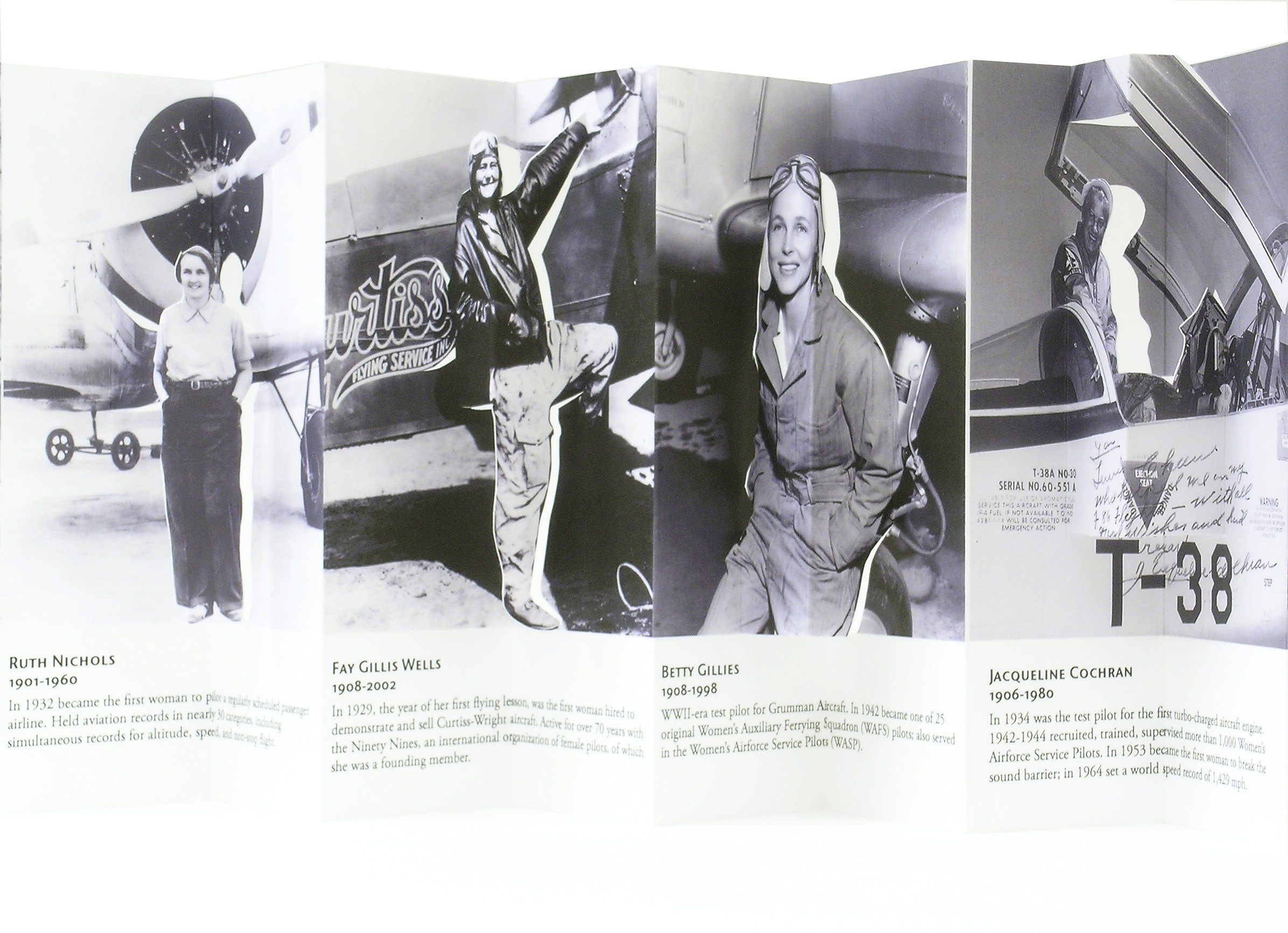
An accordion format pop-up book with vintage photographs of 14 women aviators from the beginnings of powered flight until the present. Brief text lists the accomplishments of each woman. Subjects set records of altitude, speed, endurance or made other significant contributions to the field, not as women's firsts, but across gender lines. Created 2005.

BEAUT.E(CODE) Computer Professionals Reflect on the Art in Software
Text keypunched onto computer cards, “bound” with custom printed rubber band. Created 2002.
3.25 x 7.25 x .5"
Open edition
This book documents interviews conducted with computer software developers to explore the aesthetic values in, and their fond feelings for, computer programming.
Text includes:
Well-written code is like well-written prose. There’s a flow, a clarity.
It gives a feeling of completeness
It responds to errors, clears up misunderstandings gently, carefully, sweetly
A great code is probably as rare as diamonds
Beautiful software reflects a profound understanding of the world in some way
Like a good poem, there are new levels of insight to be gained at each reading
Like a good lecture, it leaves me with a desire to use what I’ve just learned
I feel a satisfaction. I can resonate with it.
Software in which the soul of the developer can be seen
A piece of software is among the most complex creations of mankind
Akin to good writing music poetry, even the arrangement of the stars in the sky
Beautiful software is elegant, inspiring, lean, clear, revealing
Timeless. Sweet. Clever.
Elegant. Subtle. Surprising.
Rhythmic, spare, modest, clean
Elegant. Neat. Sophisticated. It makes my head swim.
Simplicity
Uniqueness, balance, clarity
Integrity, quality
The code: elegant, clear. The user experience: smooth, appropriate, engaging.
Beautiful software is lean, elegant, and efficient
It is a living thing
I’m driven to understand things deeply. Programming gives me a vehicle for that.
To me it feels more like a calling as opposed to a job to make a lot of money
Such a simple box, you can instill so much power just by pressing different keys
There is nothing like the satisfaction of getting a program to work
I wanted to build things. Building with software is like having a mega Lego box.
Solving problems, fitting pieces together, doing powerful things by just typing
I will not let this computer beat me. I will not let this computer win.
Have your own way of doing things. Develop a style. Put some soul into it.
I like to solve puzzles and see if I can make the machine do what I want
I’m a creative person. I can’t sing, compose, draw. I want to create something.
Programming is still the most fun I can have sitting in a chair with arms
Created for the 2002 exhibition BEAUT.E(CODE). Statement below:
I am a visual artist. My husband is a software engineer.
For years I have listened to his conversations with colleagues about hardware and software, what is good or pleasing and what is not and why, what they find new and exciting or classic and exciting. I am able to sense, but am unable to experience the excitement they feel. I wanted to find a point of entry into this world, and find a way to convey their excitement to other non-technical people.
I gathered information by conducting group interviews with and sending questionnaires to computer professionals to explore aesthetic values in the art of computer programming and how they are similar to (or different from) aesthetic values in art. Or more plainly, “what excites these guys?”
Three elements are combined to create the pieces in this show: quotes from the interviews which I thought best or most colorfully expressed these aesthetic values, representations of artifacts I remember fondly from my college days working in the machine room of the university’s computer center circa 1980, and my simplistic understanding of the basic inner workings of a computer.

Big Blue
Laser print on polyester film, computer punch card. Created 2006.
3.25x7.5"
Edition of 100 National Archives image of 1970s era computer room overlaid on punch card.

I Remember My First
Inkjet prints on green bar computer paper, stab binding through pin feed holes, pages scored near spine before sewing to improve opening. Created 2003.
8.75 x 7.5 x .5"
Edition of 100
Quotes from interviews with software engineers exploring how they became interested in working with computers and what they still find compelling about software, hardware and the act of programming.
Created for the 2002 exhibition BEAUT.E(CODE).
I am a visual artist. My husband is a software engineer.
For years I have listened to his conversations with colleagues about hardware and software, what is good or pleasing and what is not and why, what they find new and exciting or classic and exciting. I am able to sense, but am unable to experience the excitement they feel.I wanted to find a point of entry into this world, and find a way to convey their excitement to other non-technical people. I gathered information by conducting group interviews with and sending questionnaires to computer professionals to explore aesthetic values in the art of computer programming and how they are similar to (or different from) aesthetic values in art. Or more plainly, “what excites these guys?”
Three elements are combined to create the pieces in this show: quotes from the interviews which I thought best or most colorfully expressed these aesthetic values, representations of artifacts I remember fondly from my college days working in the machine room of the university’s computer center circa 1980, and my simplistic understanding of the basic inner workings of a computer.

It is a living thing
Pigment inkjet prints
33 objects, 34 x 15" each, each unique: this is not an editioned work.
Quotes from interviews with software engineers exploring what they find beautiful or compelling about well-written software and the act of programming. Quotes accurately printed and “punched” on large replicas of computer punch cards.
Created for the 2002 exhibition BEAUT.E(CODE). Statement below:
I am a visual artist. My husband is a software engineer. For years I have listened to his conversations with colleagues about hardware and software, what is good or pleasing and what is not and why, what they find new and exciting or classic and exciting. I am able to sense, but am unable to experience the excitement they feel. I wanted to find a point of entry into this world, and find a way to convey their excitement to other non-technical people.
I gathered information by conducting group interviews with and sending questionnaires to computer professionals to explore aesthetic values in the art of computer programming and how they are similar to (or different from) aesthetic values in art. Or more plainly, “what excites these guys?”
Three elements are combined to create the pieces in this show: quotes from the interviews which I thought best or most colorfully expressed these aesthetic values, representations of artifacts I remember fondly from my college days working in the machine room of the university’s computer center circa 1980, and my simplistic understanding of the basic inner workings of a computer.

Random Passions
Laser prints on translucent paper, pamphlet in case binding covered with velvet finish book cloth, hot stamped title. Created 2008.
7x4x.25”
Edition of 100
Couples from romance novel covers traced on translucent paper layer together and multiple new combinations emerge.
That shameful temptress Karen Hanmer has really done it this time! Under that tantalising red cover is a heady series of swooning ladies and masterful men. In a whirlwind of passion, dozens of romance novels have been condensed into one steamy artist’s book of multiple outlines emerging through transparent papers. Will you be able to resist Random Passions? I couldn’t, it was so good I had to buy two. —Sarah Bodman, UWE, Bristo
Karen Hanmer exploits both materials (transparent paper) and format (the codex) to create her orgy of embracing figures, all traced from the covers of romance novels. It thrills me to think of the hot action these couples get being so closely bound between the book’s red covers! —Barb Tetenbaum, Triangular Press
A Bookbinder’s Coloring Book
Drum leaf binding. Inkjet prints on Arches cover, Cave paper spine, paste paper by the artist. Illustrations by Henry Maron. Created 2018.
14 pages, 7 x 5 x .5"
Edition of 20
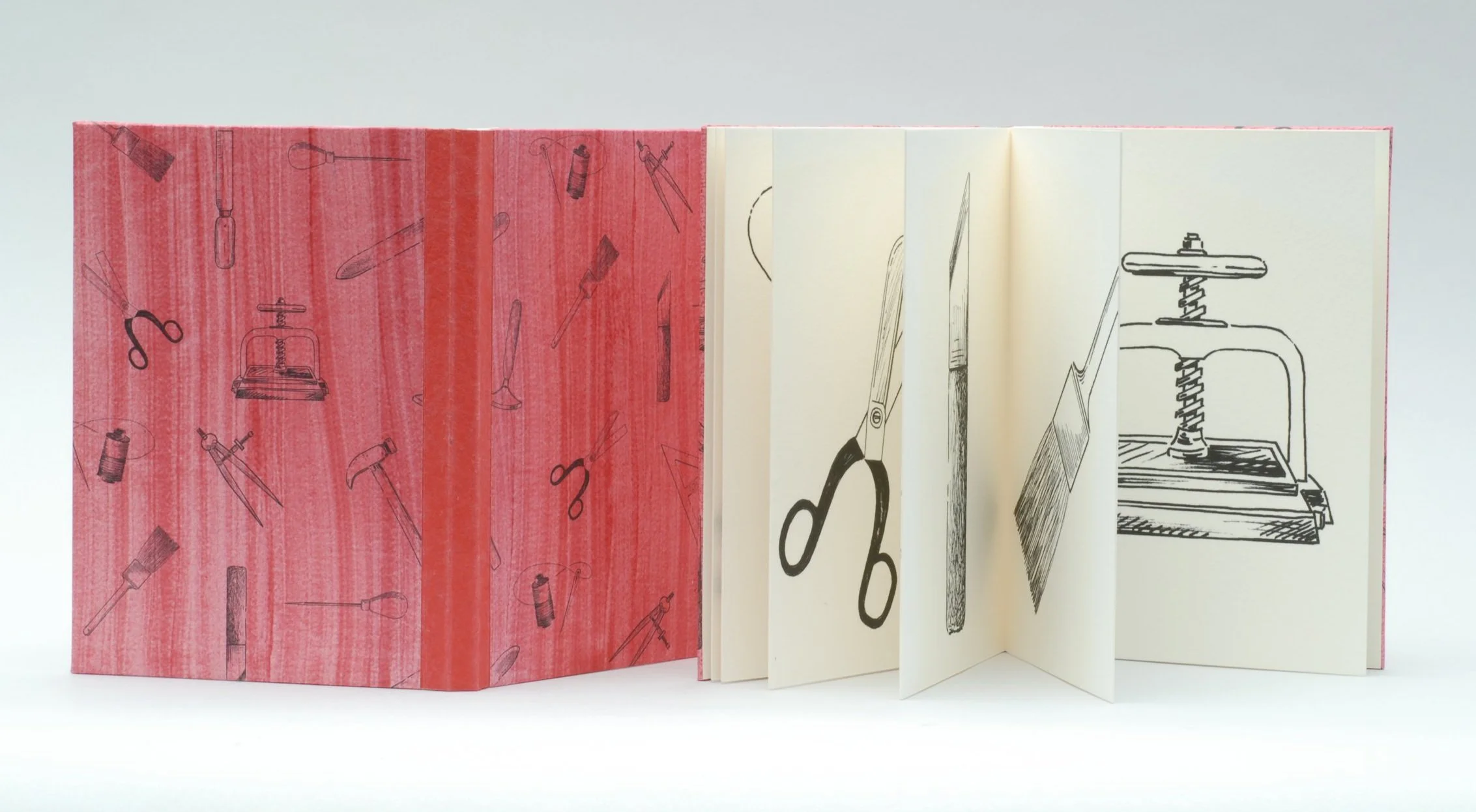
A Bookbinder’s Coloring Book features line art illustrations of familiar and beloved bookbinding tools.
Please note this piece is made to order and may not be available for immediate delivery.

Franklin Fatigue: Reflections on life, liberty, fortune and romance by America’s founding father and Philadelphia’s favorite son
Pigment inkjet prints, false accordion binding in quarter cloth case. Cover illustration by Henry Maron. Created 2009.
6 ½ x 5 x ½”
edition of 100
Originally created for a friend eager to leave Philadelphia, this tongue-in-cheek tribute combines portraits and proverbs by the ubiquitous author, publisher, statesman, ladies’ man and inventor.
A book should be both a joy to read and a joy to hold. Karen Hanmer's latest book, Franklin Fatigue, fits both bills. Hanmer's wit and wisdom are once again present, channeled through the writings of Ben Franklin. Through the clever use of Mr. Franklin's quotes and quips, Hanmer reflects not only on our most loquacious of Founding Fathers, but on the current situation... in all it's glory and messiness. But the messiness is only in the current situation, because Hanmer’s careful craftsmanship is evident throughout Franklin Fatigue. The book feels right in the hand. The pages turn easily. And as with any page turner, you'll want to keep turning them to read all those wonderful things about good old Ben. And there are enough quotes and facts to surprise anyone but the most devoted of Franklin scholars.
— Eric Alstrom, book arts instructor and Collections Conservator, Michigan State University Libraries

Tesla and Me
Laser print on French Speckletone. Created 2011
6 x 4”
open edition, single folio
An account of the artist’s connection with scientist and inventor Nikola Tesla. This text first appeared on Jeff Peachey’s blog on April 1, 2011, as part of A short treatise on the history and use of the electric backing hammers.

All Shook Up
Flag book: Pigment inkjet prints. Black velvet finish paper cover.
8 x 4.75 x .5” closed
8 x 19 x 3" fully open
Edition of 20
Imagery of Elvis, his birthplace in Tupelo, Mississippi, and a list of his best known songs deconstruct and reconstitute as this flag book takes various forms. In 2004, All Shook Up won the Best of Show award at the annual Elvis Week Art Contest at Graceland in Memphis, TN. Created 1999.

Deal me in, Mona
Flag book: Pigment inkjet prints.
8 x 4.75 x .5” closed
8 x 19 x 3" fully open
Edition of 20
Contrasts two staples of Western Art History, Mona Lisa and Waterloo, a Poker Dogs painting by Cassius Coolidge. Created 1999.

They All Laughed
Flag book: Pigment inkjet prints. Created 2002
7 x 5 x 26" | 7 x 5 x .75" closed
Edition of 20
Photographs and archival documents pertaining to the Wright Brothers’ first manned, powered flight, contrasted with the Gershwin song, They All Laughed, that lists a number of screwball ideas for inventions that became the foundation of modern society.
Secrets of Flight
Flag book: Pigment inkjet prints
7 x 26 x 5" open
7 x 5 x 3.75" closed
Edition of 30
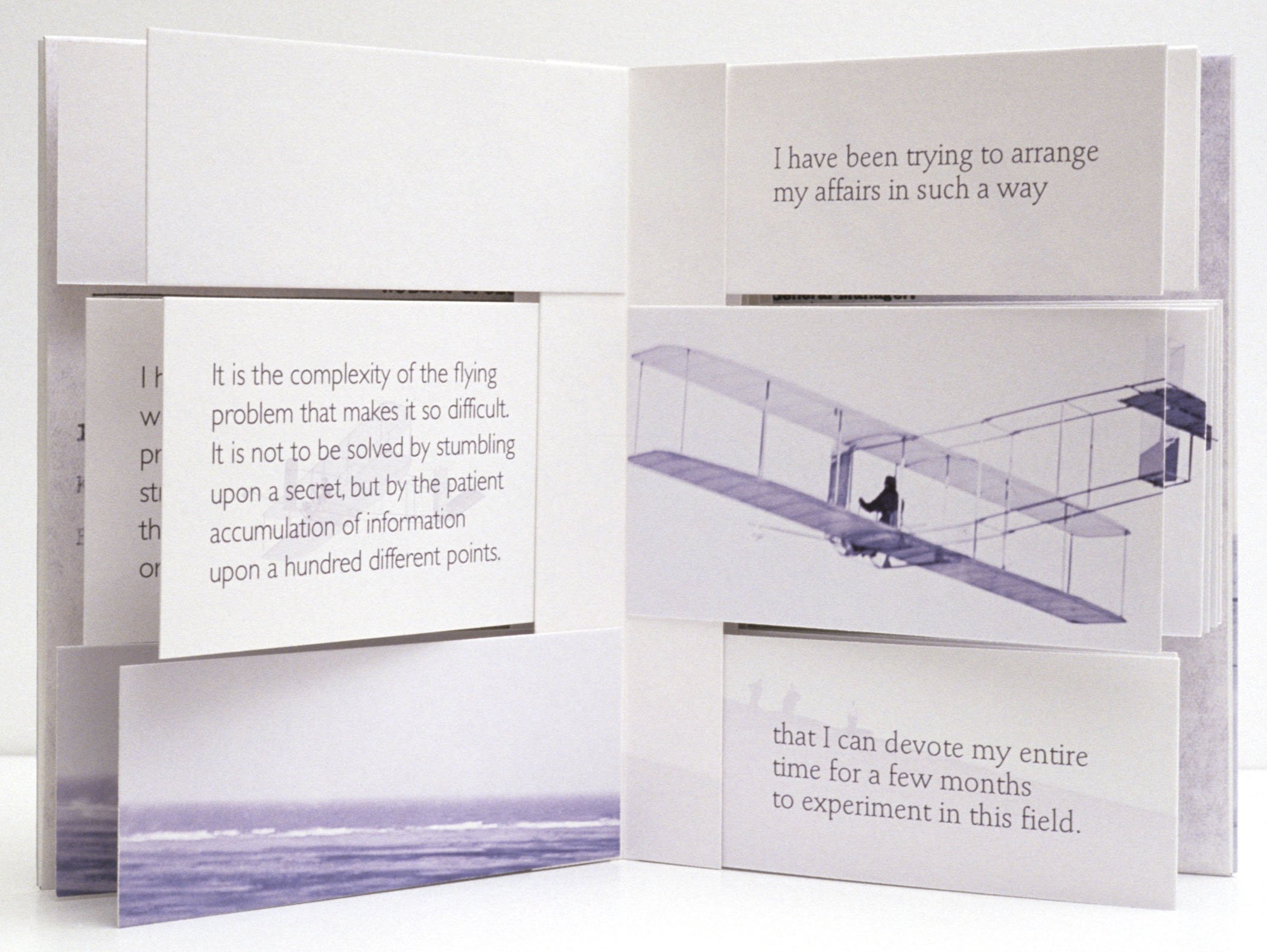
Photographs and archival documents pertaining to the Wright Brothers’ experimentation to develop the first manned, powered flight. Text in large, easily readable fonts for beginning readers. Created for Turning Pages: A Collection of Artists’ Books shown in The Living Room, the family installation space at the Wichita Art Museum. Created 2004.

Elephants Battle Aggressive Vegetation in Ancient Egypt: Mix & match decorative motifs from the designed bindings collections at The Athenaeum of Philadelphia
A boxed set of 7 plaquettes: binders’ board covered with inkjet printed cotton backed with Japanese tissue. Housed in clamshell box: bookcloth over binders’ board, inkjet-printed label. Accordion-fold colophon includes artist’s statement, small images of the five books from The Athenaeum’s collection and image credits. Created 2011.
each plaquette 7.5 x 4.75”
Edition of 20
Elephants Battle Aggressive Vegetation in Ancient Egypt: Mix & match decorative motifs from the designed bindings collections at The Athenaeum of Philadelphia creates new cover designs by combining elements from each of the five late nineteenth and early twentieth century publishers’ bindings The Athenaeum made available online to artists in the fall of 2011.
Part decorative arts and part cabinet of curiosities, the five bindings represent a cross section of styles, including Art Nouveau, Arts and Crafts, and Egyptian Revival. The new cover designs, like those they take as their starting point, reflect late nineteenth century interest in exotic locales, architecture, flora and fauna.
Please note these sets are made to order and may not be available for immediate delivery.

Discovery and exploration of the Mississippi Valley, with the original narratives of Marquette, Allouez, Membré, Hennepin, and Anastase Douay by John Gilmary Shea. Albany: Joseph McDonough 1903.
Antiquarian book on exploration of the Mississippi River disbound and signatures tacketed with goat vellum into accordion-folded historical map, Carte de la découverte faite l'an 1673 dans l'Amérique septentrionale by Jacques Marquette. Map courtesy of Library of Congress, Geography and Map Division. Letter and additional map by Marquette and portrait of LaSalle reproduced from the text and tacketed in at front. Original map also enclosed in pocket at rear of binding. All illustrations printed on Akbar Natural handmade paper from Griffen Mill. Bound 2016.
Closed: 8.75 x 7.5 x 4.25”
Open: 8.75 x 7.5 x 25”
Discovery and exploration of the Mississippi Valley, with the original narratives of Marquette, Allouez, Membré, Hennepin, and Anastase Douay is online at the Internet Archive.

Big River
Pigment inkjet prints, binders' board, plexiglass, ball bearings
10.75 x 8.75 x 1.25"
Edition of 20
Like the child’s pocket game, the viewer maneuvers the box to get each of the balls into a divot corresponding to a city mentioned in the Johnny Cash song, Big River, where the lovesick narrator chases his beloved down the Mississippi River, missing her at every port. Created 2004.

Celestial Navigation
Pigment inkjet prints
6.75x5.75x.5" closed, 17.5x 30" open
Edition of 30, out of print.
Created 2008
At once vast and minimal, sparse and rich, the night sky has always been a canvas upon which people project their myths and dreams. In Celestial Navigation a photograph of the Milky Way provides the background for an illustrated catalog of instruments used across the ages to navigate by the stars, and a 19th-century astronomical chart.
This historical content is complemented by a brief poem in which the artist looks to the night sky to recapture the memory of a long lost beloved. Celestial Navigation is constructed of ink-jet printed, hinged triangles that can be held in the hand and read page by page like a traditional book. Unfolded flat, it references historical star charts or contemporary NASA composite photographs. The book can also be folded into myriad sculptural shapes. For our entire existence as a species, we have looked to the heavens. In the night sky we see possibilities, a map to our future, a document of our past.
The panorama of deep space comprises a powerful metaphor, and in two books ... the metaphor is used to ample effect both conceptually and structurally. Celestial Navigation and Star Poems share the same structure and compositional background: a series of hinged triangle with start fields printed on deep blue. Each may be read as a traditional accordion fold, formed into myriad sculptural configurations, or unfolded flat as a kind of map referencing historical and contemporary astronomical charts.
In Celestial Navigation, the narrative evokes a deep sense of loss and longing; reaching to the stars as a way of recapturing the memory of the long-departed: 'Like ancient navigators, I look to the sky to find my way back to you.' . The diamond-shaped page-spread offers text printed against a star field on the left, mirrored by a 19th-century star chart on the right. The one-point rhythm of each page spread progresses steadily, and is resolved by a final spread of uniform space in which one can almost discern the presence of the beloved. The book has three possible spaceways: the textual narrative occupying one path, and the other two taken up with lists of astronomical instruments - particularly instruments of navigation - juxtaposed against 17th-century images of astrolabes, sextants, telescopes, and the like. — Max Yela, Head, Special Collections, University of Wisconsin Milwaukee

Destination Moon
Flag book: pigment inkjet prints
7 x 5 x 26" open
7 x 5 x .75" closed
Edition of 20, out of print
Archival photographs and documents pertaining to the Apollo Manned Space Program contrast John F. Kennedy's "Man on the Moon by the end of the decade" speech with Roy Alfred and Marvin Fisher's whimsical song (popularized by Dinah Washington), Destination Moon, about a romantic journey to the moon. Created 2003.

Pride Prejudice Passion: Head Over Heels
Jacob’s Ladder: inkjet prints and found images. Created 2011.
Closed size 3.5 x 3.5 x 1.5”
Open Size 3.5 x 3.5 x 28”
Edition of 2. Out of Print.
This sculptural work pairs text from the archetypal 1813 romance novel by Jane Austen with images cut from the covers of its modern counterparts. This piece was created from a minimum quantity of recycled and already-purchased materials and with limited use of electricity for Sustainable Book and Paper Arts, a 2011 exhibition curated by Shawn Sheehy and Melissa Jay Craig.
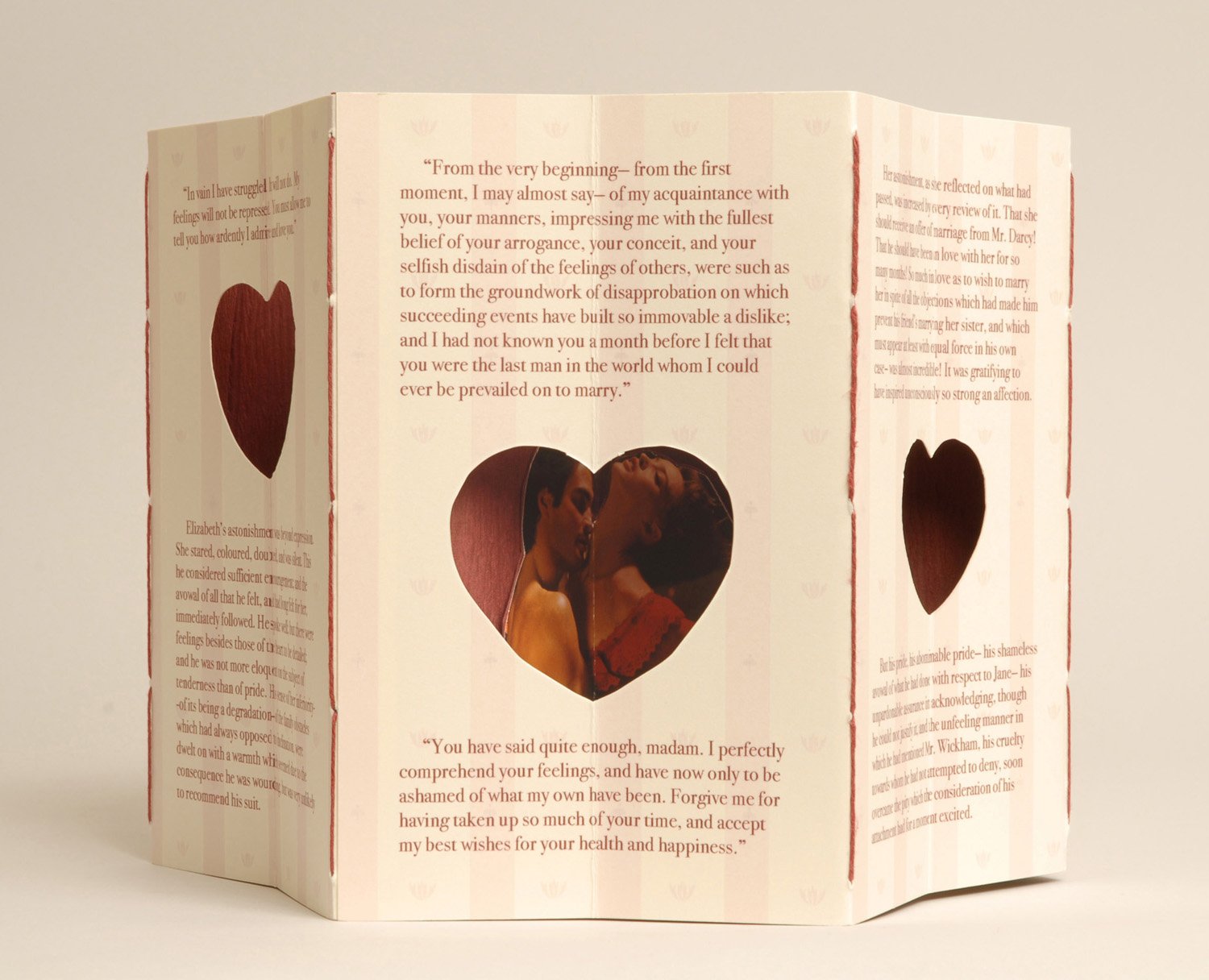
Pride Prejudice Passion: Whirlwind Romance
Carousel Book: inkjet prints and found images. Created 2011.
Closed size 6.75 x 4.25 x 3” Open Size 6.75 x 8.5 x 8.5”
Edition of 3
This sculptural work pairs text from the archetypal 1813 romance novel by Jane Austen with images cut from the covers of its modern counterparts. Background pattern references Regency era roller-printed textiles. This piece was created from a minimum quantity of recycled and already-purchased materials and with limited use of electricity for Sustainable Book and Paper Arts, a 2011 exhibition curated by Shawn Sheehy and Melissa Jay Craig.
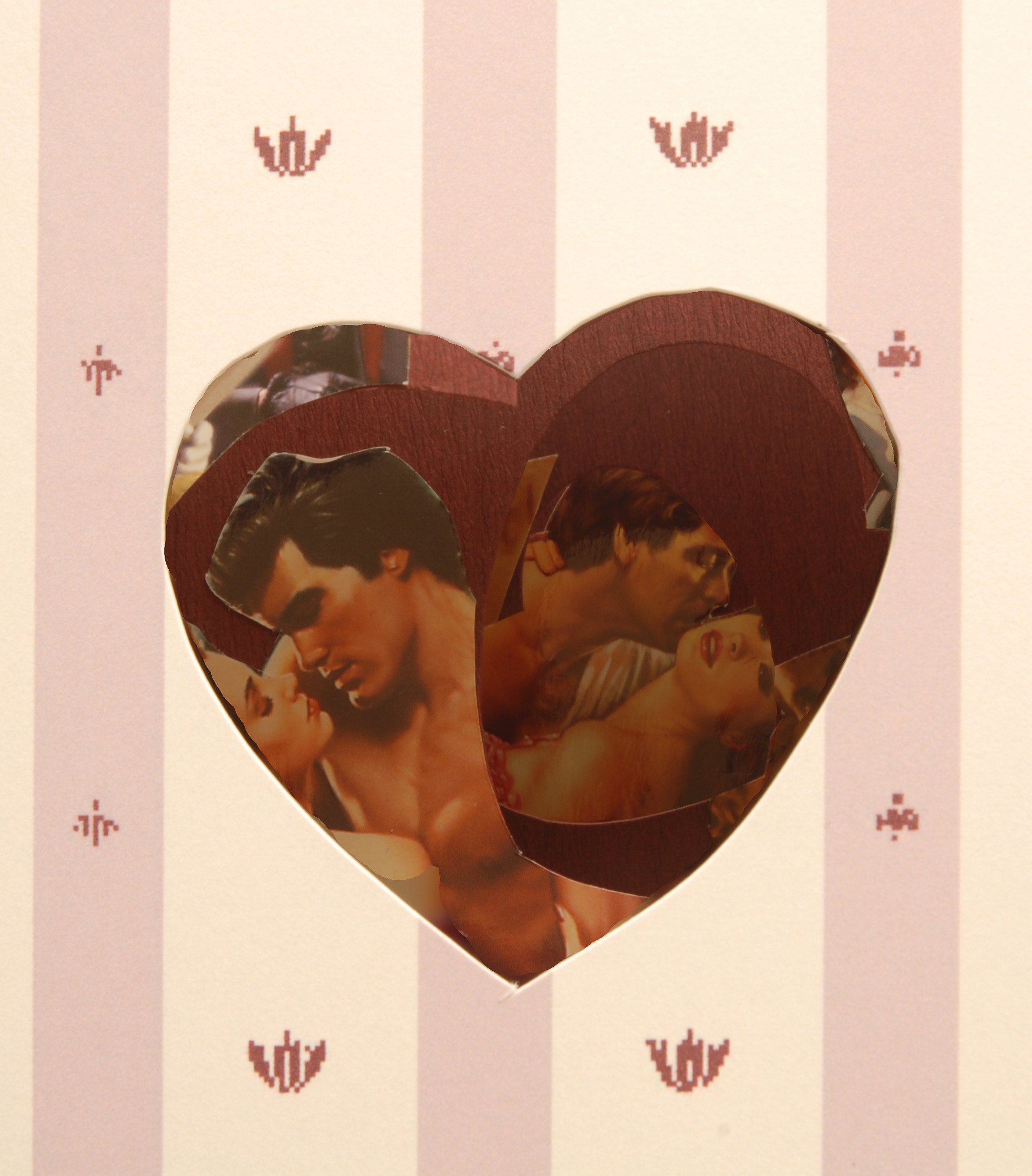
Pride Prejudice Passion: Tunnel of Love
Collection of Johns Hopkins University
Tunnel Book: inkjet prints and found images. Created 2011
Closed size 8 x 8 x 2” Open Size 8 x 8 x 18”
Unique artists’ book
This sculptural work pairs text from the archetypal 1813 romance novel by Jane Austen with images cut from the covers of its modern counterparts. Background pattern references Regency era roller-printed textiles. This piece was created from a minimum quantity of recycled and already-purchased materials and with limited use of electricity for Sustainable Book and Paper Arts, a 2011 exhibition curated by Shawn Sheehy and Melissa Jay Craig.

Prairie
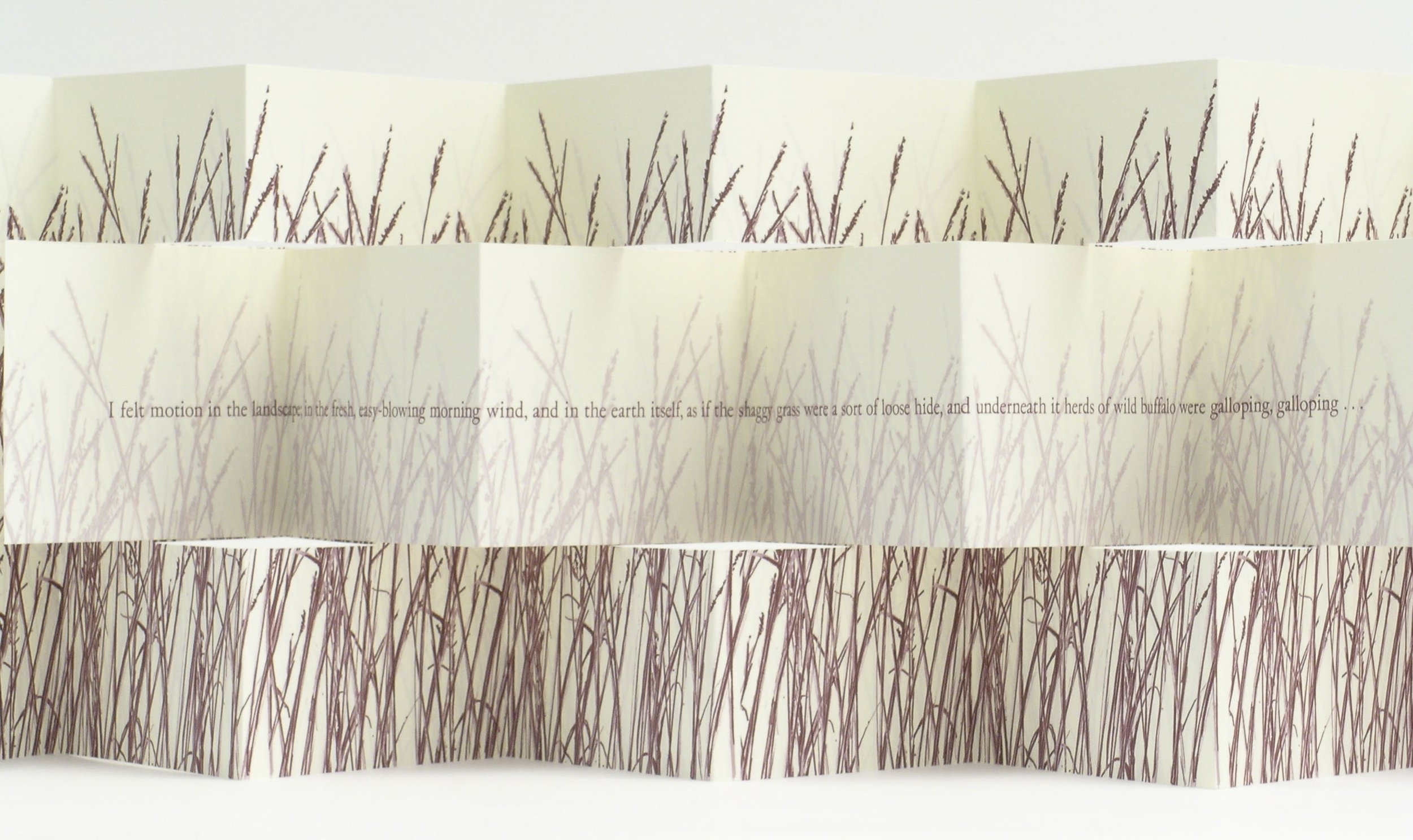
Pigment inkjet prints. Illustration in collaboration with Henry Maron, folded structure learned from Peter Thomas. Created 2006.
6x3x.2" closed, 8x15x2.5" open
edition of 100. out of print
Edition of 100 Inspired by Willa Cather’s My Antonia, and includes quote from the text : “I felt motion in the landscape; in the fresh, easy-blowing morning wind, and in the earth itself, as if the shaggy grass were a sort of loose hide, and underneath it herds of wild buffalo were galloping, galloping . . .”
But such as I can be, I will: A Romantic book of excuses
But such as I can be, I will is produced in an edition of seventy five. The deluxe edition is presented in an early 19th-century-style publishers’ binding with marbled paper by Pamela Smith. The standard edition is presented in a paper wrapper. Both are pigment inkjet printed on Ruscombe Mill pale laid handmade paper. The chapbook edition is a single-signature pamphlet laser printed on French Construction whitewash with wrapper pigment inkjet printed on Zerkall German Ingres. The illustration from William Blake’s Night Thoughts used on the Standard wrapper and as the Deluxe frontispiece is courtesy of the Yale Center for British Art, Paul Mellon Collection. Created 2019.
Deluxe edition of 15, 56 pages, 7 x 4 1/4 x 1/4"
Standard edition of 20, 48 pages, 7 x 4 1/4 x 1/8”
Chapbook edition of 40, 48 pages, 7 1/4 x 4 1/4 x 1/4"
But such as I can be, I will: A Romantic book of excuses is excerpted from an 1801 letter written by William Blake to his long-suffering patron Thomas Butts. I imagine the visionary, late in the day and still in his dressing gown, dashing off a quick note, Great Mansplaining his inability to honor his commitments. The letter came to my attention when it was used as the set book for the 2019 Open·Set bookbinding competition.
Text:
Time flies
I labour incessantly
I accomplish not one half of what I intend
I thank you again and again for your generous forbearance
only now I approach the prospect
my seeming neglect
my want of steady perseverance by which want I am still your debtor, and you so much my creditor
labouring
matchless industry
I shall have an opportunity
my abstract folly hurries me often away
who shall deliver me
I endeavour
which you may expect soon which I have nearly completed
Alas! wretched, happy, ineffectual labourer
I, with my whole might, chain my feet to the world of duty
But in vain!
I can be grateful, and I can soon
still unfinished, but is in a finishing way
perhaps, or rather certainly
but such as I can be, I will
I remain, dear Sir, ever yours sincerely