
New & Available - Design Bindings
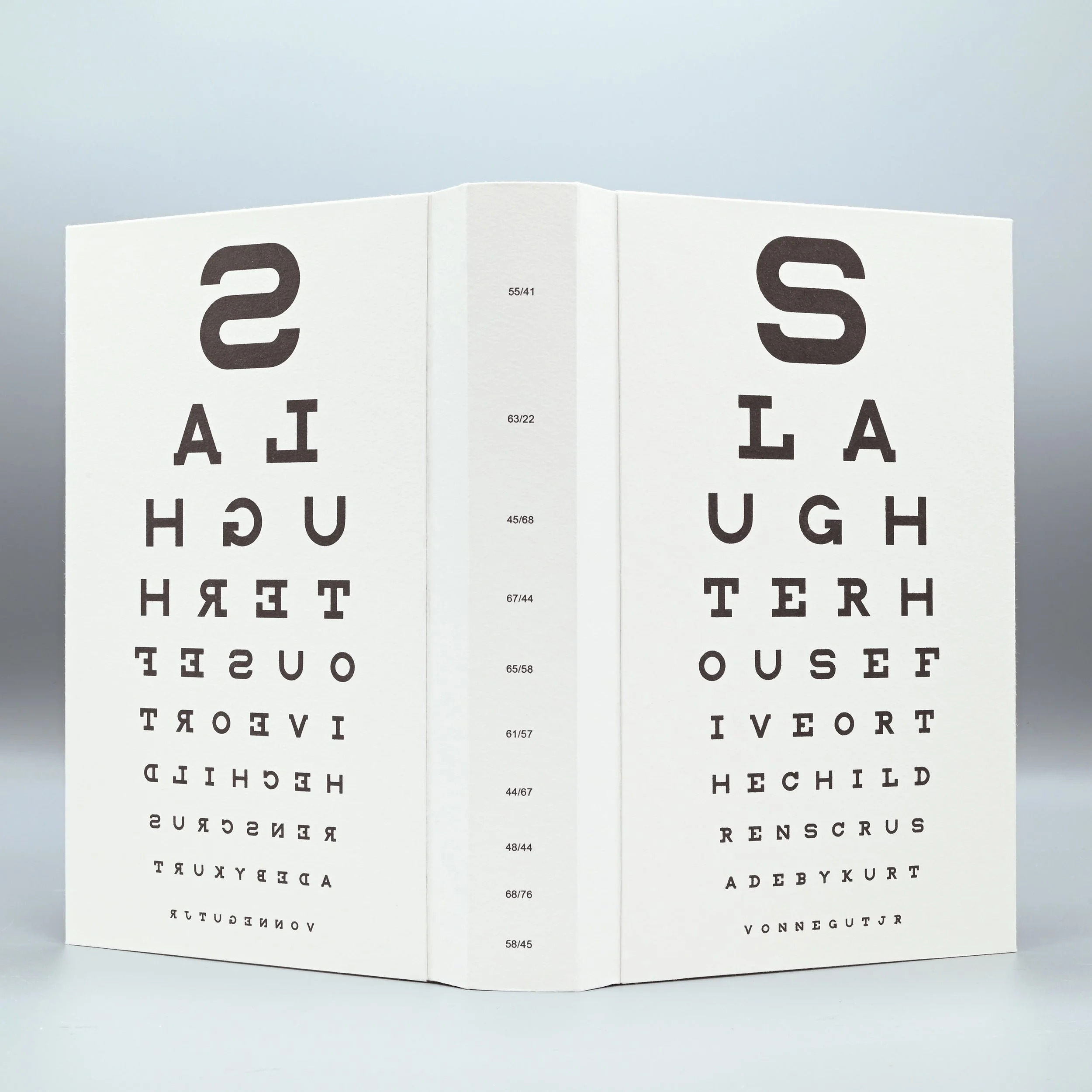
Slaughterhouse-Five by Kurt Vonnegut, illustrations by Julian De Narvaez. Irvine, CA: Suntup Editions, 2022.
Sewn boards binding: Covered in inkjet-printed Ruscombe Mill chateau vellum paper with Fabriano Roma flexi endpapers. Bound 2026.
9 x 6 x 1 ¼”
23 x 15.5 x 3.5 cm
The protagonist’s horrific wartime experiences leave him unmoored in time, space, and reality. The book is titled both normally and inverted as the archetypal tool of his postwar profession: the optometrist’s Snellen eye chart. Numbers on the spine document years between his numerous time jumps.
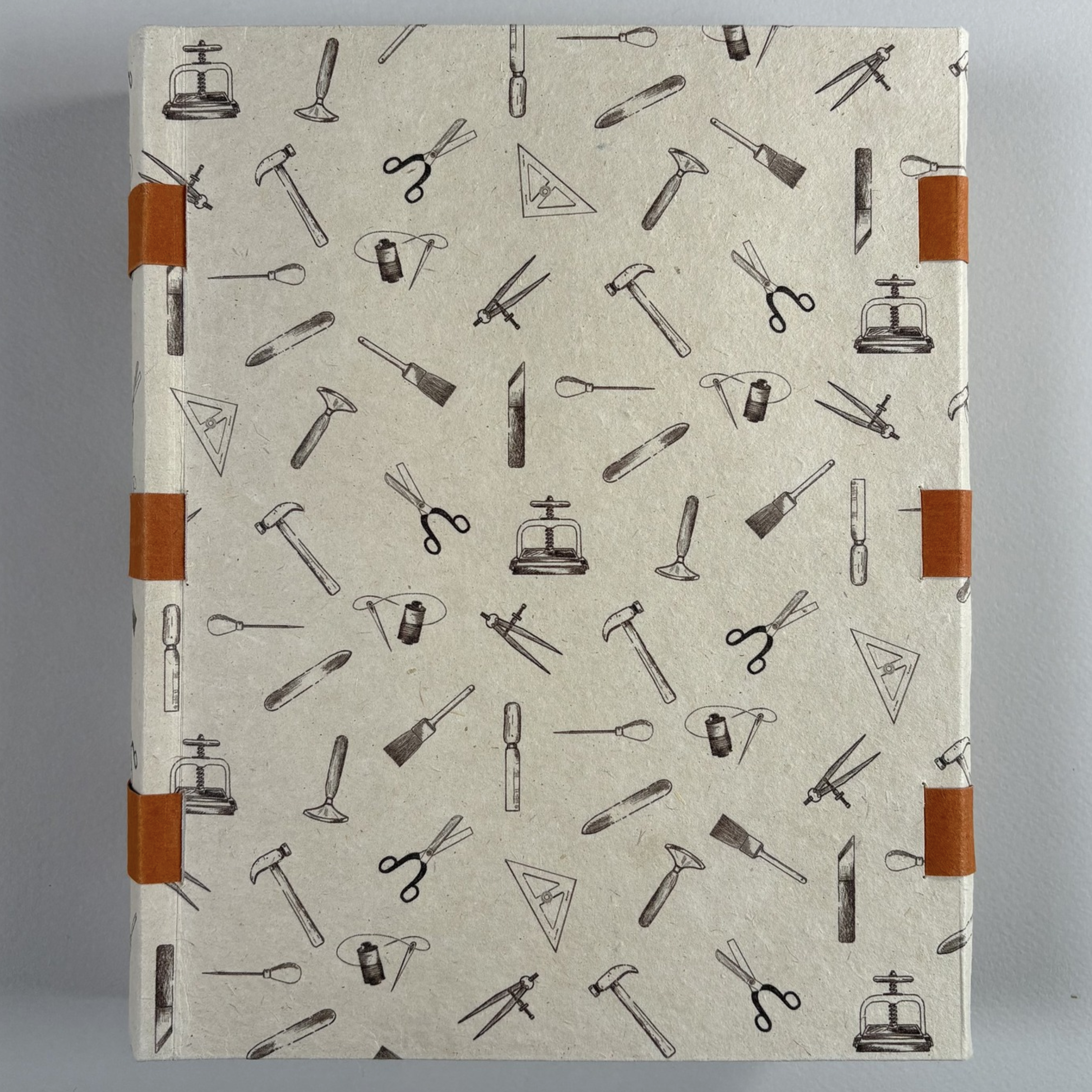
A Bookbinder’s Compendium: Workshop Handouts 2001-2025 by Karen Hanmer.
Glenview, IL: Karen Hanmer Book Arts, 2025.
Illustrations of tools used in traditional bookbinding by Henry Maron, inkjet-printed onto limp case of Hook cotton and linen case paper, lacing straps of Cave paper. Roma handmade paper endsheets. Bound 2026.
8 ¾ x 7 ¼ x 1 ¾ “
This binding contains the only printed version of the first draft of an anthology of thirty-three workshop handouts written by the binder on topics including fine binding, a range of historical and contemporary structures, notes on materials, and professional practices.
This text is available in printed, unsewn sheets.
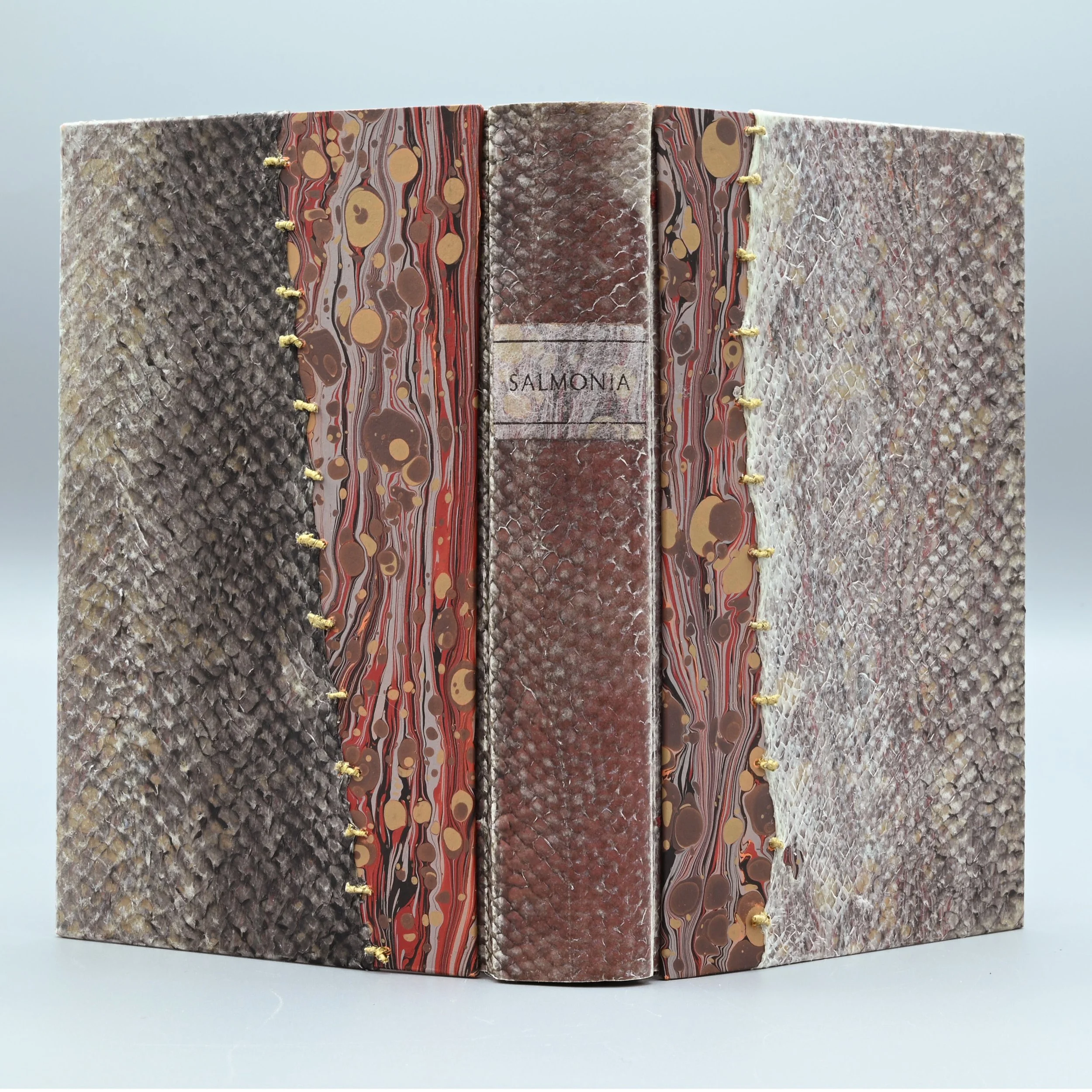
Salmonia: Or Days of Fly Fishing. In A Series Of Conversations. With Some Account Of The Habits Of Fishes Belonging To The Genus Salmo, by Sir Humphrey Davy. London: John Murray, 1828, first edition.
Bradel binding covered in sockeye salmon parchment processed by the binder over marbled paper by Abra Mueller. Attachment of parchment to the boards is reinforced with salmon parchment tackets painted with shell gold. Spine wrapper of parchment over red Roma paper.
Hahnemühle Ingres endpapers with Roma flexi flyleaves and pastedowns. Rolled Japanese tissue endbands. Head and tail of spine wrapper painted with shell gold. Label of Japanese tissue over marbled paper, title stamped in dark brown foil. Bound 2026.
7 x 4 ½ x 1 ¼”
18 x 11.5x 3 cm
This volume by British scientist Humphrey Davey continues the tradition of The Compleat Angler, as an extended reflection on science, nature, and the human condition through the lens of fly fishing. The book contains three engravings and a sprinkling of smaller illustrations of fish in vaguely whimsical environments.
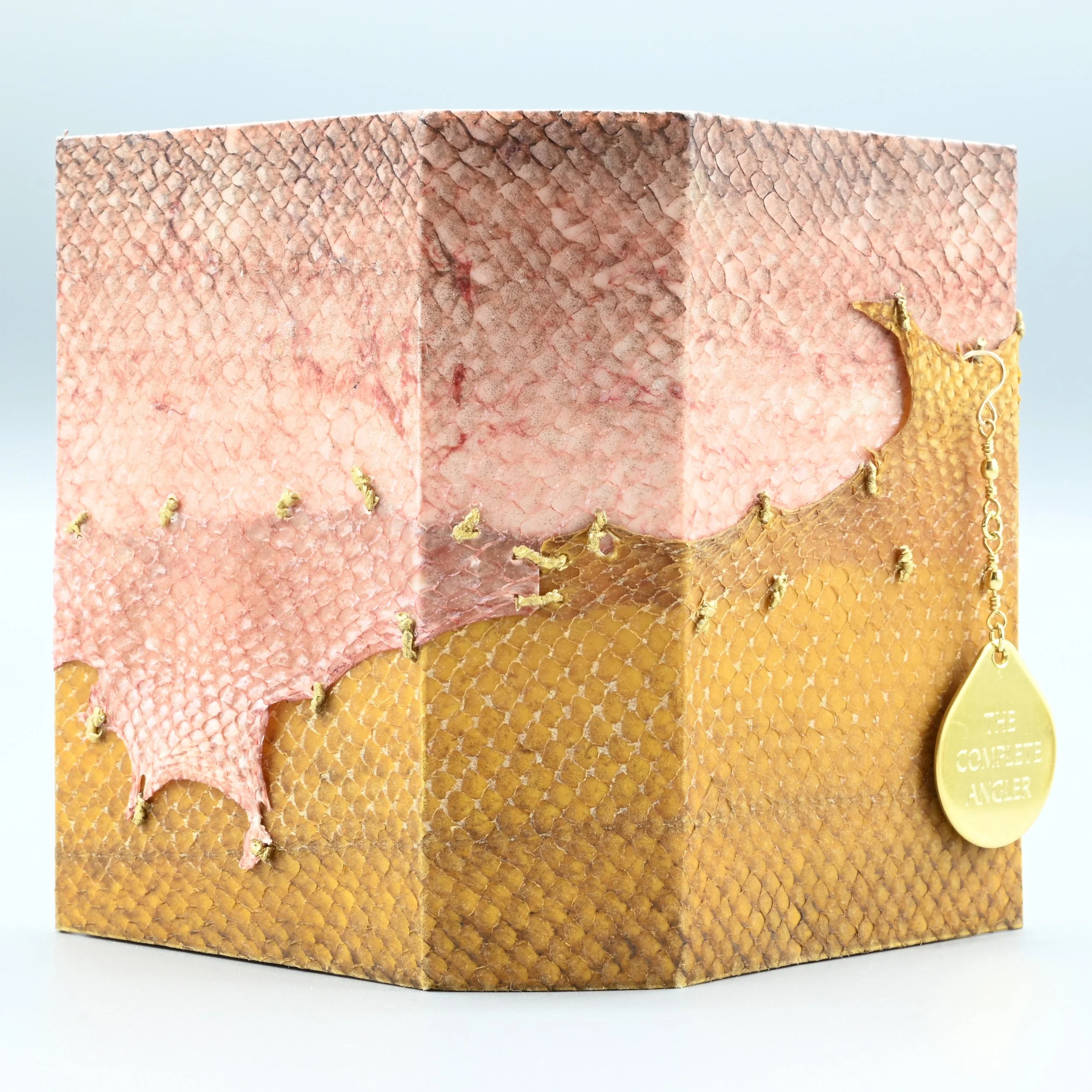
The Complete Angler, or The Contemplative Man's Recreation by Izaak Walton and Charles Cotton, London: William Pickering, 1827.
On exhibit at the New Bedford Whaling Museum October 16, 2026 - February 15, 2027.
Limp binding based on the non-adhesive “clip-on cover” structure. Covered in case of sockeye salmon parchment processed by the binder and dyed in pomegranate, cochineal, and logwood. Text block sewn long stitch into Hook Paper wrapper, Ruscombe Mill endpapers, Hahnemühle Ingres chemise. The two skins joined with fish parchment tackets painted with shell gold. Titled on removable “fishing lure” pieced together by the binder. Bound 2026.
4 1/2 x 3 x 1 1/4”
11.5 x 7.5 x 3 cm
The Complete Angler is a meditation on nature, friendship, and of course fish and fishing. First published in 1653, it remains among the most reprinted English language books. This edition, like others printed in London in the early 19th century departs from the original spelling of the title The Compleat Angler.
Incorporating the title into the design of a binding can be a challenge, especially on the uneven surface the scale pockets leave on fish parchment. This spinner engraved with the title hooks into the seam between the two skins.
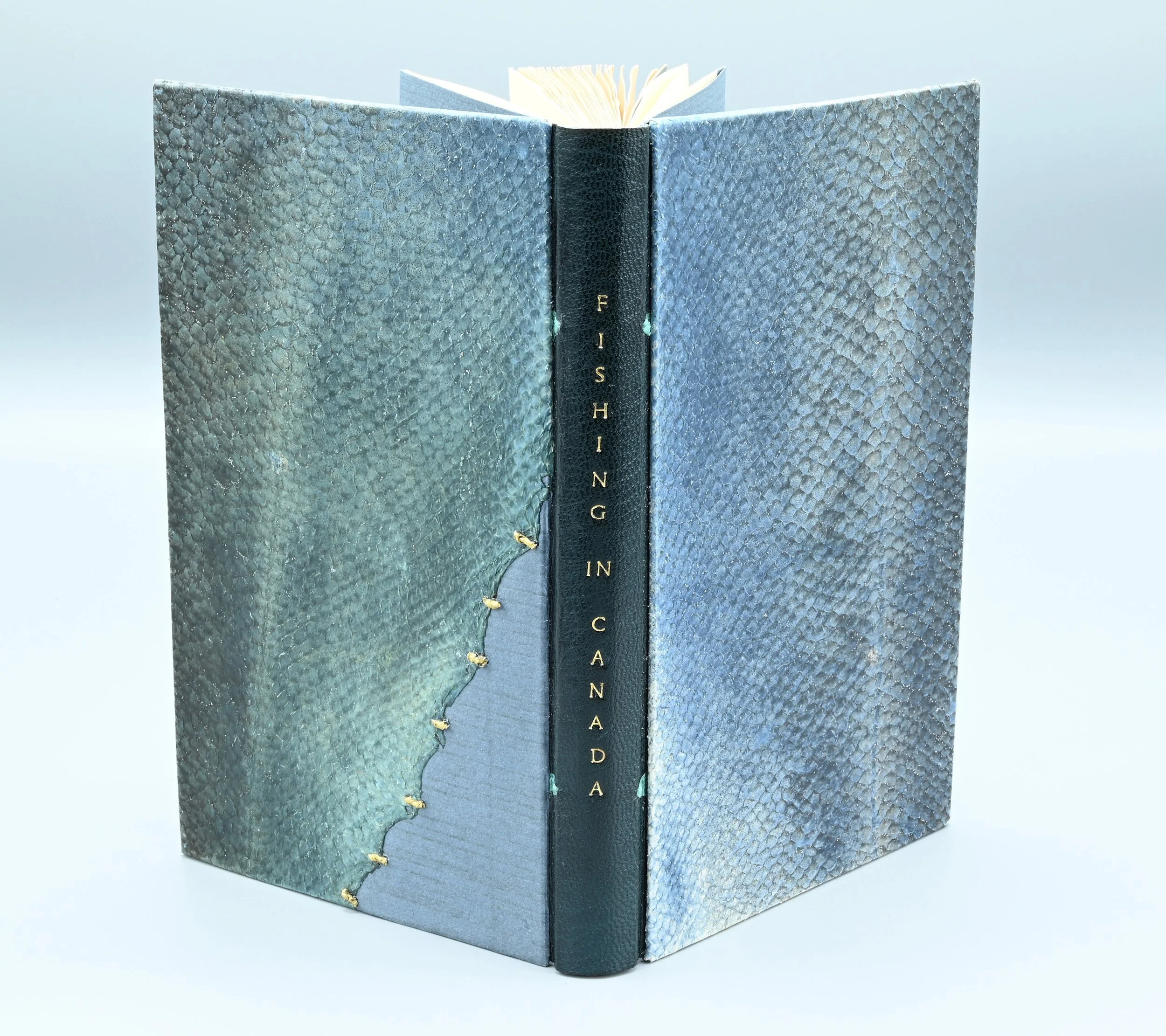
Fishing in Canada. Montreal: Canadian National Railways, ca 1930.
Aspects of exposed structure are part of the aesthetic of this Even More Simplified binding. Boards covered in coho salmon parchment processed by the binder and dyed in indigo, pomegranate and cochineal. Parchment backed with Roma handmade paper, some visible on the rear board. Goatskin spine wrapper laced on with linen sewing cords made by the binder. Attachment of parchment to the boards is reinforced with salmon parchment tackets, these and the endcaps are painted with shell gold. Hahnemühle Ingres endpapers with Roma flexi flyleaves and pastedowns. Rolled leather endbands. Hand titled in 22 kt gold foil. Bound 2025.
8 3/16 x 5 x 7/8”
20.7 x 12.7 x 2.3 cm
The book, missing the original cover, which was scanned and printed from a similar edition, was a garage sale find, a gift from a colleague. A 1923 edition of the missing map was located online, printed on handmade Akbar paper, and sewn in on a guard. Map courtesy of the University of British Columbia Library Digitization Centre and its generous donors. <http://dx.doi.org/10.14288/1.0343188>

One comedy, one tragedy, one history and the series prospectus from the Limited Editions Club The Plays of William Shakespeare (1939-1940) bound together to approximate the size and heft of a First Folio. Included are TheTaming of the Shrew illustrated by W. A. Dwiggins, Antony and Cleopatra illustrated by Enric C. Ricart, and Henry the Eighth illustrated by Eric Gill.
Bradel binding: goatskin spine with false bands, handsewn silk endbands, marbled flexi endsheets, edges sprinkled in white acrylic. Vellum boards laser etched with the two most recognizable pages from the First Folio: the title page bearing the Martin Droeshout portrait of William Shakespeare and Ben Johnson’s dedication. Blind tooling on spine and as a frame around both boards. Digital images of the First Folio courtesy of the Library of Congress. Laser etching by Insiya Dhatt. Bound 2025.
This austere binding mirrors Johnson’s exhortation to “dwell not upon the physical book but on the words within.”
33 x 23 x 4.5 cm
13 x 9.25 x 2”
This binding was created for Durham University’s Binding the Bard competition. A proposal for binding a facsimile of Durham’s first folio, it returns the iconic pages that were removed after its 1998 theft: the title page bearing the Martin Droeshout portrait of William Shakespeare and the facing page with the dedication by Ben Johnson.
This marriage of traditional materials and contemporary technology honors the past while creating a modern binding for this four-hundred-year-old work.
The binding structure echoes this melding of classical and modern: viewed from the spine the binding appears to be sewn like the original on five raised supports laced into boards. When open the book reveals the contemporary lines of a three-part Bradel binding.
Natural markings visible on the vellum suggest the age of the First Folio and in particular the storied history of Durham University’s copy.
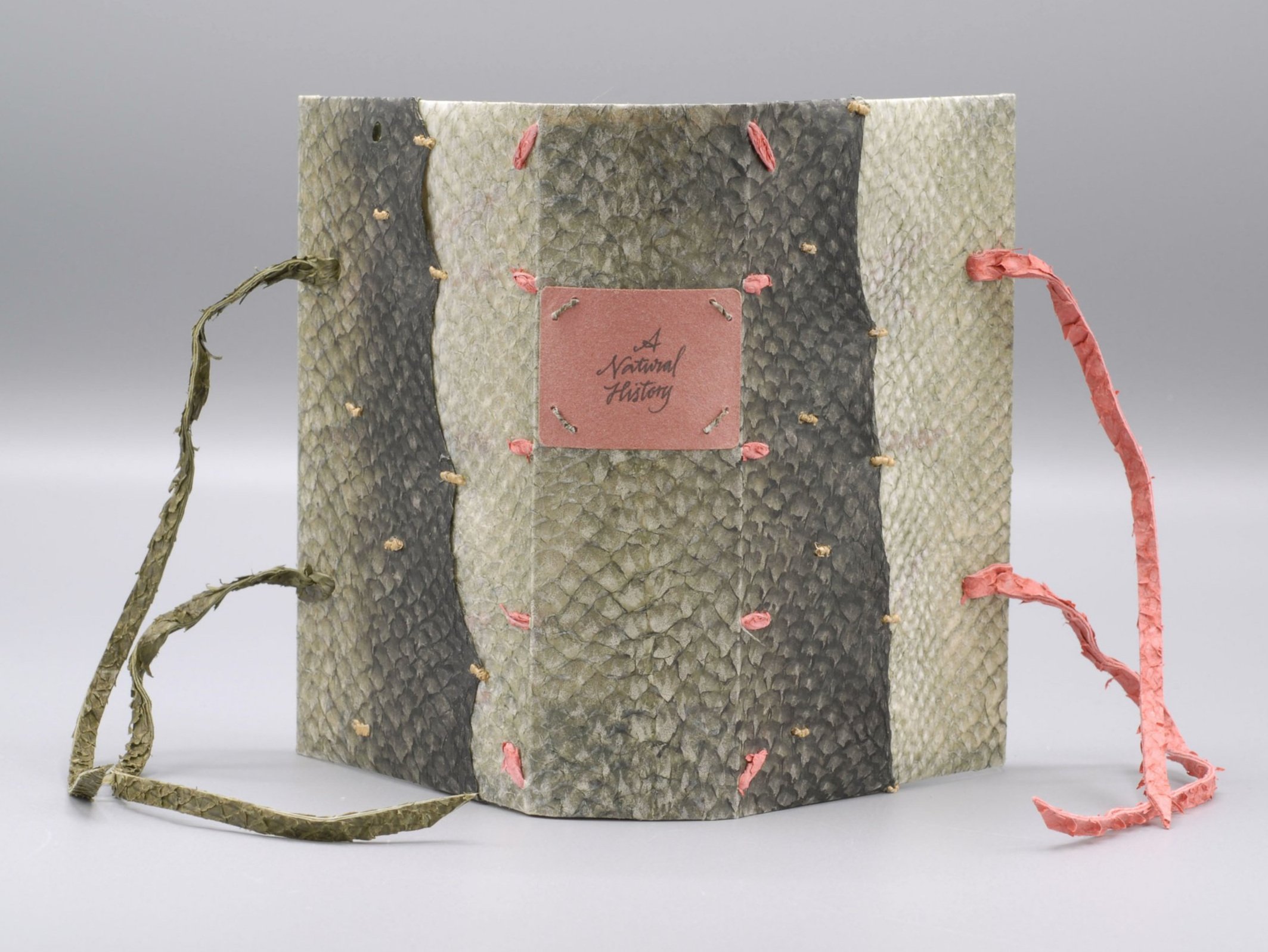
A Natural History of the most remarkable Quadrupeds, Birds, Fishes, Serpents, Reptiles and Insects by Mrs. Mary Trimmer.
Chiswick: Printed by C. Whittingham, 1830. Two volumes bound as one. Includes over 200 engravings.
Traditional limp case of Atlantic salmon parchment processed from raw skins and dyed with chlorophyllin by the binder. Pieced together with parchment tackets painted with shell gold. Ties and sewing supports of salmon leather. Pink linen sewn endbands laced in. Handmade paper endsheets and label. Label inkjet-printed with calligraphy by Beth Lee. Bound 2022.
14 x 9 x 4 cm
5.5 x 3.5 x 1.5”

Peggy Angus: Designer, Teacher, Painter by James Russell.
Woodbridge, Suffolk: Antique Collectors' Club, 2014.
This binding was awarded the 2025 Helen Warren DeGolyer Award for Excellence in Fine Binding.
Peggy Angus (1904-1993) was a Scottish artist best known for her murals, tiles and wall paper designs.
Bradel binding. Boards and spine covered in wallpaper with décor of swatches of wallpaper and fabric samples designed by Peggy Angus. Trade book disbound and sections guarded with Japanese tissue, bookblock sewn on individual stubs, guards and stubs of multiple colors to reflect Angus’s color palette. Titling inkjet-printed on Roma paper, fonts match those used in the design of the trade binding. Rolled paper endbands, endcaps colored with acrylic. Roma flexi endpapers. Original dust jacket and flyleaves bound in. Bound 2025.
9.75 x 8.5 x 1.25”
24.5 x 21.5 x 3.2 cm
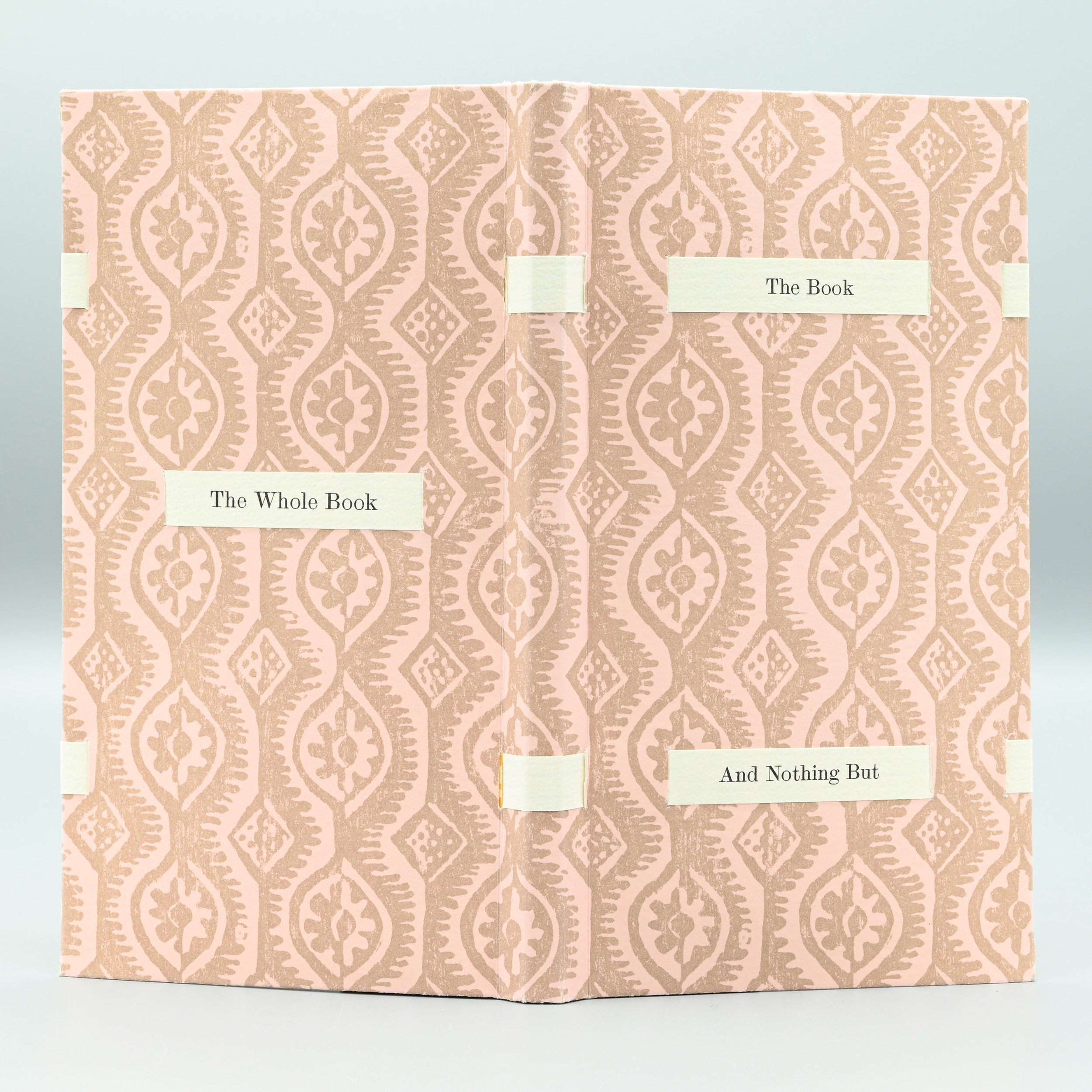
The Book, The Whole Book, and Nothing But by Graham Moss. Oldham, UK: Incline Press, 2024
Paper case featuring two papers by Peggy Angus, chosen to echo the Incline Press’s 2004 book on the artist and to mark the press's move to Scotland. Sewn unsupported, straps of handmade Roma paper lace the book block into the case. Prospectus bound in. Bound 2025.
8 ⅜ x 4 5/8 x ⅜”
21 x 11.5 x 1 cm
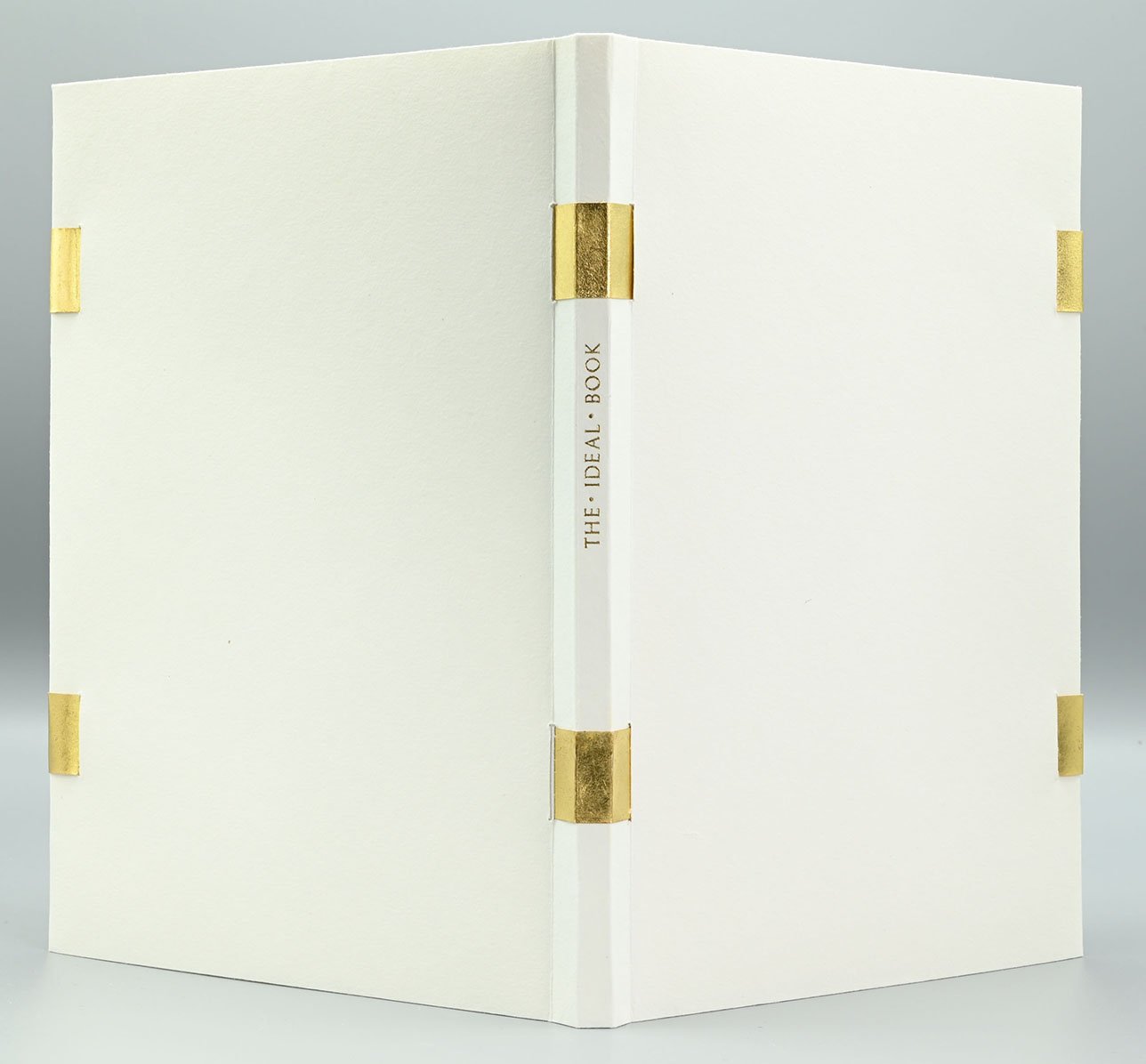
The Ideal Book or Book Beautiful: A Tract on Calligraphy, Printing and Illustration & on the Book Beautiful as a Whole by T.J. Cobden-Sanderson
A facsimile of the 1900 Dove’s Press original. Tucson, AZ: Ampersand Studios, 2022.
Limp case of Ruscombe Mill handmade linen paper. Vellum straps gilt. Binding sewn with green thread in the style of the Doves Bindery. Bound 2024.
9.25 x 6.75 x .25”
23.5 x 17 x .75 cm
I wanted a modern, enthusiastic-opening update to the original limp vellum case. I chose a paper to match rather than contrast the very bright white text. The green thread, use of at least some vellum, and the gratuitous use of gold are all nods to the work of Cobden-Sanderson. The titling mirrors the shop’s distinctive signature THE • DOVES • BINDERY

Lowlands Away, written and illustrated by Adrian Henri
Bath: Old School Press, 2001
Even More Simplified binding structure. Pink goatskin spine wrapper laced on with binder-made linen sewing supports. Boards a multi-color laminate of Colorplan paper, topped with stone veneer. Rolled leather endbands. Bugra flexi endpapers. Title carbon tooled down spine. Bound 2022 as the set book for the Hand Bookbinders of California 50th anniversary exhibition.
27 x 20 x 1.25 cm
10.75 x 7.75 x .5”
From the Old School press website:
Adrian Henri wrote ten poems as texts for an oratorio by Richard Gordon-Smith for soloists, chorus and orchestra, which has recently been recorded on CD by the Royal Liverpool Philharmonic Orchestra. It tells the story of the loss at sea of the Thames and Medway barge Cynthia, commanded by the composer's great-grandfather, a century before in 1896, and of his last words to his wife, cast into the sea in a bottle and subsequently forwarded to her.

Bookbinding with Numerous Engravings and Diagrams
Edited by Paul N. Hasluck, Grove, Wantage, England: The Black Swan Press, 1992, reprint of 1902 first edition.
On exhibit at the New Bedford Whaling Museum October 16, 2026 - February 15, 2027.
Full goatskin binding with laced-in boards. Trade book disbound, guarded and resewn on flattened cords, leather hinge, marbled paper by Pamela Smith. Hand sewn, silk headbands; three edges sprinkled with blue acrylic ink. Blind title and tooling, acrylic pochoir. Illustrations scanned from the text and laser printed onto goatskin onlays. Illustrations scanned from the text and inkjet printed onto Mohawk Superfine cover, then hand cut into pop-ups, are sewn inside each of the text block’s ten signatures. Bound 2014.
8.5 x 5.5 x 2”
The design for this binding is inspired by the text’s charming vintage illustrations, many of which feature disembodied hands performing common binding tasks. Tooling and pochoir further illuminate aspects of structure and process: beating the text block prior to sewing, sawing in sewing stations, lacing on boards, turning in and forming corners, tooling, and the figure-eight motion of the polishing iron.

Nineteen Eighty-Four by George Orwell, illustrated by Jonathan Burton. London: Folio Society, 2014
Bradel binding. Dyed goatskin by Pergamena. Text: inkjet printed on spine, pochoir with acrylic on boards. Three-color hand-sewn silk endbands, head decorated with sponged multicolor watercolor, Bugra flexi endpapers. Bound 2018.
9.5 x 6.5 x 1.5”
24 x 16 x 3.5 cm
Design features repeated Party slogans from Orwell’s 1949 dystopian novel that feel disturbingly prescient. A title that overwhelms the dimensions of the binding and the ominous palette enhance the mood of oppression.
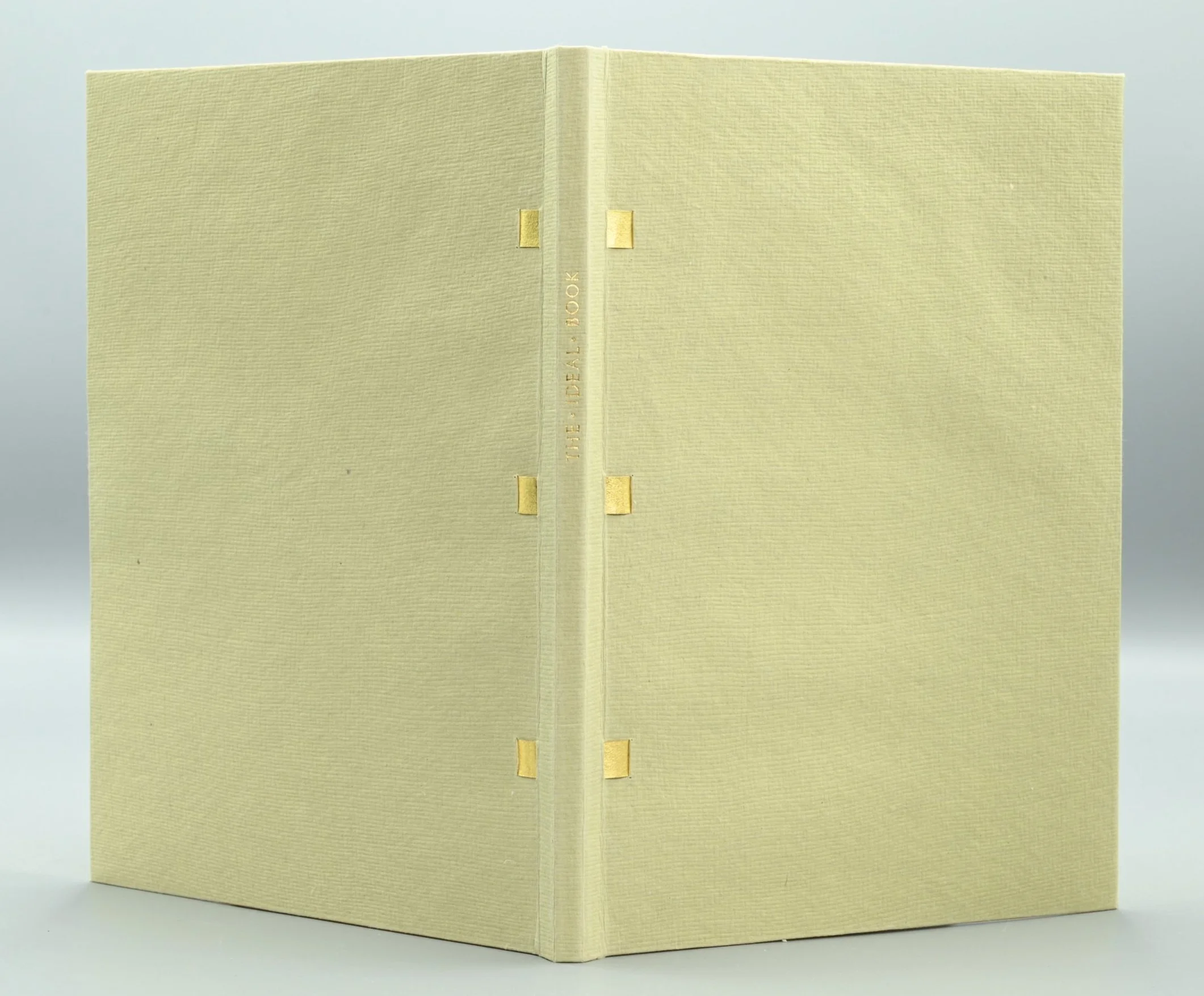
The Ideal Book or Book Beautiful: A Tract on Calligraphy, Printing and Illustration & on the Book Beautiful as a Whole by T.J. Cobden-Sanderson
A facsimile of the 1900 Dove’s Press original. Tucson, AZ: Ampersand Studios, 2022.
Limp case of pale green Khadi handmade cotton paper, Ruscombe Mill Chateau Vellum handmade paper sewing supports and edges of case gilt with 23 kt gold foil. Binding sewn with green thread in the style of the Doves Bindery. Bound 2024.
9.25 x 6.75 x .25”
23.5 x 17 x .75 cm
I wanted a modern, flexible, enthusiastic-opening update to the original limp vellum case. I chose green case paper to reference the Doves Bindery’s use of green sewing thread for their limp bindings. The gratuitous use of gold is a nod to the work of Cobden-Sanderson. The titling mirrors the shop’s distinctive signature THE • DOVES • BINDERY

Native Soil: poems from South Texas poets. Selected by Naomi Shihab Nye, School by the River Press, San Antonio, 2007.
“Gebrochene rücken” variation of the Bradel binding, covered in full goatskin. Goatskin hinges and endbands, 3 watercolor edges, hand-tooled title, design in black, brown, maroon and gold foils. Bound 2011.
10 x 7 x ¼”

Grimoire: New Scottish Folk Tales poems by Robin Robertson, drawings by Tim Robertson. Rochdale, England: Andrew J. Moorhouse, 2022.
Bradel binding. Boards and spine covered in deer parchment. Rolled leather endbands, head decorated in multicolor sponged acrylic, acrylic pochoir across boards, hand-titling in brown foil. Brown Roma flexi endpapers. Bound 2025.
10 5/8 x 7 1/16 x 11/16”
27 x 18 x 1.5 cm
Robertson’s poems are dark, mysterious, primal, and filled with allusions to the natural world. An illustration from the text was stenciled onto boards covered in deer parchment that was purchased already mottled and distressed.
Available Artists’ Books

But such as I can be, I will: A Romantic book of excuses
But such as I can be, I will is produced in an edition of seventy five. The deluxe edition is presented in an early 19th-century-style publishers’ binding with marbled paper by Pamela Smith. The standard edition is presented in a paper wrapper. Both are pigment inkjet printed on Ruscombe Mill pale laid handmade paper. The chapbook edition is a single-signature pamphlet laser printed on French Construction whitewash with wrapper pigment inkjet printed on Zerkall German Ingres. The illustration from William Blake’s Night Thoughts used on the Standard wrapper and as the Deluxe frontispiece is courtesy of the Yale Center for British Art, Paul Mellon Collection. Created 2019.
Deluxe edition of 15, 56 pages, 7 x 4 1/4 x 1/4"
Standard edition of 20, 48 pages, 7 x 4 1/4 x 1/8”
Chapbook edition of 40, 48 pages, 7 1/4 x 4 1/4 x 1/4"
But such as I can be, I will: A Romantic book of excuses is excerpted from an 1801 letter written by William Blake to his long-suffering patron Thomas Butts. I imagine the visionary, late in the day and still in his dressing gown, dashing off a quick note, Great Mansplaining his inability to honor his commitments. The letter came to my attention when it was used as the set book for the 2019 Open·Set bookbinding competition.
Text:
Time flies
I labour incessantly
I accomplish not one half of what I intend
I thank you again and again for your generous forbearance
only now I approach the prospect
my seeming neglect
my want of steady perseverance by which want I am still your debtor, and you so much my creditor
labouring
matchless industry
I shall have an opportunity
my abstract folly hurries me often away
who shall deliver me
I endeavour
which you may expect soon which I have nearly completed
Alas! wretched, happy, ineffectual labourer
I, with my whole might, chain my feet to the world of duty
But in vain!
I can be grateful, and I can soon
still unfinished, but is in a finishing way
perhaps, or rather certainly
but such as I can be, I will
I remain, dear Sir, ever yours sincerely

I labour incessantly: a William Blake to do list
Set of two ruled notepads, twenty pages each, inkjet printed onto 70 lb text weight paper. Created 2019.
8 ½ x 3 5/8”
open edition
Finally a realistic to do list. Each sheet is topped with a (non) motivational phrase by 18th century poet William Blake excusing your inability to accomplish any task. The text is excerpted from a letter to Blake’s long-suffering patron Thomas Butts.
Save one as an artists’ book, use the second, gift the third to excuse an unproductive loved one.
Phrases include:
Time flies
I labour incessantly
I accomplish not one half of what I intend
only now I approach the prospect
my seeming neglect
my want of steady perseverance
labouring
matchless industry
I shall have an opportunity
who shall deliver me
I endeavour
which you may expect soon
which I have nearly completed
Alas! wretched, happy, ineffectual labourer
I, with my whole might, chain my feet to the world of duty
But in vain!
still unfinished, but is in a finishing way
perhaps, or rather certainly
but such as I can be, I will

Nevermore Again: Poe Exhumed
Deluxe edition of 25, 44 pages, 6 1/2 x 4 1/4 x 1/4"
Standard edition of 50, 40 pages, 6 3/8 x 4 1/4 x 1/8”
Chapbook edition of 50, 32 pages, 6 3/8 x 4 1/4 x 1/8”
only two remain of the deluxe edition
created 2010
A criminal undone by his own bravado.
A national hero who has no substance.
A prosperous people believing they are immune to the tragedies befalling their neighbors.
A man leaving for a hike in the hills and coming back with an unbelievable story.
A large swath of society falling for a hoax.
Current events mirror tales written by Edgar Allan Poe over one hundred and fifty years ago. Nevermore Again: Poe Exhumed pairs twelve Poe stories with equally spine-tingling stories from the news. The Premature Burial and the struggling economy, The Balloon Hoax and the hunt for weapons of mass destruction, A Tale of The Ragged Mountains and politicians’ dalliances in the Appalachian Mountains and beyond, William Wilson and genetically modified food, The Black Cat and the bravado of a former Illinois governor, The Man that Was Used Up and the meteoric rise of a former Alaska governor.
The typography and design for Nevermore Again: Poe Exhumed are based on the first edition of Poe’s first published work, Tamerlane and Other Poems. Only twelve copies of this modest pamphlet are known to exist of the fifty printed in Boston in 1827. The Standard Edition is presented in a paper wrapper. The construction is based on the first edition of Tamerlane.
The Deluxe Edition is presented in an early 19th-century-style publisher’s binding with marbled paper by Pamela Smith. The endpapers incorporate the design of the wrapper for the Standard Edition. Both the Standard and Deluxe editions are inkjet printed on Ruscombe Mill pale wove handmade paper. Images of the first edition of Tamerlane and Other Poems on the enclosure courtesy of University of Chicago Library, Special Collections Research Center. The Chapbook is a single-signature pamphlet on French Construction whitewash in wrapper of Bugra.
”Although few people today are likely to confuse Edgar Allan Poe with Nostrodamus or to view his stories and poems as predictions of the future, book artist Karen Hanmer has cleverly and forcefully shown Poe’s relevance to today’s world in “Nevermore, Again: Poe Exhumed.”
By showing--with jarring emphasis--the connection between such Poe masterpieces as “The Premature Burial,” “The Masque of the Red Death,” and “The Black Cat” (fourteen stories and poems are referenced) and modern dilemmas or scandals, Hanmer illustrates that some things never change. Unfortunately. In “Nevermore, Again,” themes of hoax, false assurance and security, loose tongues, overreactions based on fear, and misleading facades with no underlying substance in Poe’s tales are linked to modern incidents such as the Iraqi war, political sex scandals, Internet impropriety, and man-made, technology-driven natural disasters.
As in his own day, Poe is read today for the goose-bumps his stories can raise. As “Nevermore, Again” points out, our modern life can raise even more goose-bumps, with consequences far beyond a disturbed sleep. Perhaps nothing in Poe is--or should be--more disturbing than what we are confronted with in the world around us today. “
William K. Finley
Head, Special Collections & University Archives, Jackson Library, The University of North Carolina at Greensboro

The Model Architect: The Panic of ’09
Pigment inkjet prints, calf spine, leather label, title and tooling in gold foil, red acrylic ink edges. Marbled paper by Iris Nevins. Created 2010.
14 x 11 x .5”
edition of 30, 48 pages
Please note this piece is made to order and may not be available for immediate delivery. Normal turn-around time is three months.
The Model Architect: The Panic Of ’09 is based on The Model Architect, Samuel Sloan’s 1852 collection of house plans and instructions to contractors. The new work pairs historical text and illustrations from Sloan’s work with contemporary text from the U.S. Department of Housing and Urban Development’s online Guide to Avoiding Foreclosure. The colophon provides commentary by the artist, noting the effects of speculation and financial collapse in her own neighborhood. The book is bound using the drum leaf structure, but is evocative of a mid 19th century binding in its use of materials and decorative elements: leather spine, marbled paper, decorated edge, gold tooling and titling. The large page size mirrors that of Sloan’s work. The Model Architect: The Panic Of ’09 is one of six winners of the Building by the Book competition sponsored Philadelphia Athenaeum and Philadelphia Center for the Book.
From the colophon:
Samuel Sloan’s The Model Architect was published at the mid point of a century marked by cycles of rampant speculation followed by financial collapse. The Panic of 1857 came on the heels of publication of Sloan’s work, and put a halt to the most active portion of his career. This milieu mirrors what has happened in my own neighborhood of modest homes over the past fifteen years. The transformation began with some owners remodeling their kitchen, or adding a family room or bedroom. Then larger additions came. Ultimately, the houses commanded high prices to be sold as teardowns. Huge new houses were built in their places.
The construction proceeded with increasingly grandiose features; portions of the facade faced with thin sheets of stone, wooden garage doors with cast iron-like fittings, decorative copper accents on the roofs, turrets, lions flanking the brick driveways. Now the house across the street, the house next door, and the house next door to that are all in foreclosure, and soon will be uninhabitable. The lawns grow without interruption. Without electricity and heat the basements fill with water, the pipes burst, the mechanicals are destroyed. Few modest, affordable homes remain in the neighborhood.

1984NOW
Boxed set of five flip books: laser and inkjet prints on acid-free cardstock, buckram-wrapped spine. Books presented in individual mylar sleeves, set also includes archival corrugated box. Created 2017.
2 x 5.5 x 1.25” /ea
Edition of 40
Set of five flip books inspired by the intersection of George Orwell’s 1984 and current events. Phrases from Orwell’s text morph into phrases from the headlines and back again.
Great Again suggests how 1984’s four governmental departments are manifested in 2017 America: Ministry of Truth / Lies, Ministry of Peace / America First, Ministry of Love / Law & Order, Ministry of Plenty / Defund & Privatize
Platform lists three slogans as familiar today as in Orwell’s dystopian society: War is Peace, Freedom is Slavery, Ignorance is Strength
Temperament documents many of the most common (and unconsciously self-referential) presidential words and phrases: Huge, Tremendous, Loser, Out of Control, Bad Hombre, Dangerous, Disaster, Believe Me
Topia is a reminder that one citizen’s Utopia is another’s dystopia, and how easily one can become the other.
Watching explores the seductive quality even the most dangerous leader can possess.

#Great Again #Believe Me
Jacob’s Ladder: Pigment inkjet prints, binders’ board, polypropylene. Photos courtesy of the Library of Congress. Created 2018.
21.5 x 2.5 x .125 extended | 3.5 x 2.5 x .75 closed | inches
54.5 x 6.5 x .5 extended | 9 x 6.5 x 2 closed | cm
Edition of 30, two copies remaining.
From Access Hollywood through the Mueller investigation to white nationalist support, #Great Again #Believe Me documents contemporary American personalities, pronouncements, slogans, scandals, policies and crimes, complemented by the metaphor of a deconstructing US Capitol. Housed in clamshell of archival board.
#Great Again #Believe Me shows Karen Hanmer once again being a 'first responder' to current events. Students in my introductory book arts class were interested in how the structure of the book could change at a moment’s notice, reflecting the transitory nature of our #hashtag world. A book to spark discussion and debate!
—Robert Gore Visual Arts Librarian UCLA Arts Library
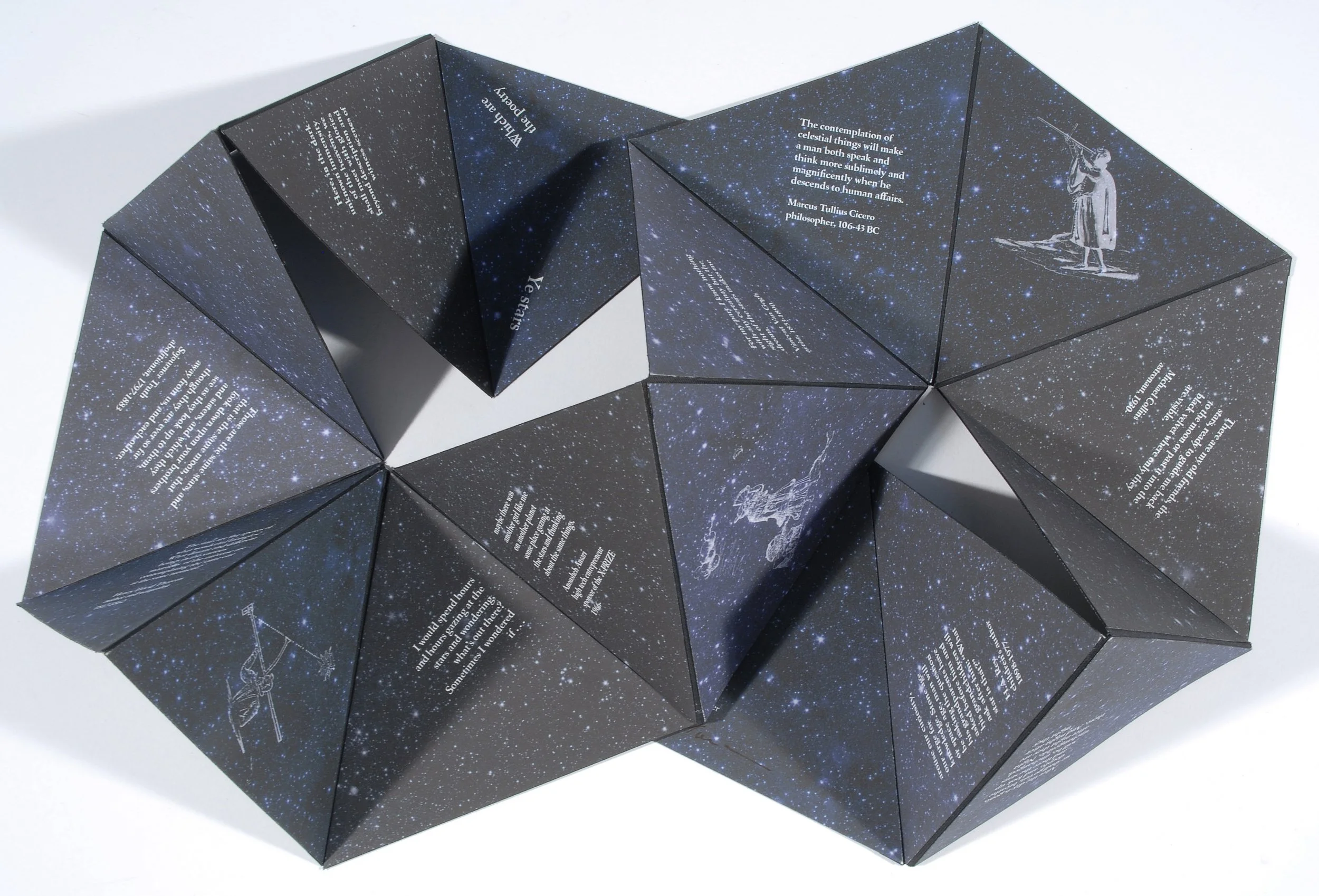
Star Poems
Pigment inkjet prints hinged with unbacked book cloth. Created 2008.
6.75x5.75x.75" closed, 17.5x 23" open
Edition of 30
Please note this piece is made to order and may not be available for immediate delivery. Normal turn-around time is three months.
At once vast and minimal, sparse and rich, the night sky has always been a canvas upon which people project their myths and dreams. Star Poems presents quotes that document response to the night sky across the ages by philosophers, artists, and poets from Plato and Byron to contemporary writers, scientists and astronauts. This text is paired with 17th century mythological images of constellation forms and images of early star gazers on a background of a NASA photograph of the Milky Way. The book can be held in the hand and read page by page like a traditional book, can be removed from its jacket and unfolded flat to reference historical astronomical charts or contemporary NASA composite photos, or can be folded into an infinite variety of sculptural shapes.
For our entire existence as a species, we have looked to the heavens. In the night sky we see possibilities, a map to our future, a document of our past. The panorama of deep space comprises a powerful metaphor, and in two books ... the metaphor is used to ample effect both conceptually and structurally. Celestial Navigation and Star Poems share the same structure and compositional background: a series of hinged triangle with start fields printed on deep blue. Each may be read as a traditional accordion fold, formed into myriad sculptural configurations, or unfolded flat as a kind of map referencing historical and contemporary astronomical charts.
Star Poems consists of astronomical quotes by historical and contemporary philosophers, scientists, artists, and poets paired with 17th century images of astronomers and constellations. The cover quote by Lord Byron, 'Ye stars / which are the poetry / of heaven,' is divided in three, with each part placed at the corners of the triangle, inviting the viewer to begin at any of the three corners. The effect is that one may travel in any direction through the vastness of heaven and encounter the profoundness of eternity, as if meaning were embedded in the environs of space itself, to be reflected and mediated through human synthesis.
— Max Yela, Head, Special Collections, University of Wisconsin Milwaukee
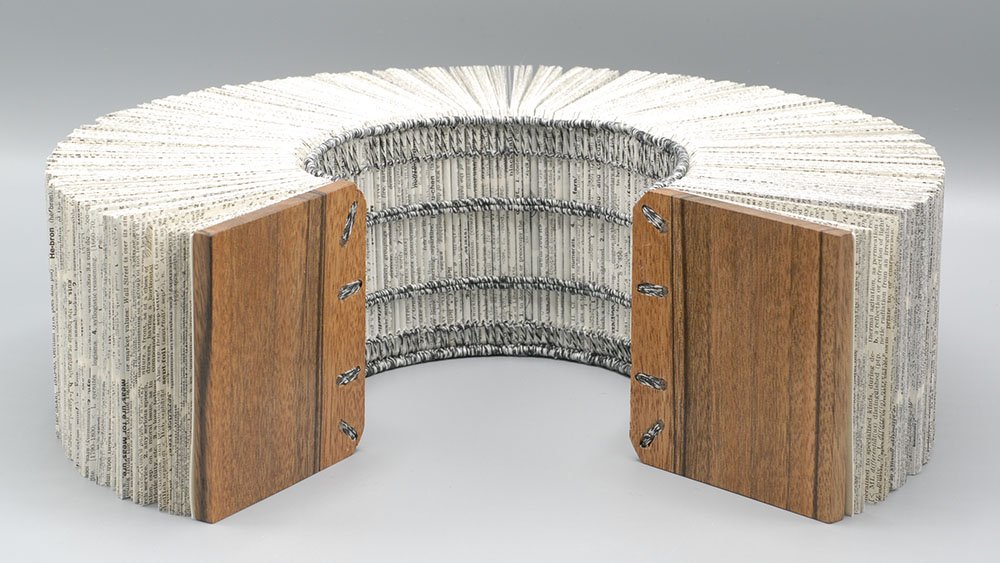
Unabridged
Linen thread, some made into sewing supports by the binder; wood boards; repurposed Random House Unabridged Dictionary pages, parchment hooked endleaves. Thread color and wood for boards vary. Created 2020.
approximately 4 x 4 x 13”
Series of 20
In late 2018 I responded to a call for entries to make a book from one volume of a 1910 encyclopedia that would otherwise have been discarded. I viewed the book as a supply of wonderfully thin but surprisingly strong paper with a lovey, subtle pattern. The strength provided by packed sewing on double cords supplemented with endbands with frequent tie-downs transformed the binding into a kind of medieval slinky.
Early in the Pandemic while I listened to my Governor's daily hour-long briefing, I began work on a series of similar but much thicker books, each made from one entire Random House Unabridged Dictionary. The bindings are stripped down to their most elemental structure: paper, linen, wood. Any ornamentation comes only from those materials: the pattern of the text, the tone and grain of the wood, the color of the thread and the sewing supports. I began to vary the later by making my own sewing cord from linen thread using historical rope-making techniques.
Note: Please note these bindings are made to order and may not be available for immediate delivery. Normal turn-around time is six months.
Bookbinding with Numerous Engravings and Diagrams
Edited by Paul N. Hasluck, Grove, Wantage, England: The Black Swan Press, 1992, reprint of 1902 first edition.
On exhibit at the New Bedford Whaling Museum October 16, 2026 - February 15, 2027.
Full goatskin binding with laced-in boards. Trade book disbound, guarded and resewn on flattened cords, leather hinge, marbled paper by Pamela Smith. Hand sewn, silk headbands; three edges sprinkled with blue acrylic ink. Blind title and tooling, acrylic pochoir. Illustrations scanned from the text and laser printed onto goatskin onlays. Illustrations scanned from the text and inkjet printed onto Mohawk Superfine cover, then hand cut into pop-ups, are sewn inside each of the text block’s ten signatures. Bound 2014.
8.5 x 5.5 x 2”
The design for this binding is inspired by the text’s charming vintage illustrations, many of which feature disembodied hands performing common binding tasks. Tooling and pochoir further illuminate aspects of structure and process: beating the text block prior to sewing, sawing in sewing stations, lacing on boards, turning in and forming corners, tooling, and the figure-eight motion of the polishing iron.
New & Available Book Structure Models
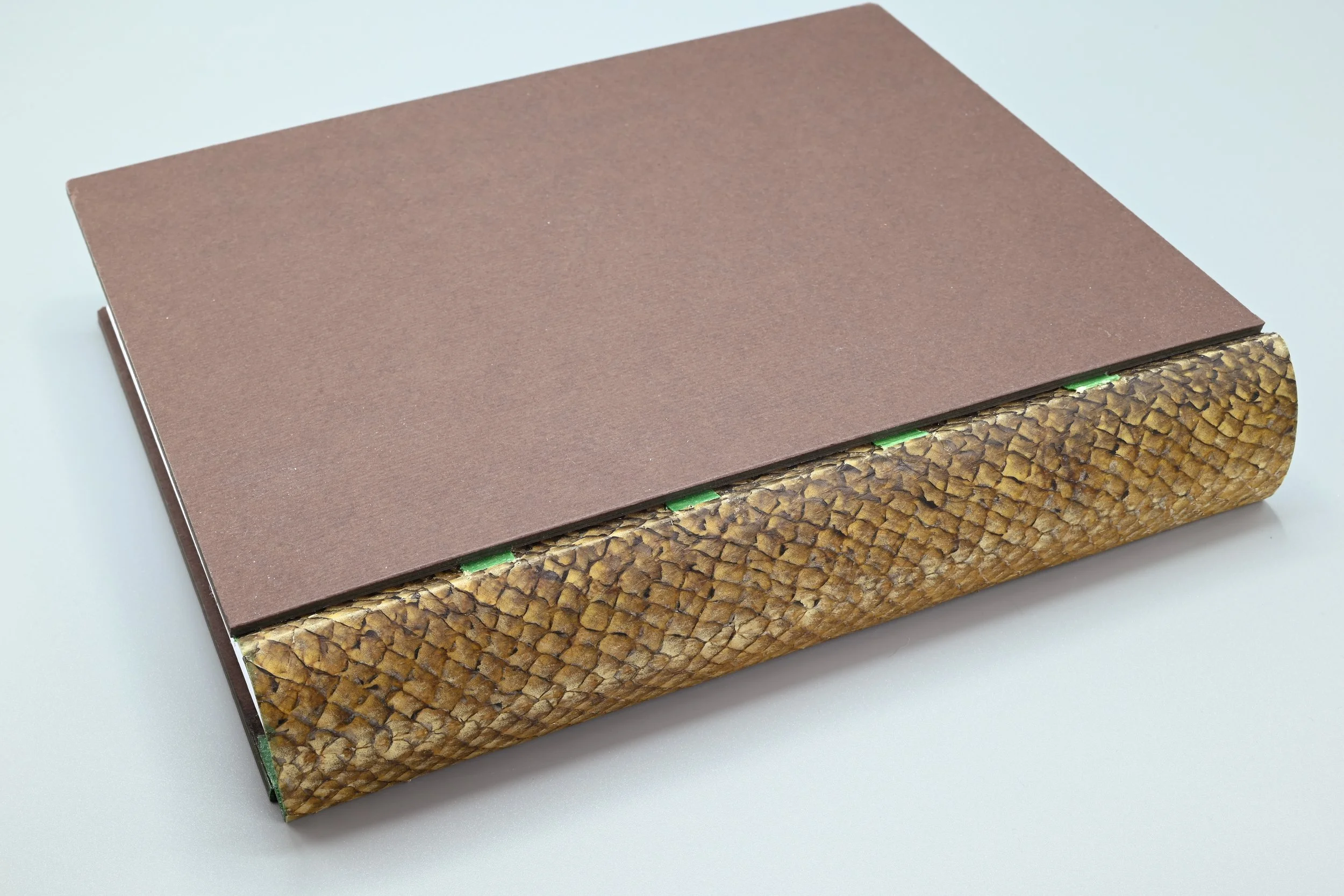
A Bookbinder’s Compendium: Workshop Handouts 2001-2025 by Karen Hanmer.
Glenview, IL: Karen Hanmer Book Arts, 2026.
Even More Simplified binding: spine wrapper of Atlantic salmon parchment processed by the binder and dyed in pomegranate and logwood. Boards a laminate of multicolored Murillo paper, sewn on vellum supports laced in and out at the shoulders. Hahnemuhle Ingres endsheets. Rolled paper endbands. Headcaps and sewing supports colored with mica-infused watercolor. Bound 2026.
8 ¾ x 7 ⅜ x 1 ¾ “
This is the second bound copy of an anthology of thirty-three workshop handouts written by the binderon topics including fine binding, a range of historical and contemporary structures, notes on materials, and professional practices.
This text is available in printed, unsewn sheets.
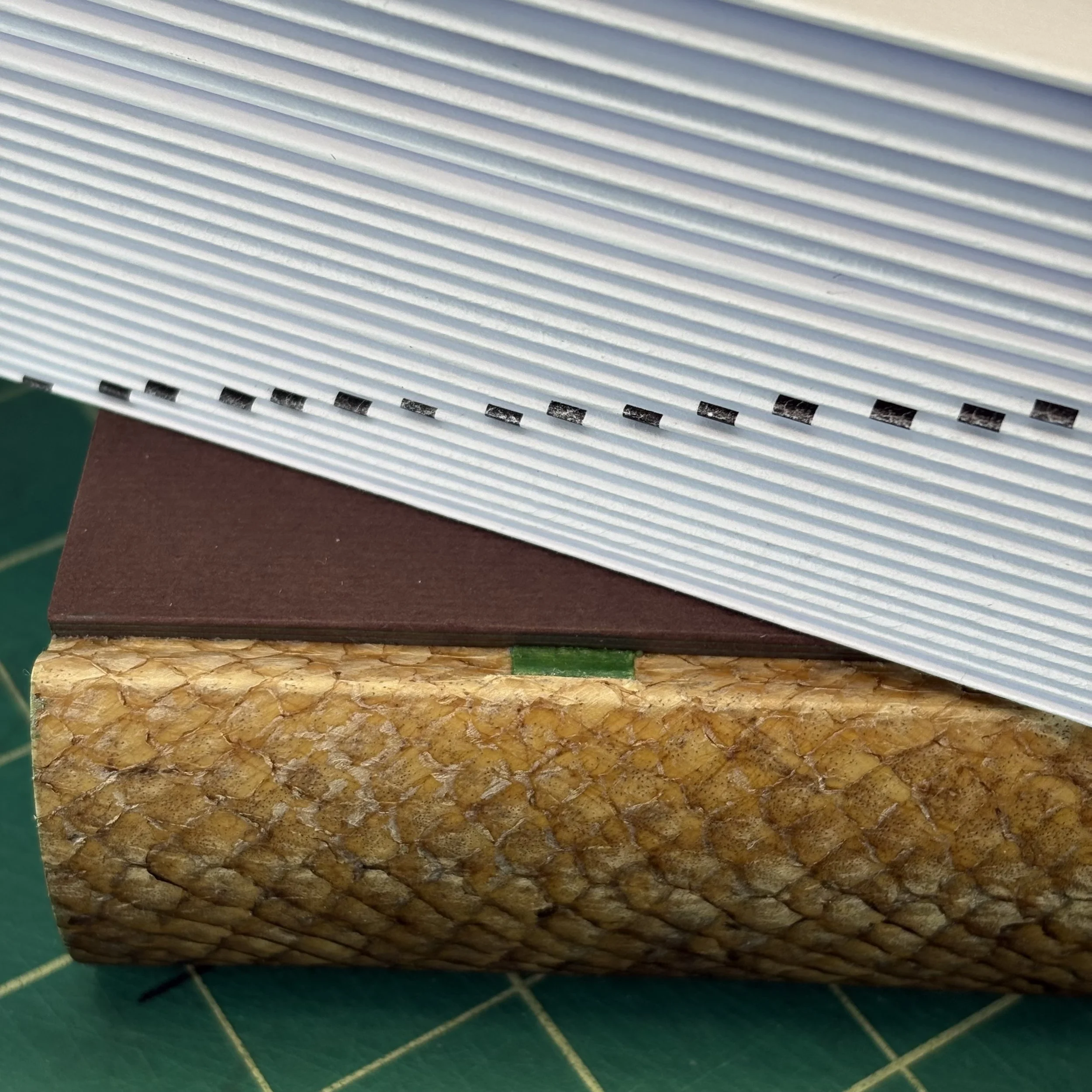
A Bookbinder’s Compendium: Workshop Handouts 2001-2025 by Karen Hanmer
Available only in unbound sheets.
Low stock, more expected early November
SHIPPING TO US ADDRESSES ONLY
Available to bookbinders everywhere through Colophon Book Arts Supply.
This collection includes instructions on thirty four topics across six categories, arranged in the order they were written.
Historical Structures and Traditional Binding
Paper Cases and Modest Structures
Book Arts Structures
Notes on Materials
Decorative and Luxury Features
Professional Practices
Most of the material here was written as a supplement to, not a replacement for, an in person or online class. Still, handouts for many of the topics are detailed enough to guide those with basic forwarding skills in making the structure described. Most include a detailed tool and supply list.
Twenty-four sections, 23 with five folios each, one with 3 folios, 462 pages total.
Unfolded page size (short grain) 14 × 8.5”
Folded text block: 8.5 × 7 × 1.25”
Printed on bright white 70 lb text with a Canon varioPrint iX Digital Press by HF Group in North Manchester, IN
Most of this material is available for free download as individual documents
Download a sample here. (formatted to print on legal-sized paper, the margins here are slightly smaller than in the printed sheets)
As I continue to teach and research binding structures I will periodically be crafting my own bindings of these sheets. Learn more about these bindings here.
A Bookbinder’s Compendium: Workshop Handouts 2001-2025 by Karen Hanmer.
Glenview, IL: Karen Hanmer Book Arts, 2025.
Illustrations of tools used in traditional bookbinding by Henry Maron, inkjet-printed onto limp case of Hook cotton and linen case paper, lacing straps of Cave paper. Roma handmade paper endsheets. Bound 2026.
8 ¾ x 7 ¼ x 1 ¾ “
This binding contains the only printed version of the first draft of an anthology of thirty-three workshop handouts written by the binder on topics including fine binding, a range of historical and contemporary structures, notes on materials, and professional practices.
This text is available in printed, unsewn sheets.

Biblio Tech: Reverse engineering historical and modern binding structures (with a focus on board attachment).
Please note these sets are made in batches and are not available for immediate delivery. Turn-around time may be up to eighteen months.
Set of twelve binding models with leather and various papers and sewing supports, wooden boards, museum board. Housed in clamshell box. Each binding approximately 5 x 3.25 x .5” Edition begun 2013.
This reference set of twelve binding models is based on Karen Hanmer's popular workshop Biblio Tech: Reverse engineering historical and modern binding structures. The models remain uncovered and only partially completed so methods of board attachment, sewing, spine lining, and endsheet construction are visible. The set is accompanied by a forty-five page illustrated guidebook outlining key structural features of each binding, and providing numerous references for further study. The hand-bound manual is sewn in three signatures and presented in a German stiffened paper binding.
These models are a valuable reference for libraries, book arts programs, or for anyone who is interested in learning more about the engineering aspects of the book. Structures include:
Tacketing of a thick single signature into a leather wrapper
Ethiopian Binding
Medieval Binding
Laced-on boards Binding
Colonial American Scaleboard Binding
Early Nineteenth Century Publishers Boarded Binding
German Case Binding with double fan adhesive text block
Split Board Binding
Simplified Binding
Crossed Structure Binding
Sewn Boards Binding
Non-Adhesive Paper Case
* * *
A forty-five page illustrated guide outlining key structural features of each binding, and providing numerous references for further study is also available, print on demand from Lulu.com.
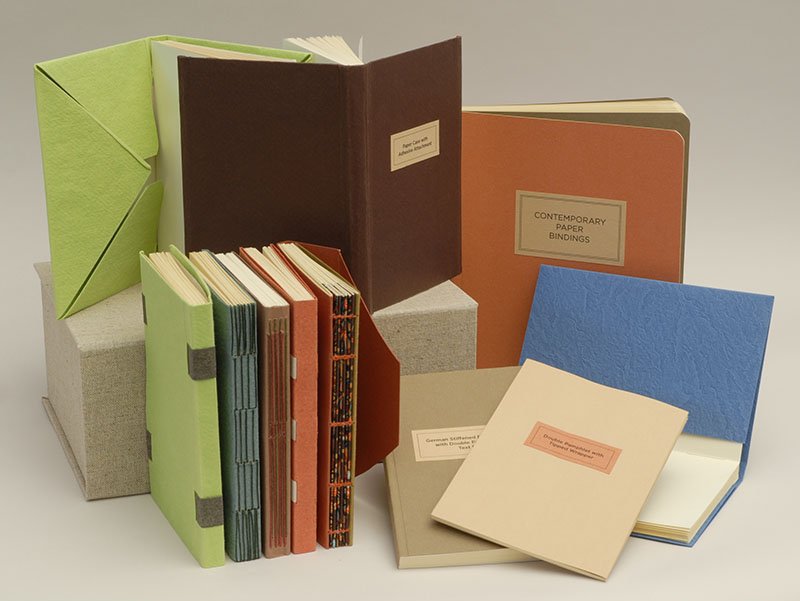
Contemporary Paper Bindings: A guide to bookbinding techniques, tools, and materials
Please note these sets are made in batches and are not available for immediate delivery. Turn-around time may be up to eighteen months.
Boxed set of ten structure models plus manual.
The manual is also available separately, print on demand, or available forfree download.
Ten paper bindings in a clamshell box, mostly non-adhesive, mostly unsupported sewing: three folded paper cases, supported and unsupported laced cases, long stitch, chain stitch with decorative guards, double-pamphlet in tipped wrapper, multi-section pamphlet, German stiffened paper binding with double-fan adhesive text block.
The set also includes a 140 page hand-bound b&w laser-printed manual: a skill-building guide to bookbinding techniques, tools, and materials with a glossary and an extensive bibliography (many of the resources available online). Chapters on tools and supplies, ergonomics, signature preparation, endsheets, sewing and working with case-weight papers precede complete instructions for crafting ten different paper binding structures. Each process is illustrated with numerous b&w photographs and diagrams. The instructions for each structure are also provided as PDFs for classroom distribution. Edition begun 2016.
Each model approximately 6.5 x 4.5", manual 9 x 6"
For centuries paper has served as a quick, elegant, and economical covering material for books. These models and accompanying instructions will introduce beginners to the basic tools, techniques and materials of bookbinding. Experienced practitioners will discover how features from multiple bindings can be combined to create a new, custom structure to meet the requirements of any project. All of these structures can be made in a sparsely-equipped studio with minimal specialized tools or equipment.
This material is also covered in a workshop which can be condensed or expanded to fit a time frame of one to five days.
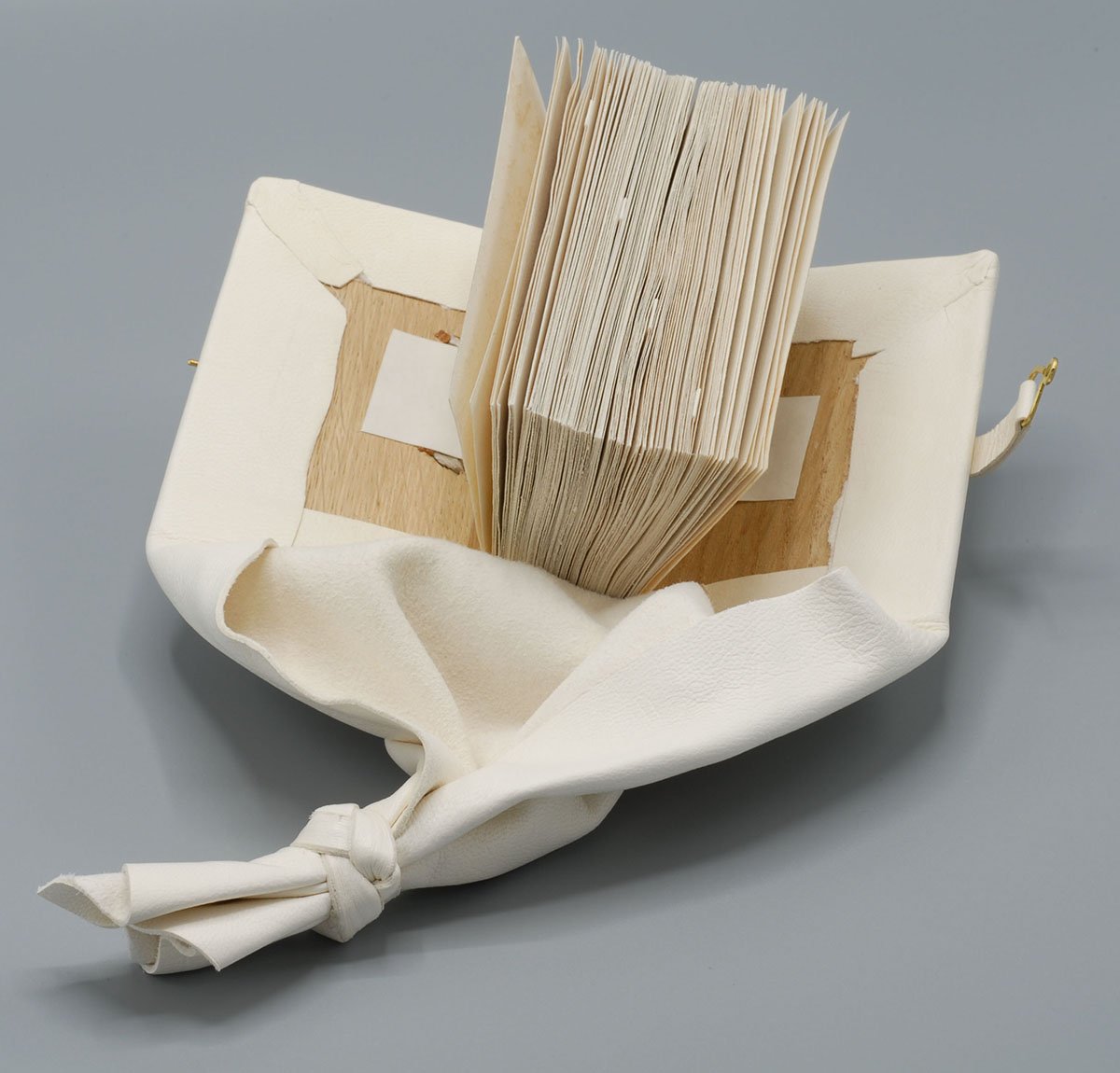
Medieval girdle book
Please note: these models are made to order. Turn-around time may be up to twelve to eighteen months. One covered in pig suede is available for immediate delivery.
This model is accompanied by a twelve-page, illustrated booklet with bibliography outlining the construction of medieval bindings in general and the girdle book in particular.
The girdle book is a medieval binding structure featuring a long extension of leather, which could be attached to a traveler’s belt. This leather extends from the tail of the book, so the text can be read while the book is still attached to the reader’s belt. The extension often terminates in a decorative knot or hook. The twenty-three extant girdle books date from 1454 to 1579.
There are hundreds of representations of these bindings in paintings and other visual arts. This model displays features typical of medieval bindings:
• Text block sewn on double supports
• Wooden boards shaped all around, with special attention given to the inside spine edge to match the text block’s shoulder
• Spine linings extend beyond the text block and attach to the inside of the boards
• Text block laced onto boards and cords pegged in
• Sewn headbands also laced into the boards
• Full covering in vividly-colored leather or velvet
• Strap and pin closure
• Corner bosses
• Vellum foredge markers
• Turk’s head knot to finish leather extension at the binding’s tail
Text block of Hahnemuhle Gutenberg, 4.75 x 3.25 x 1.25 inches.
Book can be covered in pig suede or alum-tawed goat. Colors will vary.
Also available: Detailed instructions for constructing a girdle book Medieval binding
A Bookbinder’s Compendium: Workshop Handouts 2001-2025 by Karen Hanmer.
Glenview, IL: Karen Hanmer Book Arts, 2026.
Even More Simplified binding: spine wrapper of Atlantic salmon parchment processed by the binder and dyed in pomegranate and logwood. Boards a laminate of multicolored Murillo paper, sewn on vellum supports laced in and out at the shoulders. Hahnemuhle Ingres endsheets. Rolled paper endbands. Headcaps and sewing supports colored with mica-infused watercolor. Bound 2026.
8 ¾ x 7 ⅜ x 1 ¾ “
This is the second bound copy of an anthology of thirty-three workshop handouts written by the binderon topics including fine binding, a range of historical and contemporary structures, notes on materials, and professional practices.
This text is available in printed, unsewn sheets.