
ARTISTS’ BOOKS | Sculptural & Movables

YESNOMAYBE Karen Hanmer: concept and production, Amy Macek: typography
Flip book: inkjet prints, double-fan adhesive binding. Created 2013.
2 x 4.75 x 1.5”
Open edition
A quick flip through an indecisive decision-making process.
Beautifully conceived and executed. Hanmer continues to demonstrate the conceptual richness of the flipbook form.
— Buzz Spector, book, installation and mixed media artist, and Dean of the College and Graduate School of Art, Washington University.

A2Z
Flip book: inkjet prints, double-fan adhesive binding.
2 x 4.75 x 2"
Open edition
A quick flip through the alphabet. Created 2013.
I'm particularly engaged by A2Z, whose bulk supplements the transitions from letter to letter. Such good form!
—Buzz Spector, book, installation and mixed media artist, and Dean of the College and Graduate School of Art, Washington University.
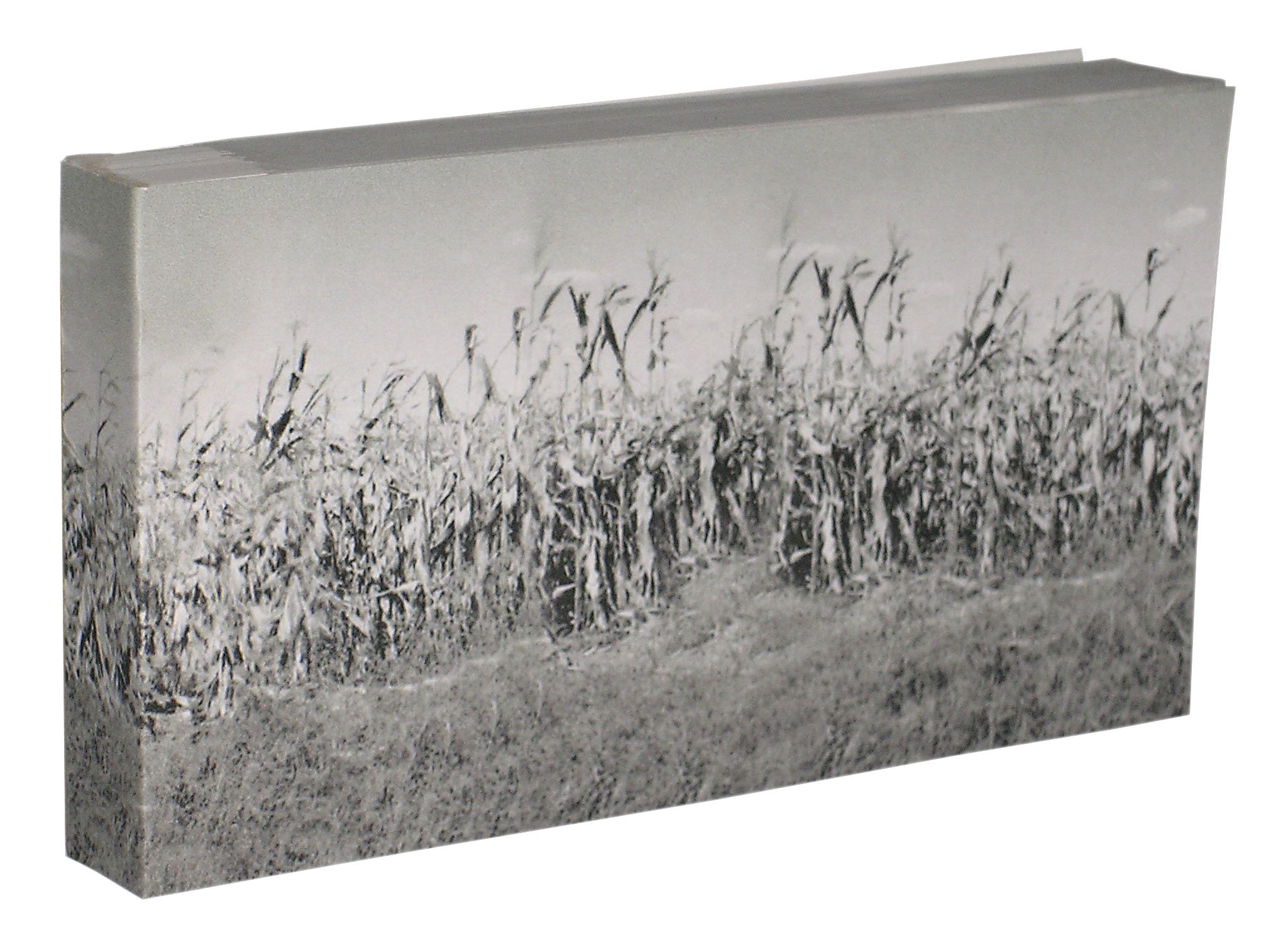
Flip Farm
Pigment inkjet prints
2x3.5x.5”
Edition of 100
Flip book simulates the experience of driving past a field of corn. Created 2002

The House That George Built
Flip book: Pigment inkjet prints. Illustration in collaboration with Henry Maron. Created 2007.
2.5x4.5x.75”
Edition of 100, out of print
An image of the White House deconstructs to represent blunders and evil-doings since the 2001 inauguration.

#Great Again #Believe Me
Jacob’s Ladder: Pigment inkjet prints, binders’ board, polypropylene. Photos courtesy of the Library of Congress. Created 2018.
21.5 x 2.5 x .125 extended | 3.5 x 2.5 x .75 closed | inches
54.5 x 6.5 x .5 extended | 9 x 6.5 x 2 closed | cm
Edition of 30, two copies remaining.
From Access Hollywood through the Mueller investigation to white nationalist support, #Great Again #Believe Me documents contemporary American personalities, pronouncements, slogans, scandals, policies and crimes, complemented by the metaphor of a deconstructing US Capitol. Housed in clamshell of archival board.
#Great Again #Believe Me shows Karen Hanmer once again being a 'first responder' to current events. Students in my introductory book arts class were interested in how the structure of the book could change at a moment’s notice, reflecting the transitory nature of our #hashtag world. A book to spark discussion and debate!
—Robert Gore Visual Arts Librarian UCLA Arts Library
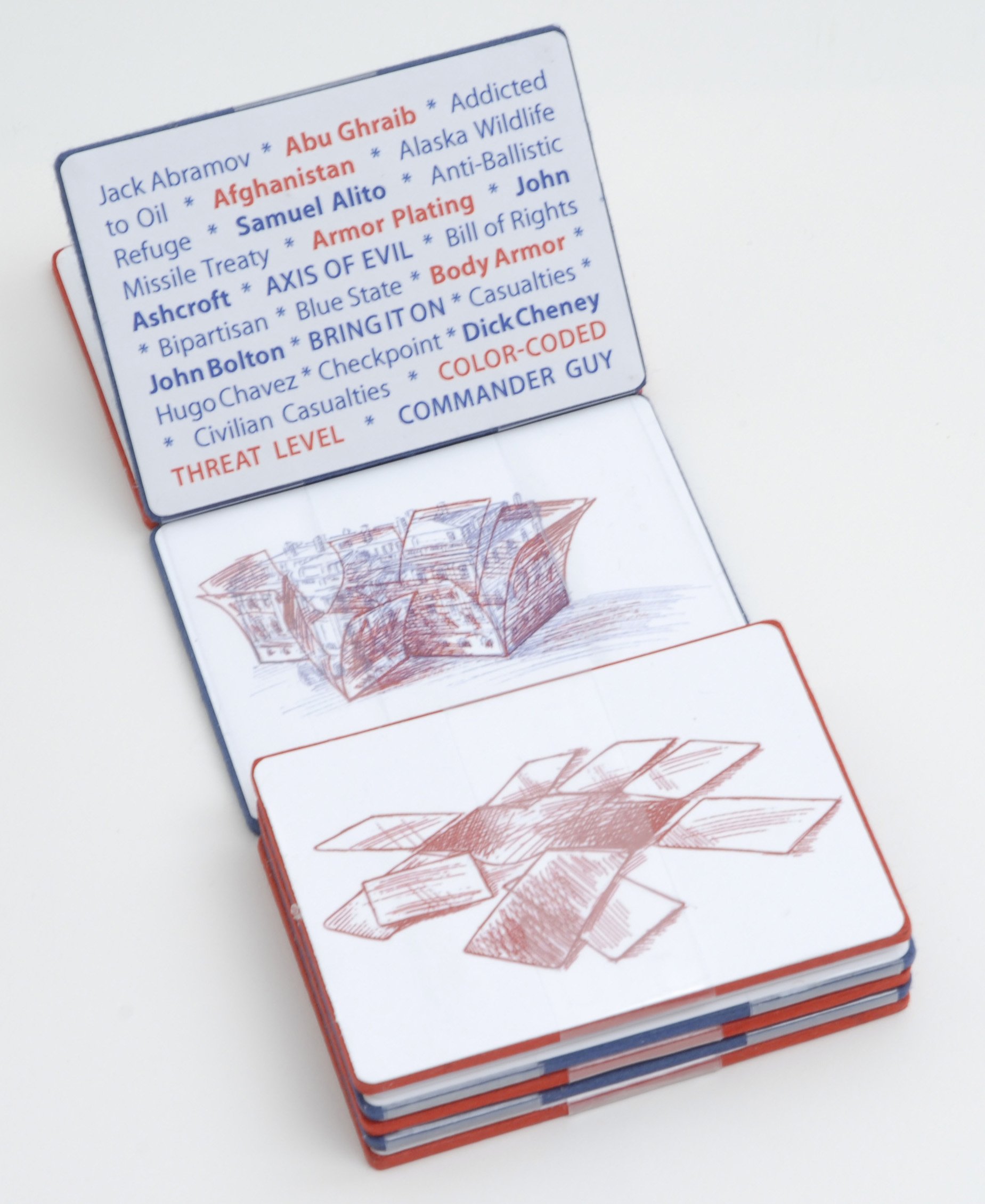
House of Cards
Jacob’s Ladder: Pigment inkjet prints, binders’ board, polypropylene Illustration in collaboration with Henry Maron. Created 2007.
20.5 x 3.5 x .25" extended
2.5 x 3.5 x 1.25 closed
Edition of 30. Out of print. One gently used display copy available.
An image of the White House deconstructs as text on reverse documents blunders and evil-doings since the 2001 inauguration.
Exactly what we’ve come to expect of Karen Hanmer’s work: structure and content in lockstep, meticulous craft, pointed and unsubtle satire eliciting immediate visceral response. Again she reminds us that emotional impact doesn’t depend on complexity. The only incongruity is emotional: the books reference nursery rhymes, toys, and the innocence of children; the minimal text of House of Cards—from Abu Ghraib to Paul Wolfowitz—elicits from at least one reader tears of loss and frustration.
— Bill Stewart, Vamp & Tramp
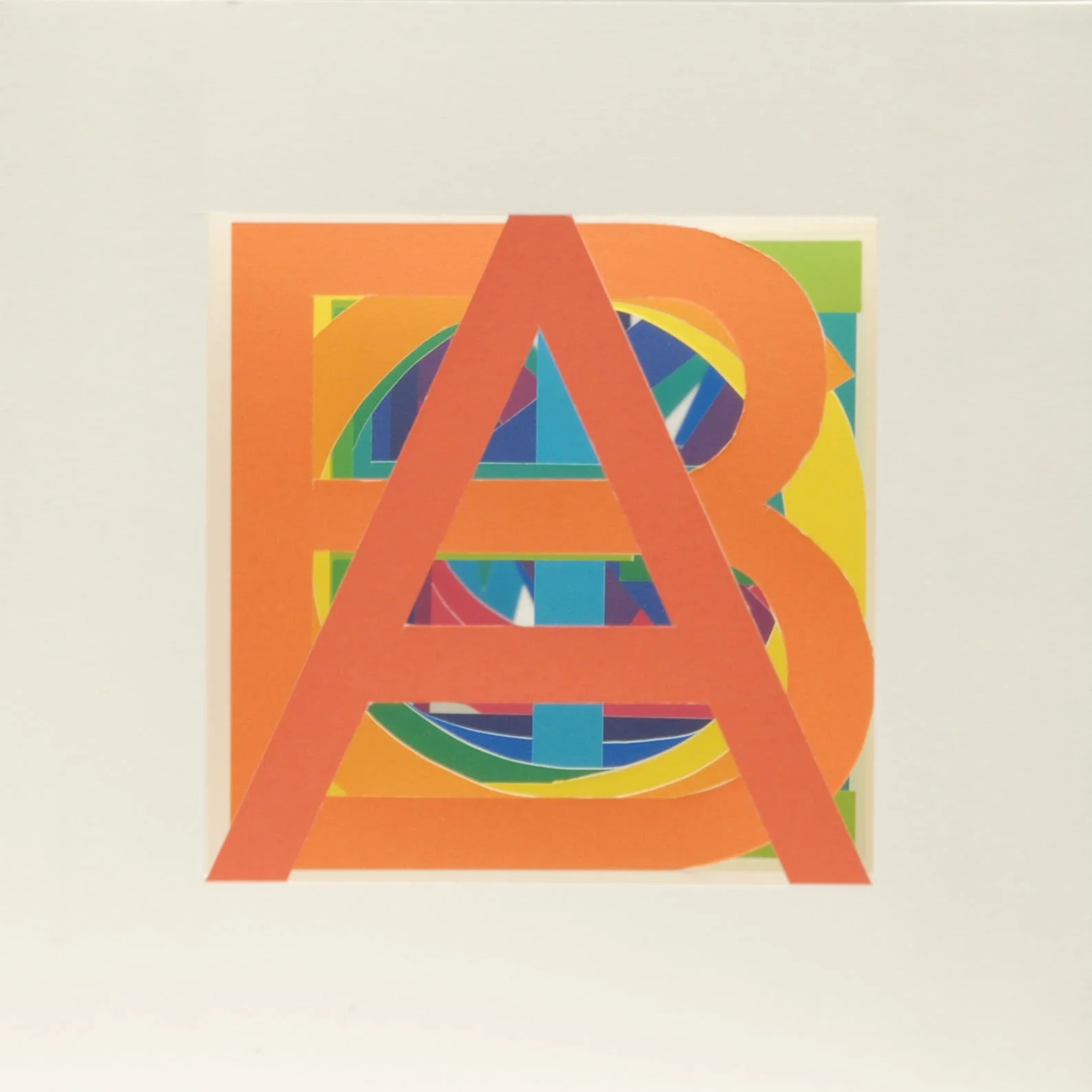
The Spectrum A to Z
Tunnel book: Pigment inkjet prints. Created 2003
5 x 5 x 18"
Edition of 20
Tunnel book with letters of the alphabet colored to run through the spectrum and back.
Spectrum A to Z was reviewed in Robert Bolick’s Book on Books blog, October 25, 2021.
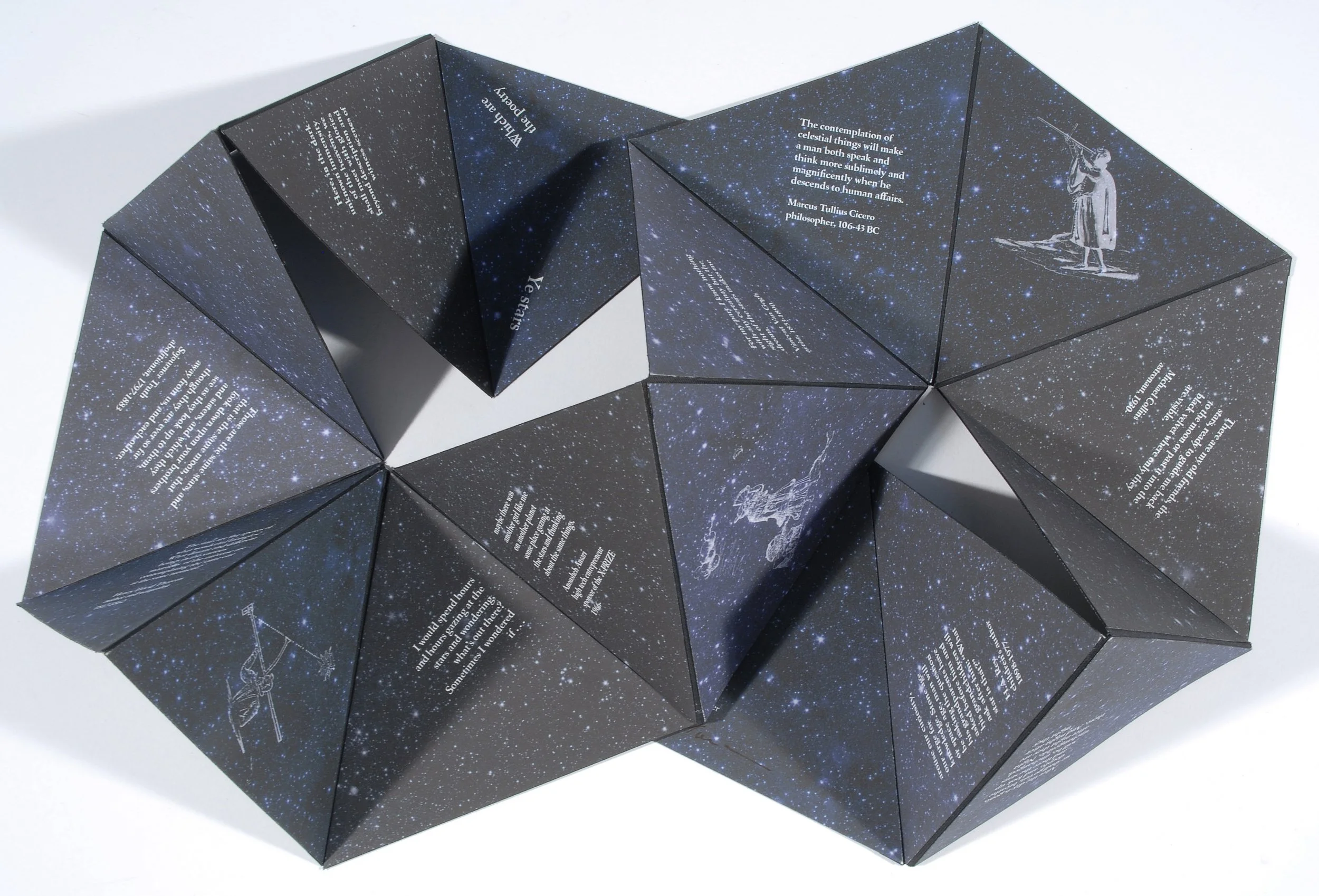
Star Poems
Pigment inkjet prints hinged with unbacked book cloth. Created 2008.
6.75x5.75x.75" closed, 17.5x 23" open
Edition of 30
Please note this piece is made to order and may not be available for immediate delivery. Normal turn-around time is three months.
At once vast and minimal, sparse and rich, the night sky has always been a canvas upon which people project their myths and dreams. Star Poems presents quotes that document response to the night sky across the ages by philosophers, artists, and poets from Plato and Byron to contemporary writers, scientists and astronauts. This text is paired with 17th century mythological images of constellation forms and images of early star gazers on a background of a NASA photograph of the Milky Way. The book can be held in the hand and read page by page like a traditional book, can be removed from its jacket and unfolded flat to reference historical astronomical charts or contemporary NASA composite photos, or can be folded into an infinite variety of sculptural shapes.
For our entire existence as a species, we have looked to the heavens. In the night sky we see possibilities, a map to our future, a document of our past. The panorama of deep space comprises a powerful metaphor, and in two books ... the metaphor is used to ample effect both conceptually and structurally. Celestial Navigation and Star Poems share the same structure and compositional background: a series of hinged triangle with start fields printed on deep blue. Each may be read as a traditional accordion fold, formed into myriad sculptural configurations, or unfolded flat as a kind of map referencing historical and contemporary astronomical charts.
Star Poems consists of astronomical quotes by historical and contemporary philosophers, scientists, artists, and poets paired with 17th century images of astronomers and constellations. The cover quote by Lord Byron, 'Ye stars / which are the poetry / of heaven,' is divided in three, with each part placed at the corners of the triangle, inviting the viewer to begin at any of the three corners. The effect is that one may travel in any direction through the vastness of heaven and encounter the profoundness of eternity, as if meaning were embedded in the environs of space itself, to be reflected and mediated through human synthesis.
— Max Yela, Head, Special Collections, University of Wisconsin Milwaukee

Most Excellent Canopy
Pigment inkjet prints
6 x 5” closed
10 x 10" open
Edition of 100
Two quotes about the beauty of the stars open to reveal an image of an early star gazer against the night sky. Six constellations are represented by punched holes as they appear in the winter sky over North America. Created 2008.
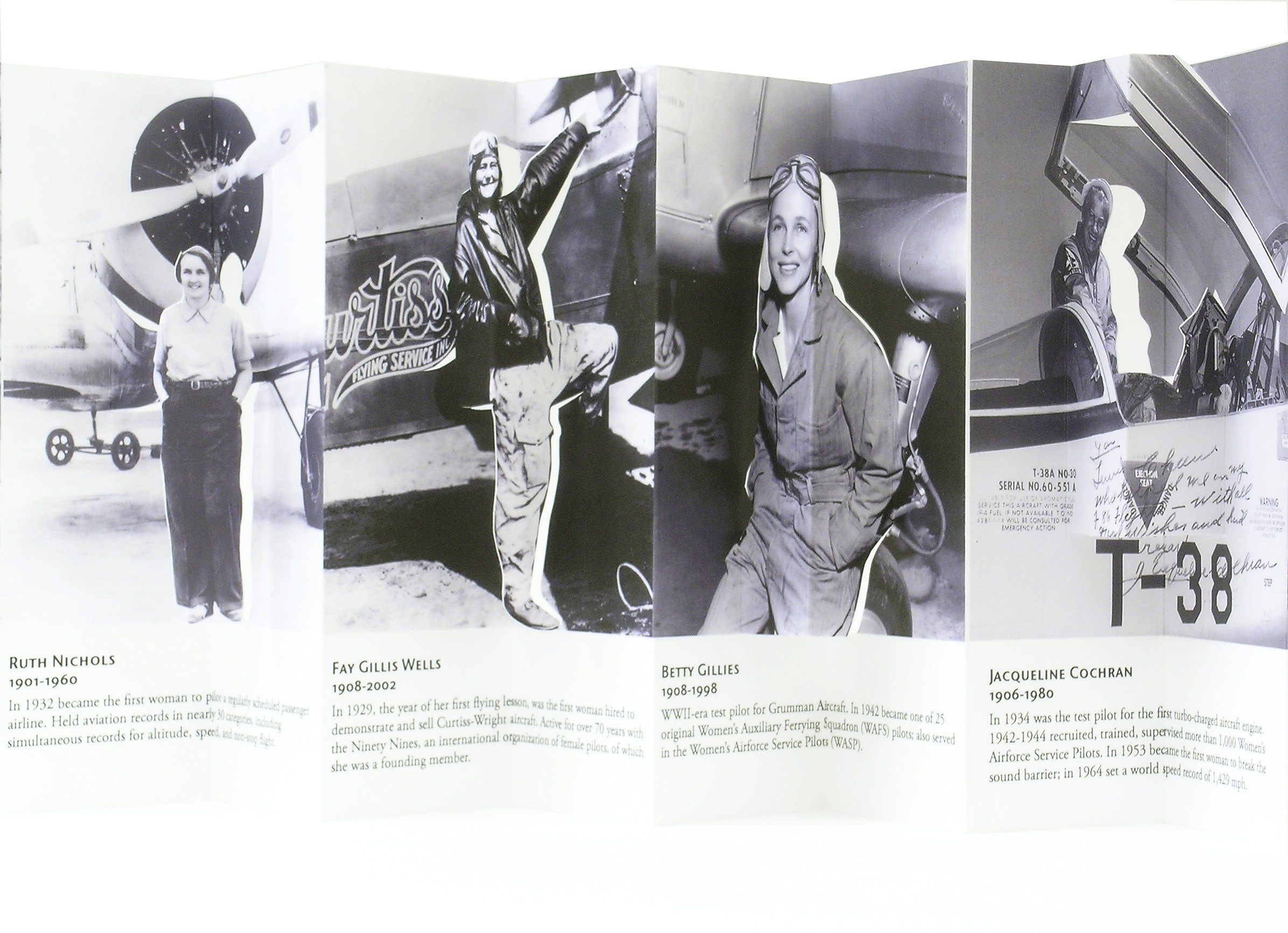
Faster Higher Further First: a sampler of women aviators
Accordion with simple pop-ups: pigment inkjet prints.
8 x 2.5 x .5" closed
Removed from dust jacket and fully extended: 8 x 56 x 5"
can also be displayed extended into a closed circular shape.
Edition of 50
Please note this piece is made to order and may not be available for immediate delivery. Normal turn-around time is three months.
An accordion format pop-up book with vintage photographs of 14 women aviators from the beginnings of powered flight until the present. Brief text lists the accomplishments of each woman. Subjects set records of altitude, speed, endurance or made other significant contributions to the field, not as women's firsts, but across gender lines. Created 2005.


Famopily (board game)
Ready to play board game: pigment inkjet prints, binder’s board. Created 1999.
18.75 x 18.75"
Edition of 20. Two remaining copies gently worn from exhibit.
Family scrapbook images on game board, game cards collected by moving about board contain recollections about growing up in the 1960s. From artist's statement: For several years I recorded family stories and my childhood memories. I printed out each on an index card to sort through when I was looking for text for various books I was working on. It struck me that they were like odd trading cards.
The Famopily board game evolved from this idea. Players are members of a family. Mother, Father, Brother and Sister. They roll a die and move about the board collecting and reading aloud cards printed with childhood stories. My military family moved often while I was growing up. By the time I was ten, I had lived in six cities. When a player of Famopily lands on the “Moving Day” space, she must spin the wheel and relocate her playing piece to a different space on the game board. She then loses a turn. This minor inconvenience is intended to give players a small indication of how disruptive and disorienting all that moving around felt.
Karen Hanmer's work is wonderfully playful and sculptural. Interaction is encouraged in a very unique way. These qualities make the pieces quite special in artist book displays. Because we collect game oriented books, the University of Kentucky's Lucille Little Fine Arts Library collections include five of her books.
—Meg Shaw, Art Librarian, Lucille Little Fine Arts Library & Learning Center, University of Kentucky Libraries

Big River
Pigment inkjet prints, binders' board, plexiglass, ball bearings
10.75 x 8.75 x 1.25"
Edition of 20
Like the child’s pocket game, the viewer maneuvers the box to get each of the balls into a divot corresponding to a city mentioned in the Johnny Cash song, Big River, where the lovesick narrator chases his beloved down the Mississippi River, missing her at every port. Created 2004.

Crystals
Carousel book: Pigment inkjet prints
7 x 14 x 7" open
7 x 7 x 3/4” closed
Edition of 20. Out of print. One gently worn exhibit copy available.
This carousel book tells the story of the sensuous pleasures of a straight-laced child’s twilight summer walk to the candy store to purchase caramel “bull’s eyes,” in the company of the free-wheeling children from the family next door. Created 2000.

Folding
Pigment inkjet prints
4.5 x 20 x 3” extended
4.5 x 4 x .5” closed
Edition of 100
Photograph of hands folding an accordion was created for artist's flag book article in The Bonefolder online book arts journal. Created 2005.

Letter Home
Flag book: pigment inkjet prints. Created 2004.
8 x 4.75 x .5” closed
8 x 19 x 3" fully open
Edition of 20, one copy remaining
A young Navy wife’s letter written from Europe to her family on the farm.
The flag book, like other dynamic book structures, has the unfortunate potential to overwhelm content and artistic intent. Not so for Karen Hanmer’s flag book Letter Home. Here the book’s structure and its exterior and interior environments are fully integrated with content to embody and illuminate meaning. Using family photographs and dual, private voices — a letter to family and an interior commentary — Hanmer creates a visual narrative/diorama of Midwestern roots, geographic displacement, familial relationships, personal and interpersonal anxieties, and 1950s cultural transition. The work evokes emotions of longing and loss without being sentimental, as well as hope for the future that is flavored with Midwestern pragmatism. The revelatory quality of Hanmer’s flag book is quite appropriate to its content, creating a satisfying and multi-layered experience for the viewer.
— Max Yela, Head, Special Collections, University of Wisconsin Milwaukee

All Shook Up
Flag book: Pigment inkjet prints. Black velvet finish paper cover.
8 x 4.75 x .5” closed
8 x 19 x 3" fully open
Edition of 20
Imagery of Elvis, his birthplace in Tupelo, Mississippi, and a list of his best known songs deconstruct and reconstitute as this flag book takes various forms. In 2004, All Shook Up won the Best of Show award at the annual Elvis Week Art Contest at Graceland in Memphis, TN. Created 1999.

Deal me in, Mona
Flag book: Pigment inkjet prints.
8 x 4.75 x .5” closed
8 x 19 x 3" fully open
Edition of 20
Contrasts two staples of Western Art History, Mona Lisa and Waterloo, a Poker Dogs painting by Cassius Coolidge. Created 1999.
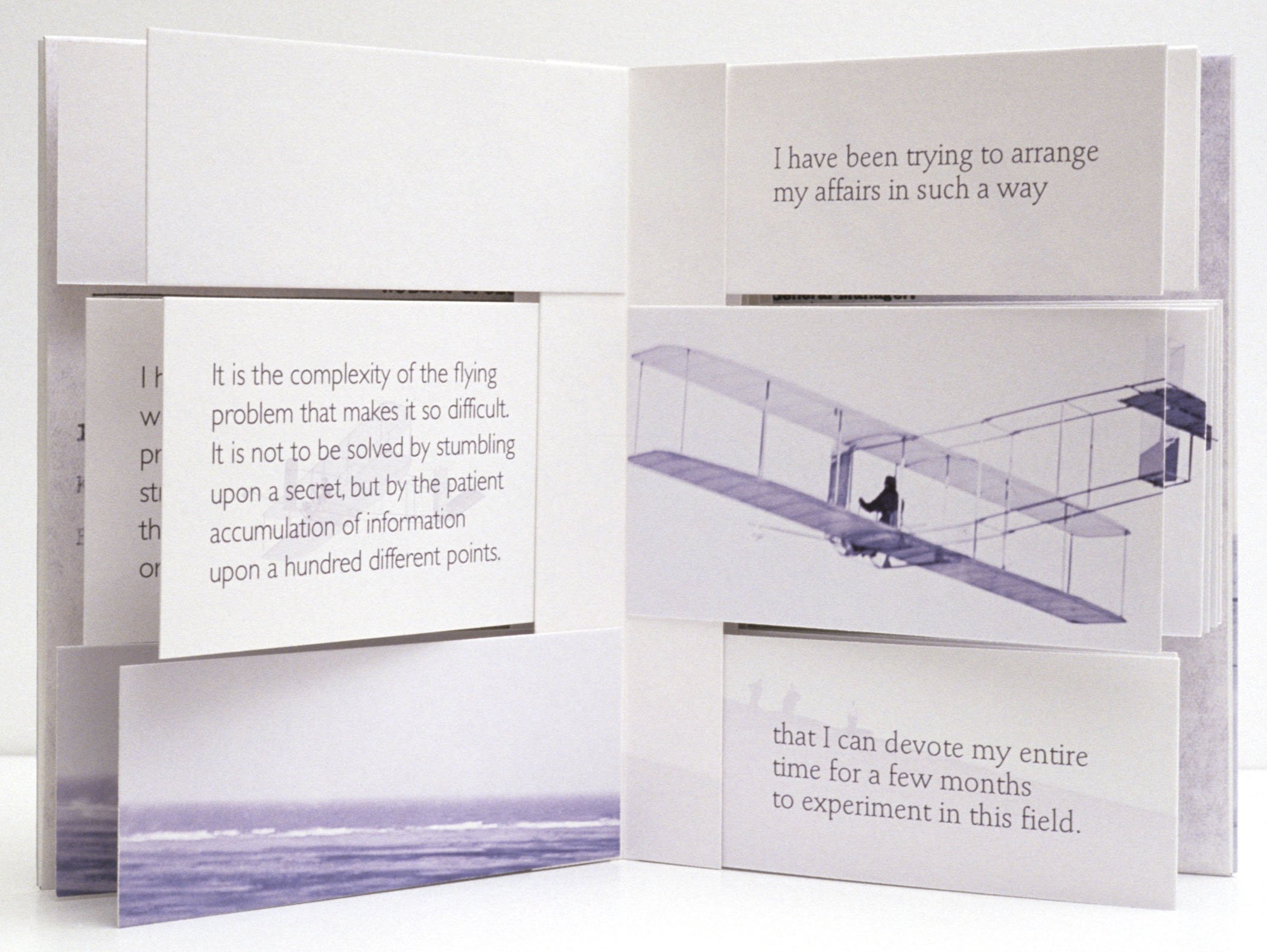
Secrets of Flight
Flag book: Pigment inkjet prints
7 x 26 x 5" open
7 x 5 x 3.75" closed
Edition of 30
Photographs and archival documents pertaining to the Wright Brothers’ experimentation to develop the first manned, powered flight. Text in large, easily readable fonts for beginning readers. Created for Turning Pages: A Collection of Artists’ Books shown in The Living Room, the family installation space at the Wichita Art Museum. Created 2004.

They All Laughed
Flag book: Pigment inkjet prints. Created 2002
7 x 5 x 26" | 7 x 5 x .75" closed
Edition of 20
Photographs and archival documents pertaining to the Wright Brothers’ first manned, powered flight, contrasted with the Gershwin song, They All Laughed, that lists a number of screwball ideas for inventions that became the foundation of modern society.
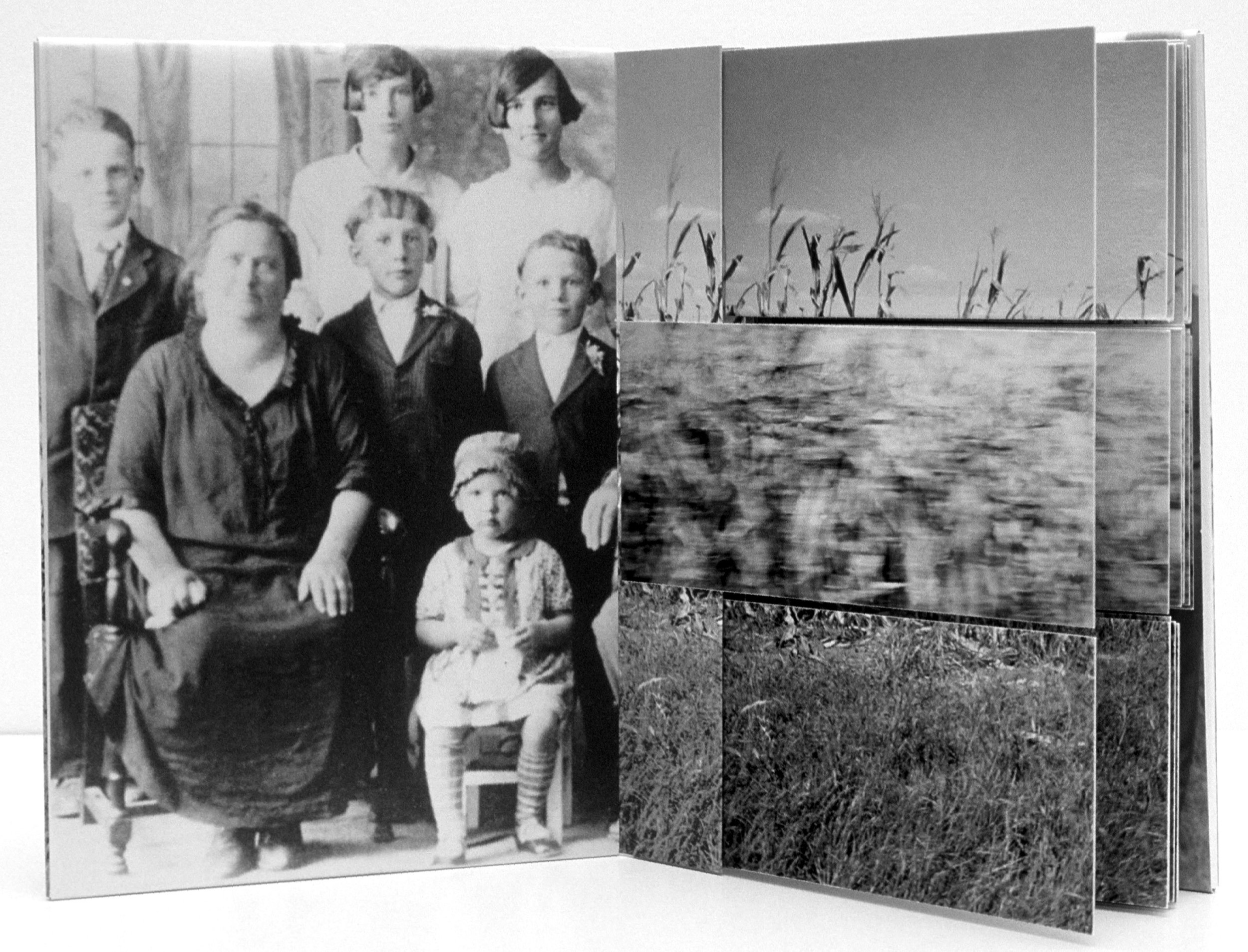
Succession
Flag book: Pigment inkjet prints. Created 2002.
Open size 7 x 5 x 26", closed size 7 x 5x.75"
Edition of 20
Transition from a detailed to a blurred field of corn and back suggests the history of a large, immigrant farming family over a 60 year span. Inside covers depict the family in the late 1920s and the late 1960s.

Bequest
Flag book: Pigment inkjet prints
8 x 19 x 3" fully open
8 x 4.75 x .5” closed
Edition of 20
Text outlines brief history of immigrant farm family and lists the names of three generations. Created 2001.
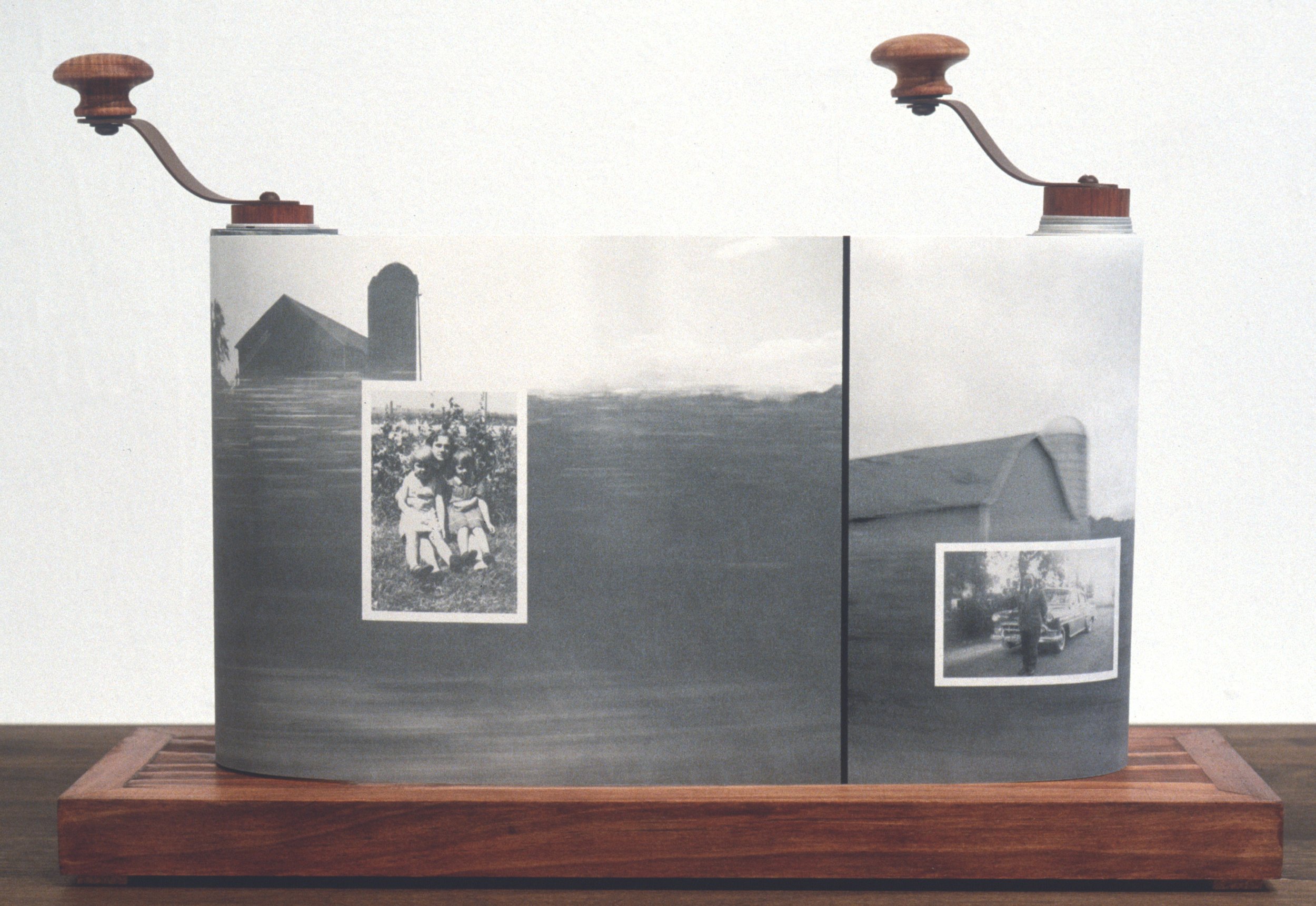
Homestead
Pigment inkjet prints, wood, metal. Created 2001
12 x 17.5 x 5.5", entire scroll is 240" long
Unique artists' book
Photos of milestones in the history of a large farming family over a 60 year span in a scroll format, 12 inches visible at one time.

Bookbinding with Numerous Engravings and Diagrams
Edited by Paul N. Hasluck, Grove, Wantage, England: The Black Swan Press, 1992, reprint of 1902 first edition.
On exhibit at the New Bedford Whaling Museum October 16, 2026 - February 15, 2027.
Full goatskin binding with laced-in boards. Trade book disbound, guarded and resewn on flattened cords, leather hinge, marbled paper by Pamela Smith. Hand sewn, silk headbands; three edges sprinkled with blue acrylic ink. Blind title and tooling, acrylic pochoir. Illustrations scanned from the text and laser printed onto goatskin onlays. Illustrations scanned from the text and inkjet printed onto Mohawk Superfine cover, then hand cut into pop-ups, are sewn inside each of the text block’s ten signatures. Bound 2014.
8.5 x 5.5 x 2”
The design for this binding is inspired by the text’s charming vintage illustrations, many of which feature disembodied hands performing common binding tasks. Tooling and pochoir further illuminate aspects of structure and process: beating the text block prior to sewing, sawing in sewing stations, lacing on boards, turning in and forming corners, tooling, and the figure-eight motion of the polishing iron.
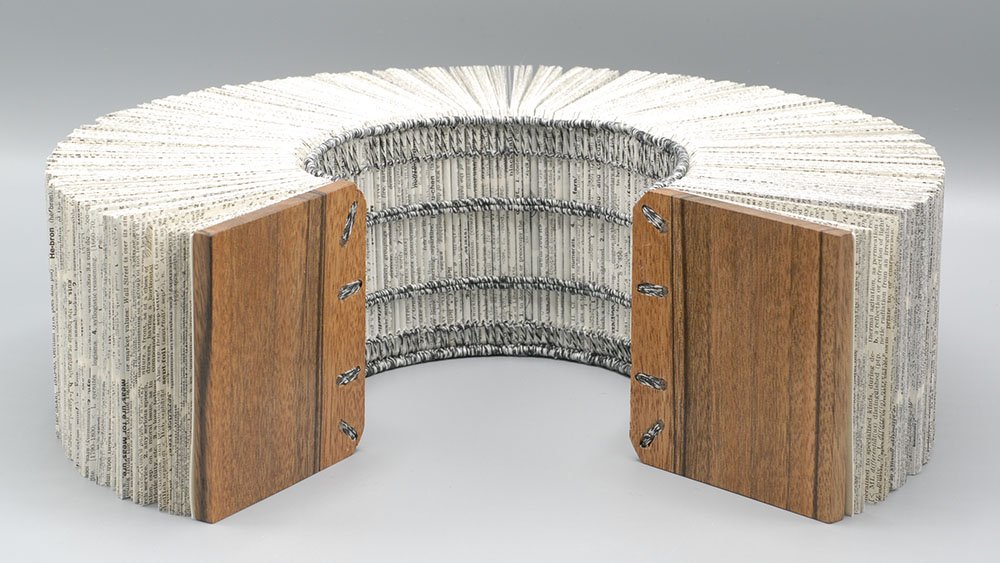
Unabridged
Linen thread, some made into sewing supports by the binder; wood boards; repurposed Random House Unabridged Dictionary pages, parchment hooked endleaves. Thread color and wood for boards vary. Created 2020.
approximately 4 x 4 x 13”
Series of 20
In late 2018 I responded to a call for entries to make a book from one volume of a 1910 encyclopedia that would otherwise have been discarded. I viewed the book as a supply of wonderfully thin but surprisingly strong paper with a lovey, subtle pattern. The strength provided by packed sewing on double cords supplemented with endbands with frequent tie-downs transformed the binding into a kind of medieval slinky.
Early in the Pandemic while I listened to my Governor's daily hour-long briefing, I began work on a series of similar but much thicker books, each made from one entire Random House Unabridged Dictionary. The bindings are stripped down to their most elemental structure: paper, linen, wood. Any ornamentation comes only from those materials: the pattern of the text, the tone and grain of the wood, the color of the thread and the sewing supports. I began to vary the later by making my own sewing cord from linen thread using historical rope-making techniques.
Note: Please note these bindings are made to order and may not be available for immediate delivery. Normal turn-around time is six months.

Discovery and exploration of the Mississippi Valley, with the original narratives of Marquette, Allouez, Membré, Hennepin, and Anastase Douay by John Gilmary Shea. Albany: Joseph McDonough 1903.
Antiquarian book on exploration of the Mississippi River disbound and signatures tacketed with goat vellum into accordion-folded historical map, Carte de la découverte faite l'an 1673 dans l'Amérique septentrionale by Jacques Marquette. Map courtesy of Library of Congress, Geography and Map Division. Letter and additional map by Marquette and portrait of LaSalle reproduced from the text and tacketed in at front. Original map also enclosed in pocket at rear of binding. All illustrations printed on Akbar Natural handmade paper from Griffen Mill. Bound 2016.
Closed: 8.75 x 7.5 x 4.25”
Open: 8.75 x 7.5 x 25”
Discovery and exploration of the Mississippi Valley, with the original narratives of Marquette, Allouez, Membré, Hennepin, and Anastase Douay is online at the Internet Archive.

Scholarly Slinky : Encyclopedia Britannica, Eleventh edition, 1910, vol. XXIV Sai to Shu
Linen thread, some made into sewing supports by the binder; walnut boards. Bound 2018.
6.25x3.75x4”
Since this volume was destined for discard and the call for entries invited participants to “do whatever they want with it,” I felt free to do just that, and viewed the book as a big ream of wonderfully thin but surprisingly strong paper. The packed sewing on double cords supplemented with endbands with frequent tie-downs combined with the content of the book in its original state transform the book into a kind of scholarly medieval slinky.

Celestial Navigation
Pigment inkjet prints
6.75x5.75x.5" closed, 17.5x 30" open
Edition of 30, out of print.
Created 2008
At once vast and minimal, sparse and rich, the night sky has always been a canvas upon which people project their myths and dreams. In Celestial Navigation a photograph of the Milky Way provides the background for an illustrated catalog of instruments used across the ages to navigate by the stars, and a 19th-century astronomical chart.
This historical content is complemented by a brief poem in which the artist looks to the night sky to recapture the memory of a long lost beloved. Celestial Navigation is constructed of ink-jet printed, hinged triangles that can be held in the hand and read page by page like a traditional book. Unfolded flat, it references historical star charts or contemporary NASA composite photographs. The book can also be folded into myriad sculptural shapes. For our entire existence as a species, we have looked to the heavens. In the night sky we see possibilities, a map to our future, a document of our past.
The panorama of deep space comprises a powerful metaphor, and in two books ... the metaphor is used to ample effect both conceptually and structurally. Celestial Navigation and Star Poems share the same structure and compositional background: a series of hinged triangle with start fields printed on deep blue. Each may be read as a traditional accordion fold, formed into myriad sculptural configurations, or unfolded flat as a kind of map referencing historical and contemporary astronomical charts.
In Celestial Navigation, the narrative evokes a deep sense of loss and longing; reaching to the stars as a way of recapturing the memory of the long-departed: 'Like ancient navigators, I look to the sky to find my way back to you.' . The diamond-shaped page-spread offers text printed against a star field on the left, mirrored by a 19th-century star chart on the right. The one-point rhythm of each page spread progresses steadily, and is resolved by a final spread of uniform space in which one can almost discern the presence of the beloved. The book has three possible spaceways: the textual narrative occupying one path, and the other two taken up with lists of astronomical instruments - particularly instruments of navigation - juxtaposed against 17th-century images of astrolabes, sextants, telescopes, and the like. — Max Yela, Head, Special Collections, University of Wisconsin Milwaukee

Destination Moon
Flag book: pigment inkjet prints
7 x 5 x 26" open
7 x 5 x .75" closed
Edition of 20, out of print
Archival photographs and documents pertaining to the Apollo Manned Space Program contrast John F. Kennedy's "Man on the Moon by the end of the decade" speech with Roy Alfred and Marvin Fisher's whimsical song (popularized by Dinah Washington), Destination Moon, about a romantic journey to the moon. Created 2003.
1984NOW
Boxed set of five flip books: laser and inkjet prints on acid-free cardstock, buckram-wrapped spine. Books presented in individual mylar sleeves, set also includes archival corrugated box. Created 2017.
2 x 5.5 x 1.25” /ea
Edition of 40
Set of five flip books inspired by the intersection of George Orwell’s 1984 and current events. Phrases from Orwell’s text morph into phrases from the headlines and back again.
Great Again suggests how 1984’s four governmental departments are manifested in 2017 America: Ministry of Truth / Lies, Ministry of Peace / America First, Ministry of Love / Law & Order, Ministry of Plenty / Defund & Privatize
Platform lists three slogans as familiar today as in Orwell’s dystopian society: War is Peace, Freedom is Slavery, Ignorance is Strength
Temperament documents many of the most common (and unconsciously self-referential) presidential words and phrases: Huge, Tremendous, Loser, Out of Control, Bad Hombre, Dangerous, Disaster, Believe Me
Topia is a reminder that one citizen’s Utopia is another’s dystopia, and how easily one can become the other.
Watching explores the seductive quality even the most dangerous leader can possess.