
DESIGN BINDINGS: Contemporary Structures
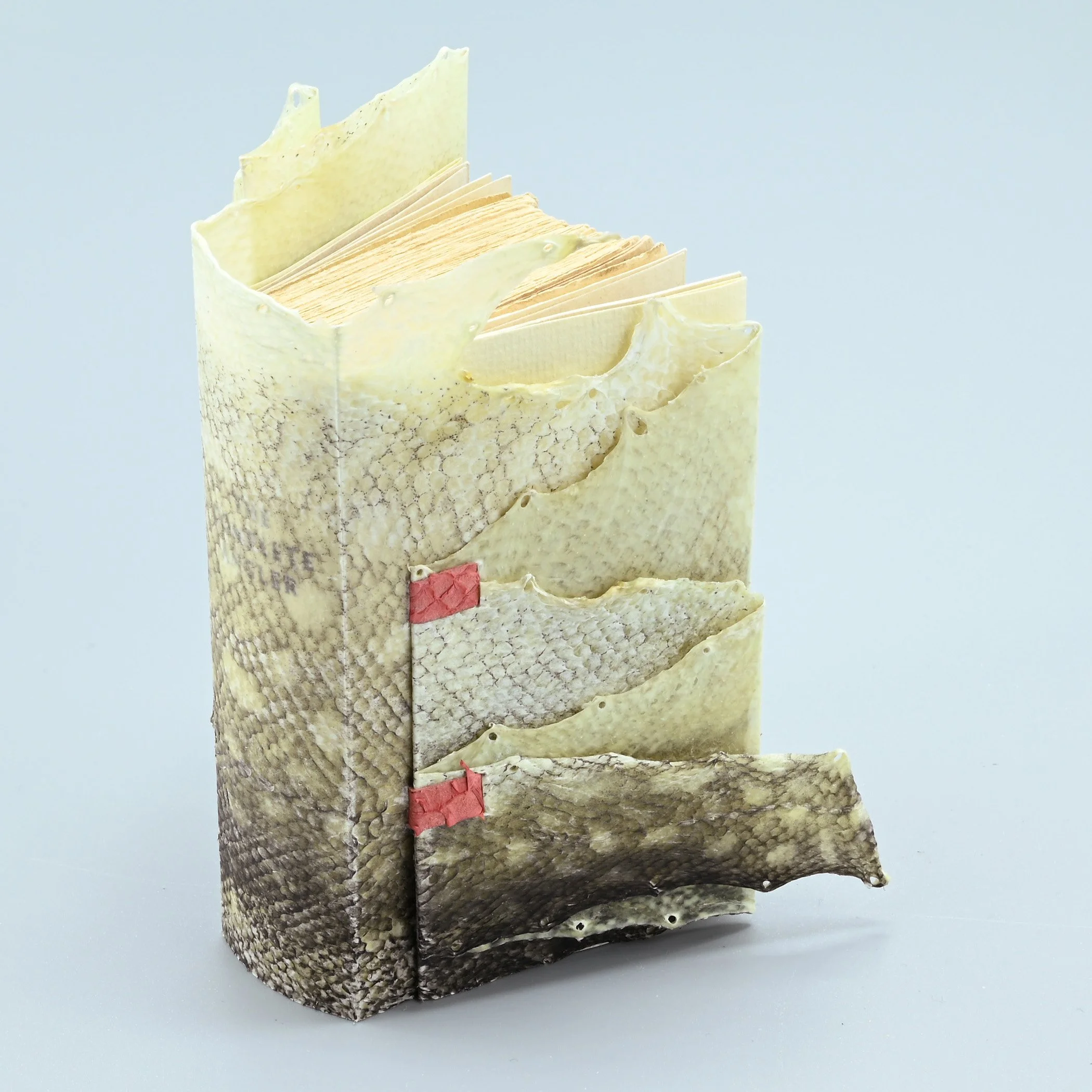
The Complete Angler, or The Contemplative Man's Recreation by Izaak Walton and Charles Cotton
London: William Pickering, 1825.
Private collection, Germany.
Laced compound folded cover binding based on a 2003 illustration by Gary Frost. Lake trout parchment processed by the binder. Sewing supports of pink salmon leather. Griffen Mill endpapers. Title inkjet-printed on Hahnemühle Ingres chemise, visible through translucent case. Bound 2026.
4 ½ x 3 ¼ x 1”
11.5 x 8 x 2.5 cm
The Complete Angler is a meditation on nature, friendship, and of course fish and fishing. First published in 1653, it remains among the most reprinted English language books. This edition, like others printed in London in the early 19th century departs from the original spelling of the title The Compleat Angler
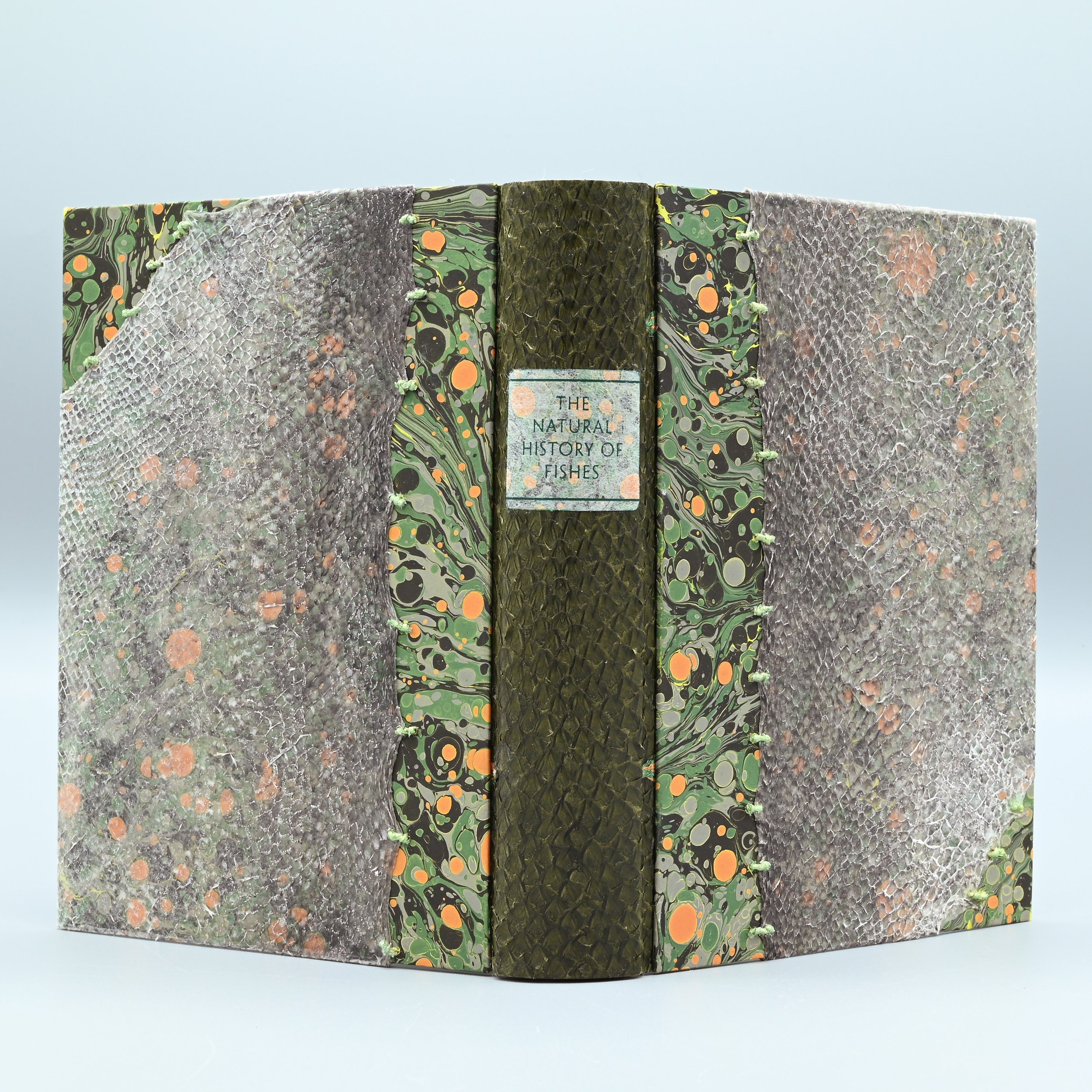
The Natural History of Fishes, particularly their structure and economical uses by J. S. Bushnan, Edinburgh: W. H. Lizars, 1840.
Award second prize in the North Bennet Street School bookbinding program 40th anniversary exhibition.
Bruce Peel Special Collections, University of Alberta
Bradel binding covered in steelhead parchment processed by the binder over marbled paper by Abra Mueller. Boards laced on with bespoke two-color, linen sewing cords. Spine wrapper of green salmon leather. Attachment of parchment to the boards is reinforced with steelhead parchment tackets painted with green watercolor that includes mica. Sewn on guards to permit full opening to the color plates.
Hahnemühle Ingres endpapers with Bugra flexi flyleaves and pastedowns. Rolled Japanese tissue endbands. Head and tail of spine wrapper painted with shell gold. Label of Japanese tissue over marbled paper, title stamped in dark green foil. Bound 2026.
6 7/8 x 5 ¼ x 1 ¼”
17.5 x 13 x 3.25 cm
This volume from a mid 19th century natural history series includes 32 hand-colored plates of fish in vaguely whimsical environments. I wished to create an aquatic context for the illustrations.
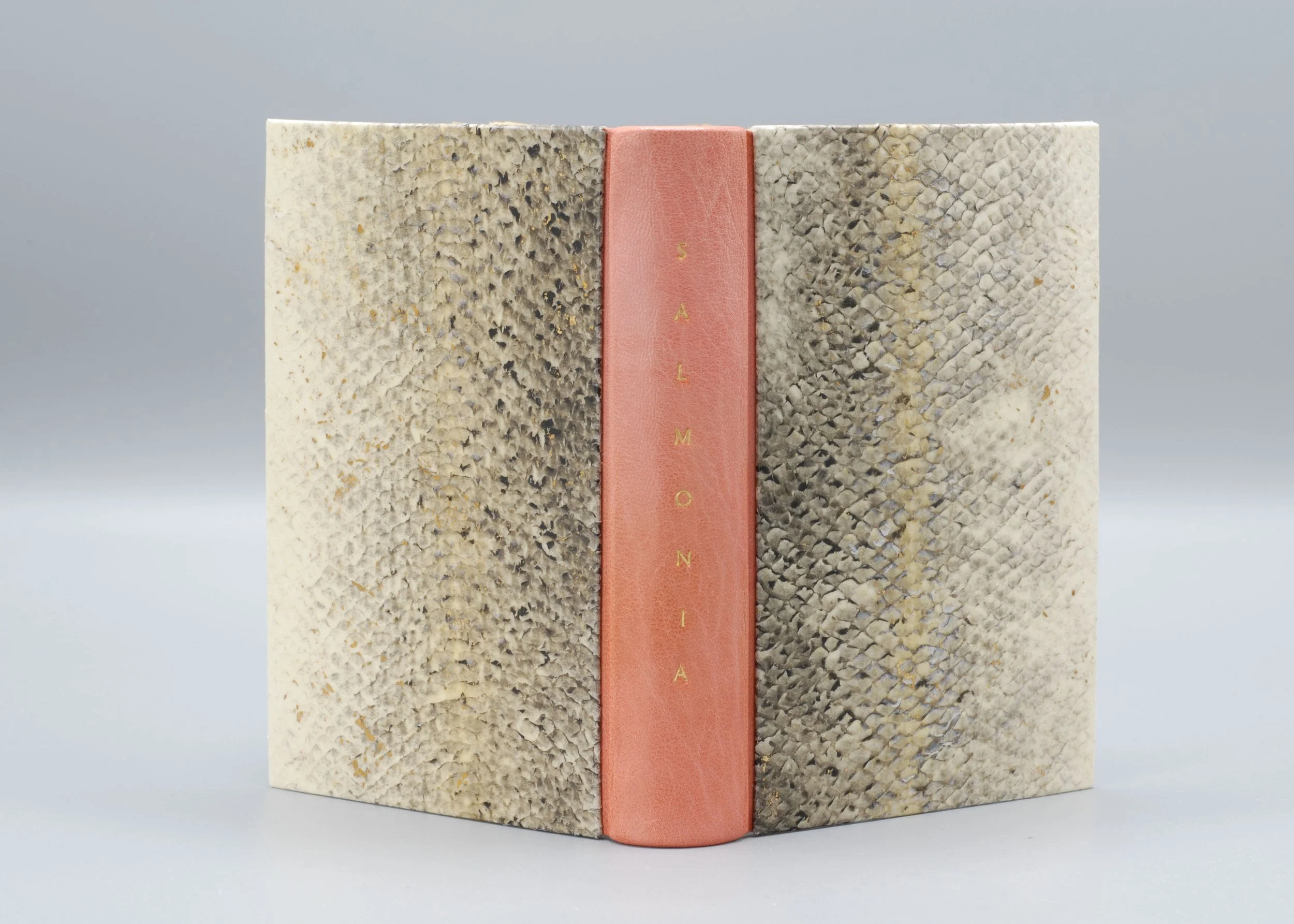
Salmonia: Or Days of Fly Fishing. In A Series Of Conversations. With Some Account Of The Habits Of Fishes Belonging To The Genus Salmo, by Sir Humphrey Davy. London: John Murray, 1834.
Bound with Atlantic salmon parchment processed by the binder, goatskin spine, and rolled leather endbands. Modified simplified/bradel structure. Original sewing retained, leaving original marbled edges undisturbed. Title hand-tooled in gold leaf, boards casually gilt with gold foill and a tacking iron. Ruscombe Mill endpapers.
6.5 x 4.5 x 1.25"
16 x 11 x 3 cm
I channeled much of my COVID restlessness into fish shopping; processing fish parchment; searching for small, fish-themed antiquarian books; and exploring modest, conservation-friendly structures to wed these activities. This volume by British scientist Humphrey Davey continues the tradition of The Compleat Angler, as an extended reflection on science, nature, and the human condition through the lens of fly fishing. The book contains six engravings and a sprinkling of woodcuts of fish in vaguely whimsical environments.
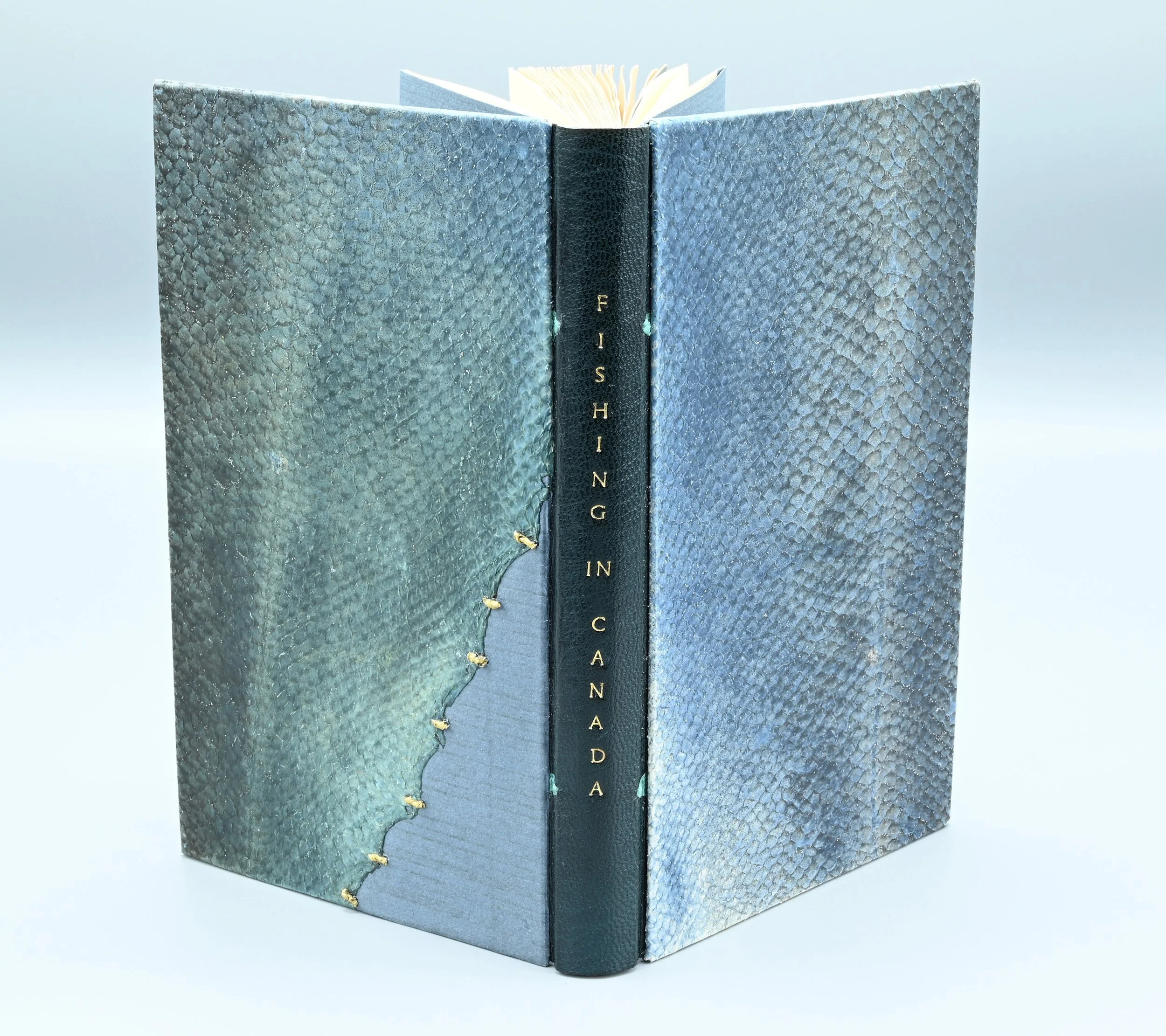
Fishing in Canada. Montreal: Canadian National Railways, ca 1930.
Aspects of exposed structure are part of the aesthetic of this Even More Simplified binding. Boards covered in coho salmon parchment processed by the binder and dyed in indigo, pomegranate and cochineal. Parchment backed with Roma handmade paper, some visible on the rear board. Goatskin spine wrapper laced on with linen sewing cords made by the binder. Attachment of parchment to the boards is reinforced with salmon parchment tackets, these and the endcaps are painted with shell gold. Hahnemühle Ingres endpapers with Roma flexi flyleaves and pastedowns. Rolled leather endbands. Hand titled in 22 kt gold foil. Bound 2025.
8 3/16 x 5 x 7/8”
20.7 x 12.7 x 2.3 cm
The book, missing the original cover, which was scanned and printed from a similar edition, was a garage sale find, a gift from a colleague. A 1923 edition of the missing map was located online, printed on handmade Akbar paper, and sewn in on a guard. Map courtesy of the University of British Columbia Library Digitization Centre and its generous donors. <http://dx.doi.org/10.14288/1.0343188>
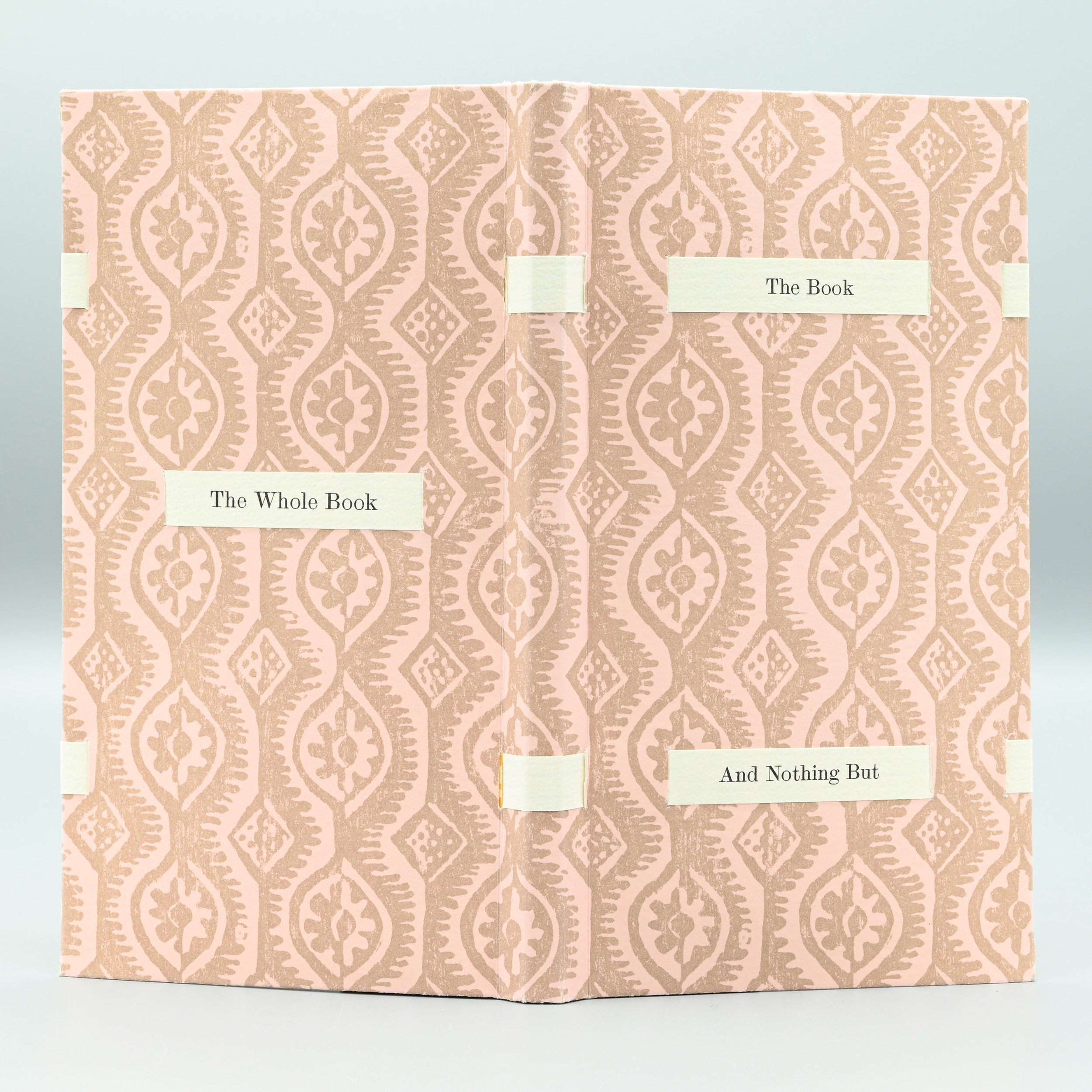
The Book, The Whole Book, and Nothing But by Graham Moss. Oldham, UK: Incline Press, 2024
Paper case featuring two papers by Peggy Angus, chosen to echo the Incline Press’s 2004 book on the artist and to mark the press's move to Scotland. Sewn unsupported, straps of handmade Roma paper lace the book block into the case. Prospectus bound in. Bound 2025.
8 ⅜ x 4 5/8 x ⅜”
21 x 11.5 x 1 cm

Grimoire: New Scottish Folk Tales poems by Robin Robertson, drawings by Tim Robertson. Rochdale, England: Andrew J. Moorhouse, 2022.
Bradel binding. Boards and spine covered in deer parchment. Rolled leather endbands, head decorated in multicolor sponged acrylic, acrylic pochoir across boards, hand-titling in brown foil. Brown Roma flexi endpapers. Bound 2025.
10 5/8 x 7 1/16 x 11/16”
27 x 18 x 1.5 cm
Robertson’s poems are dark, mysterious, primal, and filled with allusions to the natural world. An illustration from the text was stenciled onto boards covered in deer parchment that was purchased already mottled and distressed.

Peggy Angus: Designer, Teacher, Painter by James Russell.
Woodbridge, Suffolk: Antique Collectors' Club, 2014.
This binding was awarded the 2025 Helen Warren DeGolyer Award for Excellence in Fine Binding.
Peggy Angus (1904-1993) was a Scottish artist best known for her murals, tiles and wall paper designs.
Bradel binding. Boards and spine covered in wallpaper with décor of swatches of wallpaper and fabric samples designed by Peggy Angus. Trade book disbound and sections guarded with Japanese tissue, bookblock sewn on individual stubs, guards and stubs of multiple colors to reflect Angus’s color palette. Titling inkjet-printed on Roma paper, fonts match those used in the design of the trade binding. Rolled paper endbands, endcaps colored with acrylic. Roma flexi endpapers. Original dust jacket and flyleaves bound in. Bound 2025.
9.75 x 8.5 x 1.25”
24.5 x 21.5 x 3.2 cm

One comedy, one tragedy, one history and the series prospectus from the Limited Editions Club The Plays of William Shakespeare (1939-1940) bound together to approximate the size and heft of a First Folio. Included are TheTaming of the Shrew illustrated by W. A. Dwiggins, Antony and Cleopatra illustrated by Enric C. Ricart, and Henry the Eighth illustrated by Eric Gill.
Bradel binding: goatskin spine with false bands, handsewn silk endbands, marbled flexi endsheets, edges sprinkled in white acrylic. Vellum boards laser etched with the two most recognizable pages from the First Folio: the title page bearing the Martin Droeshout portrait of William Shakespeare and Ben Johnson’s dedication. Blind tooling on spine and as a frame around both boards. Digital images of the First Folio courtesy of the Library of Congress. Laser etching by Insiya Dhatt. Bound 2025.
This austere binding mirrors Johnson’s exhortation to “dwell not upon the physical book but on the words within.”
33 x 23 x 4.5 cm
13 x 9.25 x 2”
This binding was created for Durham University’s Binding the Bard competition. A proposal for binding a facsimile of Durham’s first folio, it returns the iconic pages that were removed after its 1998 theft: the title page bearing the Martin Droeshout portrait of William Shakespeare and the facing page with the dedication by Ben Johnson.
This marriage of traditional materials and contemporary technology honors the past while creating a modern binding for this four-hundred-year-old work.
The binding structure echoes this melding of classical and modern: viewed from the spine the binding appears to be sewn like the original on five raised supports laced into boards. When open the book reveals the contemporary lines of a three-part Bradel binding.
Natural markings visible on the vellum suggest the age of the First Folio and in particular the storied history of Durham University’s copy.

The Natural History of Fishes, particularly their structure and economical uses by J. S. Bushnan, Edinburgh: W. H. Lizars, 1840.
Collection of Michigan State University
Aspects of exposed structure are part of the aesthetic of this Even More Simplified binding. Spine wrapper and boards covered in bespoke marbled paper by Pamela Smith, laced on with two color, linen sewing cords made by the binder. Boards also covered in Atlantic salmon parchment processed by the binder. Attachment of parchment to the boards is reinforced with salmon parchment tackets.
Hahnemühle Ingres endpapers with Roma flexi flyleaves and pastedowns. Tackets and head and tail of spine wrapper painted with amethyst watercolor that includes mica. Rolled leather endbands. Some sections remain uncut. Title stamped in dark blue foil. Bound 2024.
This binding received the Highly Commendable: Hidden Gems designation in the 2025 OPEN•SET exhibition.
6 7/8 x 4 ¾ x 1 ¼”
17.5 x 12 x 3.25 cm
This volume from a mid 19th century natural history series includes 32 hand-colored plates of fish in vaguely whimsical environments. I wished to create an aquatic context for the illustrations.

The Helen Fragments: from books three & six of Homer's Iliad. Translated by Richard Seibert, illustrated by Winifred McNeill.
Berkeley: Editions Koch, 2003.
Collection of the University of Chicago
Bradel binding in full goatskin. Inlays of papyrus calligraphed with carbon ink applied with a reed pen, edges of cavities colored with acrylic. Inlaid goatskin lines. Head sponged in multi-colored acrylic to mimic papyrus. Title hand-tooled in black foil, hand-sewn, single-color endbands. Flexi endsheets of Cave paper. Bookblock sewn on individual stubs. Bound 2024.
28.5 x 16 x 30 cm
11 ¼x 6 ⅜ x 1 ¼”
Helen appears only six times in The Iliad. The design of six faux ancient papyrus fragments is inspired by a visit to the University of Michigan Library’s Papyrology Collection. With more than 18,000 items, it is the largest collection of ancient papyrus in North America. Even the tiniest bits are preserved and studied, potentially changing the meaning of long-settled texts. My color palette is borrowed from ancient Greek pottery.
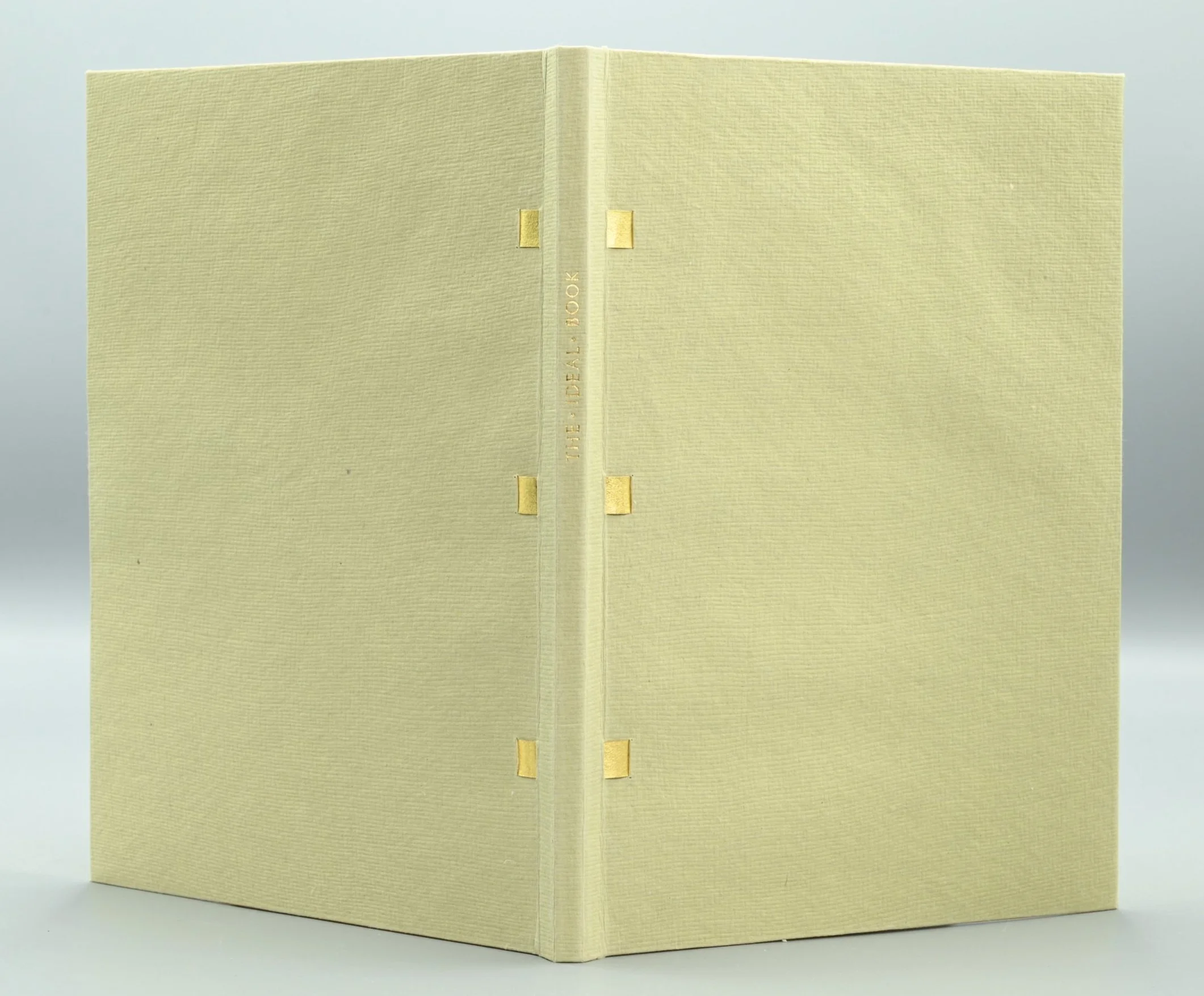
The Ideal Book or Book Beautiful: A Tract on Calligraphy, Printing and Illustration & on the Book Beautiful as a Whole by T.J. Cobden-Sanderson
A facsimile of the 1900 Dove’s Press original. Tucson, AZ: Ampersand Studios, 2022.
Limp case of pale green Khadi handmade cotton paper, Ruscombe Mill Chateau Vellum handmade paper sewing supports and edges of case gilt with 23 kt gold foil. Binding sewn with green thread in the style of the Doves Bindery. Bound 2024.
9.25 x 6.75 x .25”
23.5 x 17 x .75 cm
I wanted a modern, flexible, enthusiastic-opening update to the original limp vellum case. I chose green case paper to reference the Doves Bindery’s use of green sewing thread for their limp bindings. The gratuitous use of gold is a nod to the work of Cobden-Sanderson. The titling mirrors the shop’s distinctive signature THE • DOVES • BINDERY
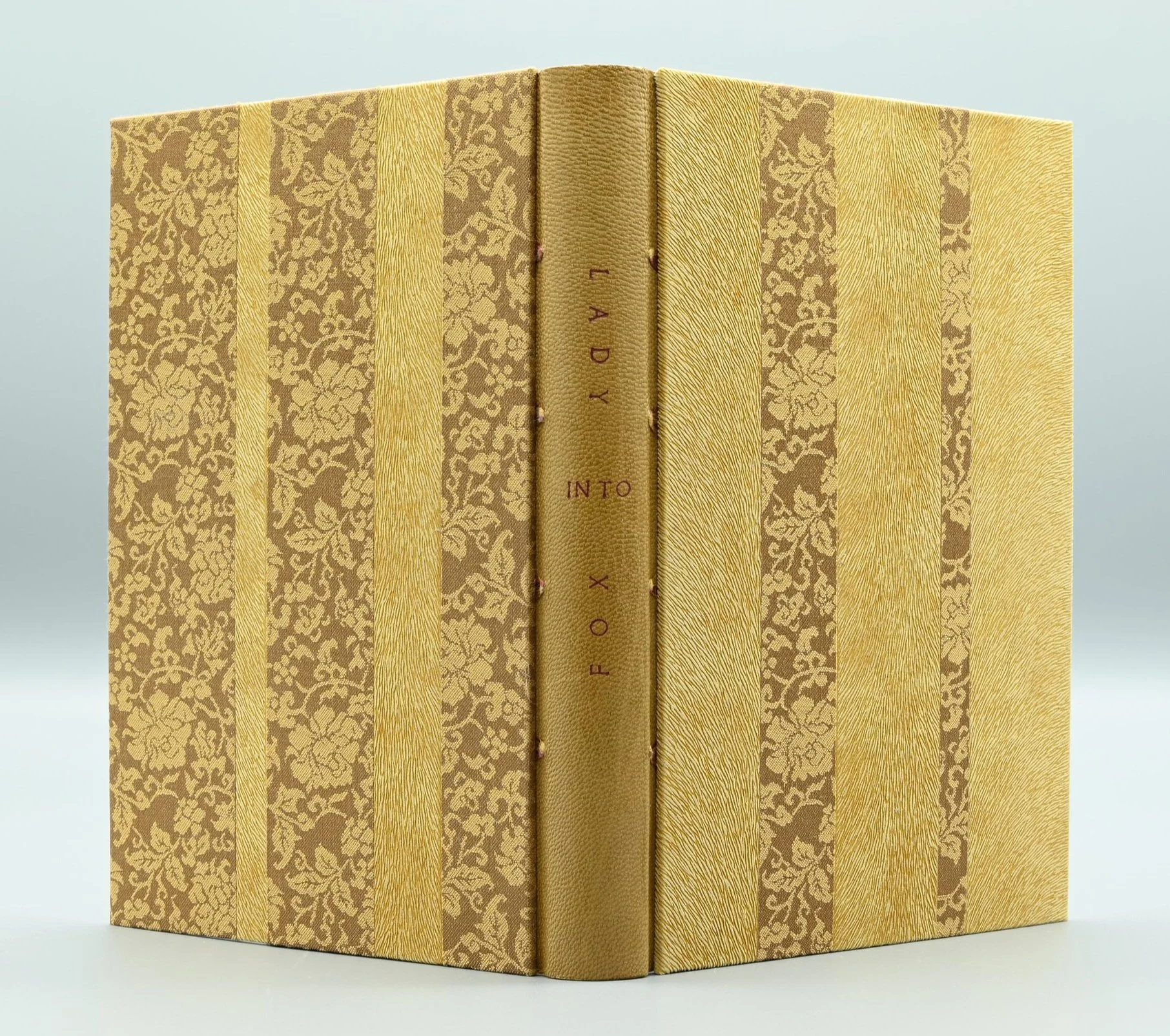
Lady Into Fox by David Garnett, illustrations by R. A. Garnett.
London: Chatto and Windus, 1922. First edition.
Collection of the University of Chicago
This binding will be traveling with Night Circus: the Guild of Book Workers Triennial Exhibition.
7 3/4 x 5 1/4 x 3/4"
19.5 x 13.5 x 2 cm
Goatskin spine wrapper laced on with two color, linen sewing cords made by the binder. Board covered in alternating strips of Japanese and Lynel fur bookcloths. Hahnemühle Ingres endpapers with Roma flexi flyleaves and pastedowns. Rolled leather endbands. Headcaps painted with gold acrylic. Original gilt head. Title hand-tooled in dark red foil. Aspects of exposed structure are part of the aesthetic of this Even More Simplified binding. Bound 2024.
Early in 1880 a young couple went for a walk in the English countryside. Suddenly and completely the woman became a fox. As time passed she fully embraced her new form, as her husband sometimes reluctantly, sometimes eagerly adapted to their evolving relationship. Lady Into Fox tells their story, and this transformation is stylized from left to right across the binding.

Le Calumet by André Salmon, illustrations by André Derain. Paris: Éditions de la Nouvelle Revue Française, 1920
Private collection
Cave paper case, sewing supports of lake trout parchment processed by the binder, walnut veneer flyleaves, Hahnemuhle Ingres endpapers. Original paper wrapper backed with Ruscombe Mill handmade paper and bound in. Ruscombe Mill laser-printed label fixed with methyl cellulose. Laced compound folded cover binding based on a 2003 illustration by Gary Frost. Matching clamshell box also in Cave paper and lake trout parchment. Bound 2024.
17 x 13 x 1.5 cm
6 5/8 x 5 3/16 x ¾”
The title poem is the melancholy reflections of an Indigenous American while enjoying his last remaining comfort, his pipe. I chose a palette reminiscent of the historical wilderness of the Great Lakes region, thinking descriptions of this area by French explorers would have informed how the author viewed the land and its history. Honoring the client’s request for unusual materials, the dark and mottled Cave paper resembles a cured tobacco leaf, the natural spotting of the Lake Trout echoes the irregular dots making up Derain’s distinctive wood engravings, and the dark wood veneer flyleaves place the reader in a melancholy forest.
The text block is hand-sized and hand-shaped: not quite square but less vertical than the typical text block shape. The flexible paper case encourages the reader to handle the binding and feel its organic textures.

The Complete Angler, or The Contemplative Man's Recreation by Izaak Walton and Charles Cotton
London: William Pickering, 1825.
Collection of the University of Chicago
Laced compound folded cover binding based on a 2003 illustration by Gary Frost. Lake trout parchment processed by the binder. Roma paper spine lining and two-ply, laminated sewing supports. Ruscombe Mill endpapers. Title stamped in dark green foil, visible through translucent case. Bound 2024.
4 x 4 1/4 x 1”
10 x 10.5 x 2.5 cm

Lady Into Fox by David Garnett, illustrations by R. A. Garnett. First published in 1922 in London by Chatto and Windus. The text and images for this edition were downloaded from public domain sources and formatted by the binder in 2023 for students in her fine binding workshops.
Goatskin spine wrapper laced on with two-color linen sewing cords made by the binder. Boards a multi-color laminate of Murillo paper, topped with alternating strips of Lynel fur bookcloth and goatskin. Bugra endpapers. Rolled leather endbands. Headcaps painted with gold acrylic. Hand titled in 22 kt gold foil. Aspects of exposed structure are part of the aesthetic of this Even More Simplified binding. Bound 2024.
7 1/4 x 4 3/4 x 3/4”
18 x 12.5 x 2 cm
Early in 1880 a young couple went for a walk in the English countryside. Suddenly and completely the woman became a fox. As time passed she fully embraced her new form, as her husband sometimes reluctantly, sometimes eagerly adapted to their evolving relationship. Lady Into Fox tells their story, and this transformation is stylized from left to right across the binding.

A Midsommer Nights Dreame by William Shakespeare, illustrations by Paul Nash.
London: Ernest Benn Limited, 1924.
Collection of the University of Chicago
This binding will be traveling with Night Circus: the Guild of Book Workers Triennial Exhibition.
Bradel binding. Goatskin spine with gold acrylic craquelure. Boards a multi-color laminate of Murillo paper topped with Lynel fur bookcloth, various Cave papers, gilt paper by Papillion Press, and wood veneer of wenge and ebony. Ruscombe Mill endpapers with Cave pastedowns and flexi flyleaves. Rolled leather endbands. Gold leaf sprinkled over graphite head. Title stamped in 22 kt gold foil. Bound 2024.
12 3/4 x 10 x 1 1/4”
32 x 25.5 x 3 cm
The heart of A Midsommer Nights Dreame is a magical night in an enchanted forest: a topsy-turvy world of mistaken identities, romance, alternating flashes of confusion and insight, and a healthy sprinkling of fairy dust.
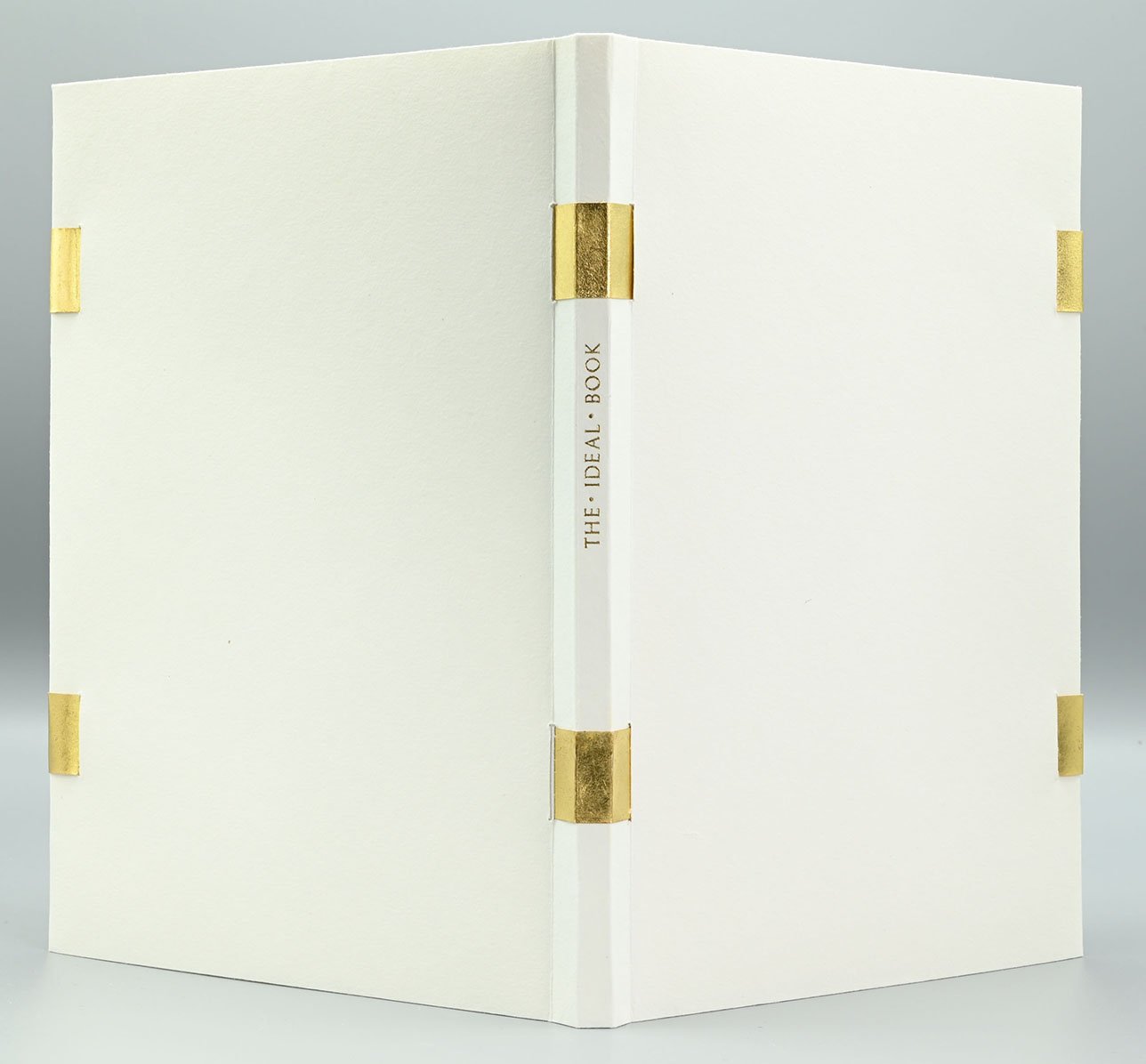
The Ideal Book or Book Beautiful: A Tract on Calligraphy, Printing and Illustration & on the Book Beautiful as a Whole by T.J. Cobden-Sanderson
A facsimile of the 1900 Dove’s Press original. Tucson, AZ: Ampersand Studios, 2022.
Limp case of Ruscombe Mill handmade linen paper. Vellum straps gilt. Binding sewn with green thread in the style of the Doves Bindery. Bound 2024.
9.25 x 6.75 x .25”
23.5 x 17 x .75 cm
I wanted a modern, enthusiastic-opening update to the original limp vellum case. I chose a paper to match rather than contrast the very bright white text. The green thread, use of at least some vellum, and the gratuitous use of gold are all nods to the work of Cobden-Sanderson. The titling mirrors the shop’s distinctive signature THE • DOVES • BINDERY
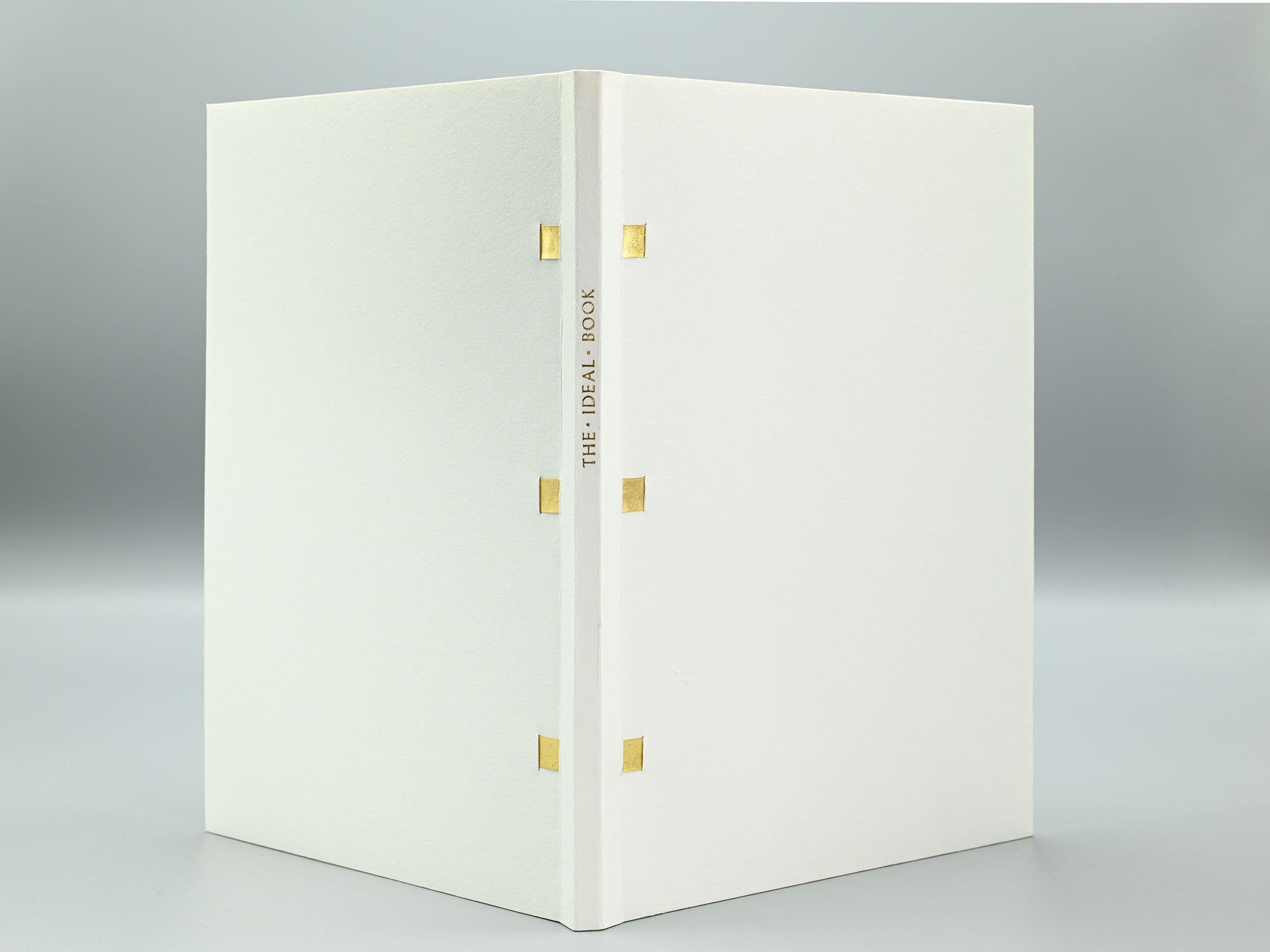
The Ideal Book or Book Beautiful: A Tract on Calligraphy, Printing and Illustration & on the Book Beautiful as a Whole by T.J. Cobden-Sanderson
A facsimile of the 1900 Dove’s Press original. Tucson, AZ: Ampersand Studios, 2022.
Collection of University of Chicago
Limp case of Ruscombe Mill handmade linen paper, vellum sewing supports and edges of paper case gilt. Binding sewn with green thread in the style of the Doves Bindery. Bound 2024.
9.25 x 6.75 x .25”
23.5 x 17 x .75 cm
I wanted a modern, enthusiastic-opening update to the original limp vellum case. I chose a paper to match rather than contrast the very bright white text. The green thread, use of at least some vellum, and the gratuitous use of gold are all nods to the work of Cobden-Sanderson. The titling mirrors the shop’s distinctive signature THE • DOVES • BINDERY

Orlando by Virginia Woolf
Glenview, IL: Karen Hanmer Book Arts, 2024.
private collection
Laced compound folded cover binding based on a 2003 illustration by Gary Frost. Surface gilding on the vellum supports, fore edges gilt with 22 kt gold foil. Cover is a laminate of screen-printed flowers over vintage printed text by Vintage Paper Co, and pink handmade paper by Katie MacGregor. Green Roma endsheets, text sewn with pink thread. Bound 2024.
7 x 4 ½ x 1”
18 x 12 x 2.5 cm
Virginia Woolf’s Orlando follows the eponymous British aristocrat across three centuries and an abrupt transformation from man to woman. This binding is a mix of vintage and antiquarian techniques and materials. The text on the decorative paper is from a history of England, this page is titled “Before the Restoration.”
The text block was created for my 2024 leather binding students. It is available in unbound sheets.
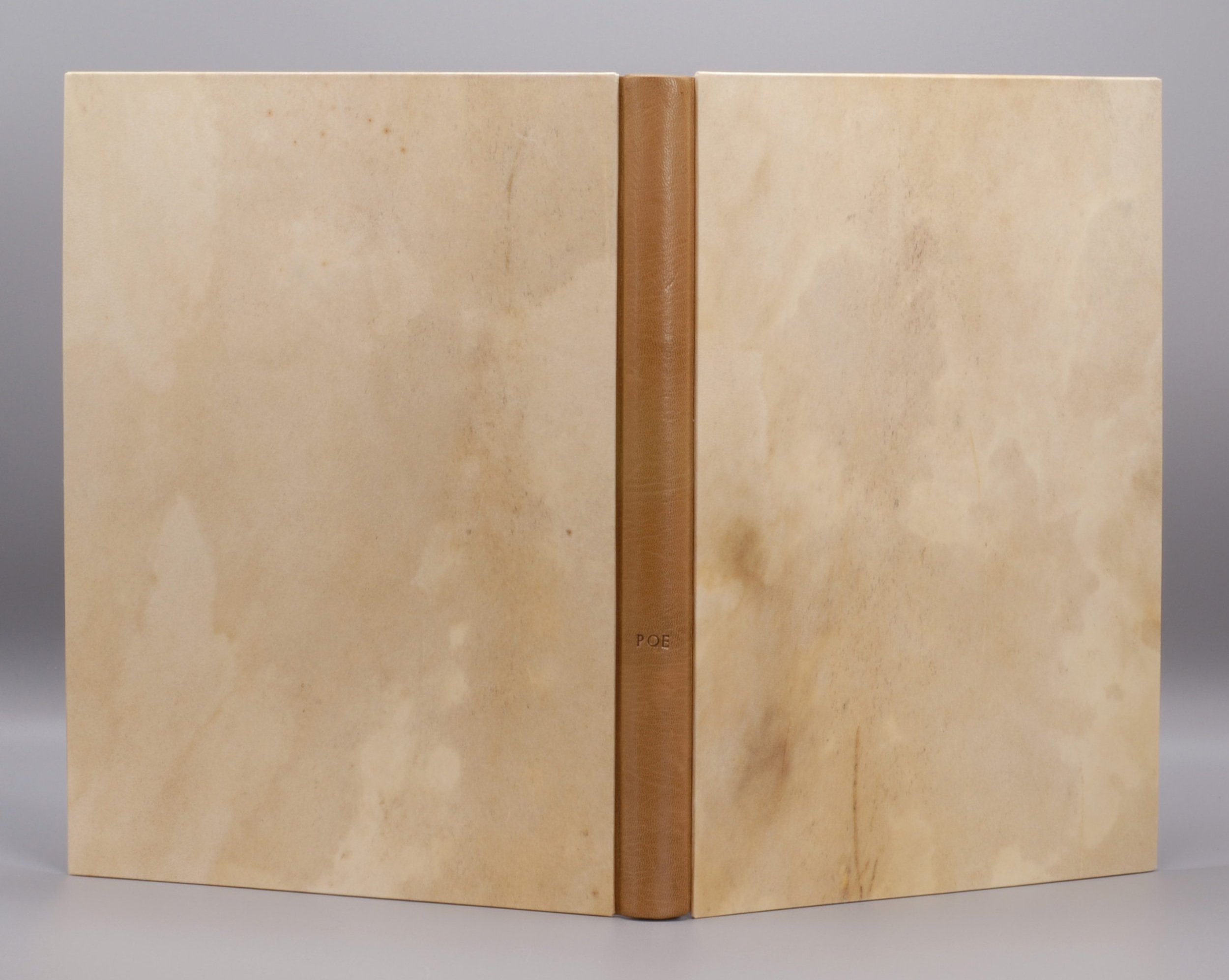
Poe’s Phantasia by Edgar Allan Poe, illustrated by Natalie Frank.
San Francisco: Arion Press, 2022.
Private collection, France
Bradel binding. Boards covered in mottled and distressed deer parchment: Goatskin spine, rolled leather endbands, graphite head, hand-titling in brown foil. Brown Roma flexi endpapers. Bound 2023.
12 3/8 x 9 1/2 x 1"
32 x 23 x 3 cm
For this illustrated collection of Poe stories I designed a restrained binding, something quietly ominous that would not compete with the text’s vivid illustrations. This is #58 of the edition. Signed by the artist. Prospectus bound in.
From the Arion Press website:
The great master of the macabre, Edgar Allan Poe, earned his living writing stories for American magazines between 1830 and his death at the age of 40 in 1849. In his short lifetime he became the pre-eminent chronicler of the unquiet mind. Fourteen of these unnerving tales and four poems are collected in Arion’s presentation. The set is composed of Poe’s Phantasia and the companion volume The Raven. The former contains three sections: “Fantasies,” “Fantasias,” and “Fever Dreams,” each of which is introduced by a celebrated poem. The Raven companion volume features seven brilliant gouache-and-chalk pastel drawings by Natalie Frank which bring into focus Lenore, the flesh-and-blood woman whose loss inspired one of the most famous refrains in English literature: Nevermore.

Lowlands Away, written and illustrated by Adrian Henri
Bath: Old School Press, 2001
Even More Simplified binding structure. Pink goatskin spine wrapper laced on with binder-made linen sewing supports. Boards a multi-color laminate of Colorplan paper, topped with stone veneer. Rolled leather endbands. Bugra flexi endpapers. Title carbon tooled down spine. Bound 2022 as the set book for the Hand Bookbinders of California 50th anniversary exhibition.
27 x 20 x 1.25 cm
10.75 x 7.75 x .5”
From the Old School press website:
Adrian Henri wrote ten poems as texts for an oratorio by Richard Gordon-Smith for soloists, chorus and orchestra, which has recently been recorded on CD by the Royal Liverpool Philharmonic Orchestra. It tells the story of the loss at sea of the Thames and Medway barge Cynthia, commanded by the composer's great-grandfather, a century before in 1896, and of his last words to his wife, cast into the sea in a bottle and subsequently forwarded to her.
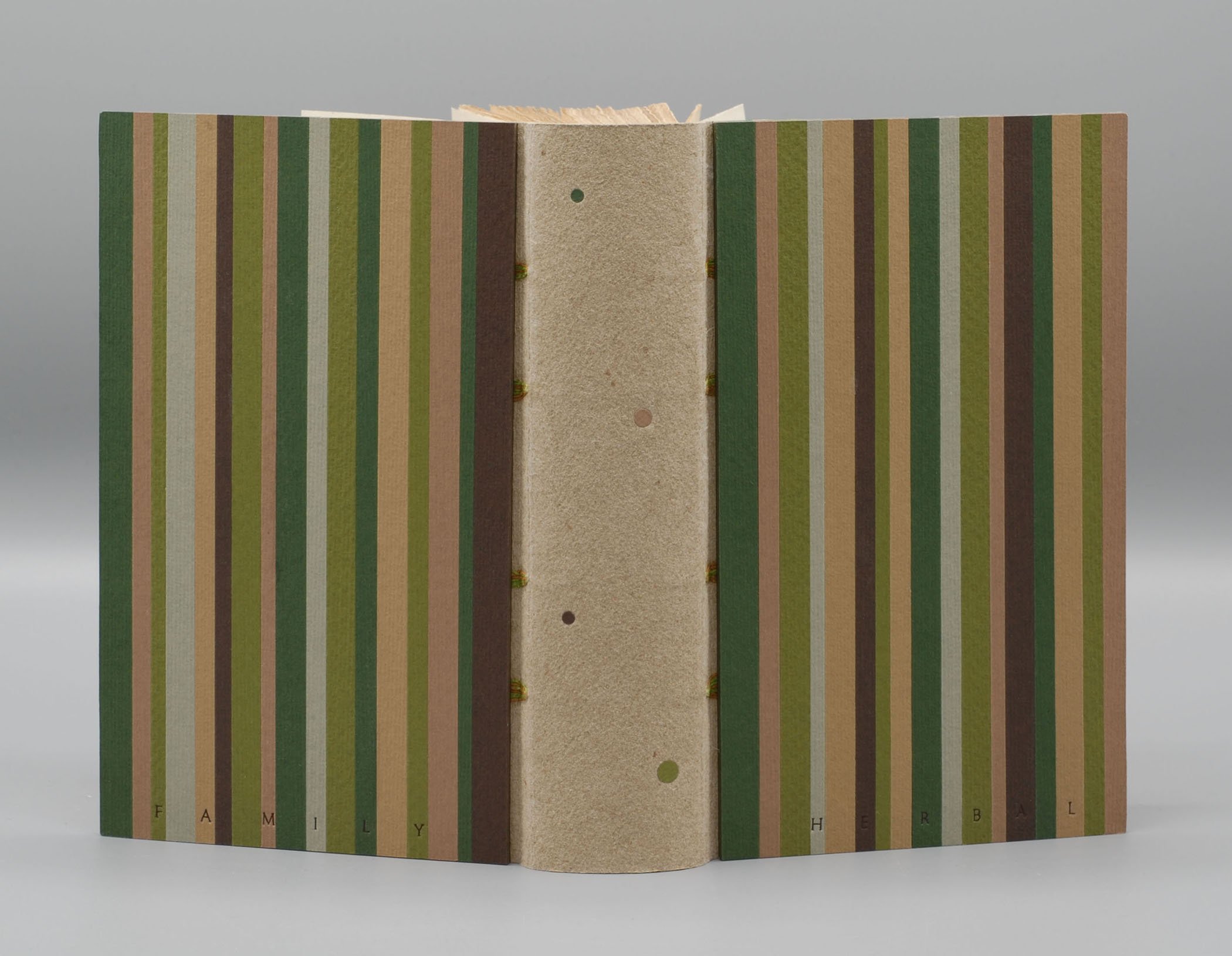
The Family Herbal , or an account of all those English plants, which are remarkable for their virtues, and of the drugs which are produced by vegetables of other countries; with their descriptions and their uses, as proved by experience. also, Directions for the gathering and preserving roots, herbs, flowers, and seeds; the various methods of preserving these simples for present use; receipts for making distilled waters, conserves, syrups, electuaries, juleps, draughts, etc. etc. with necessary cautions in giving them. Intended for the use of families. by Sir John Hill, M.D.
Bungay: C. Brightly and T. Kinnersley, ca. 1812-1820
Even More Simplified binding. Cave paper spine wrapper laced on with binder-made green and brown linen sewing supports. Boards a five-layer, multi-color laminate of Murillo. Green tissue rolled endbands. Ruscombe Mill endpapers. Includes 54 hand-colored plates. Bound 2021.
21 x 14 x 5 cm
8 ¼ x 5 ½ x 2”
Paper seemed so much more appropriate than leather for this herbal intended for home use. Colors drawn from the text’s fifty-four hand-colored illustrations.

The Farm by Wendell Berry, Larkspur Press, 2013
Private collection, Massachusetts, USA
6.25 x 4.25 x .5”
Design of foil tooling on Khadi handmade paper reflects the text, which follows the activities on a Kentucky farm through the seasons from autumn to autumn. Bound 2016.

Happy Abstract by William Blake. New York: Russell Maret, 2018.
Archival Sewn Boards Binding, developed by Gary Frost. Wrapper of laminated Nideggen paper, with additional folios of inserted into the text block. Sewn with Londonderry linen thread in beige to match. Selected phrases on wrapper are drawn from the text. Bound 2019.
22 x 16 x 2.5 cm
An informal, semi-limp structure was chosen to bind this intimate letter. Cut-outs in blank folios inserted into the text block reveal key passages, abridging the flowery prose and clarifying the author’s message. A matching wrapper and complete lack of ornamentation save for a repetition of select phrases further focus the reader on the text. The integral wrapper consolidates the pages for comfortable hold-in-one-hand reading. Sewn with a stub into the rear of the binding, the other end is tucked into the front of the binding and can easily unfold to extend the wrapper for exhibit.

Flats, Urban Houses and Cottage Homes; a companion volume to "The British home of to-day" by Frank T Verity, Edwin Thomas Hall, Gerald C Horsley, and Walter Shaw Sparrow. London: Hodder and Stoughton, 1906.
Pigment inkjet printing on Griffen Mill Akbar, steel brads, acrylic. Elevations and pans on boards and endpapers from the text. Bound 2019.
11 5/8 x 8 7/8 x 1 3/16”
A vintage blueprint motif on an all-paper binding is most appropriate for this book of plans and elevations for turn of the century urban residential architecture. Likewise the New Oriental Binding structure was chosen for its visible, linear structure and architectural feel.

The Art of the Book: A review of some recent European and American work in typography, page decoration & binding edited by Charles Holme. London, Paris, New York: "The Studio" Ltd. , 1914
New Oriental Binding in full paper: pigment inkjet printing on Griffen Mill Akbar. Sewn on Tyvek stubs. Bound 2019.
11 13/16 X 8 7/8 x 1 5/16”
Douglas Cockerell essay on the nature of fine binding from the text printed onto boards and endpapers.
Excerpt from the essay:
Fine or “extra” binding as it is called in the trade implies that the craftsman has done his best with the best materials. It may be plain or decorated, but whatever work there is should be the best of which the craftsman is capable. There are some qualities that are common to all well-bound books. Of course abnormal books have to be treated specially, but it may generally be said that every leaf of a book should open right to the back. The sections should be sewn to flexible cords or tapes, the ends of these should be firmly attached to the boards, and the back should be covered with some flexible material, such as leather, which, while protecting the sewing-thread or cord, shall itself add to the strength of the binding. A fine binding will have many other features added by way of refinement or elaboration, but unless it has these qualities it is likely to be an unsatisfactory piece of work…
Fine binding is an expensive luxury but not an unreasonable one compared with many others. We have now in England a school of really fine binding, and the most reasonable and unobjectionable form that luxury can take is the use of beautiful things in everyday life. If a book is well bound and well decorated it is fit to use, and in choosing a book to be expensively bound it would be better to choose the book most often used than one which would be put away unopened. Most fine bindings would be greatly improved by use, and the reasonable using of them would give immense pleasure, a pleasure that would justify the binder’s care and trouble and the purchaser’s outlay. The use of a beautiful thing gives a far higher form of pleasure than does the mere sense of ownership.

The Vicar of Wakefield by Oliver Goldsmith. New York: George Long, 1823.
Text block sewn unsupported, laced with Cave paper straps into limp case of Katie MacGregor paper. Additional decorative lacing of a stylized “V” and “W”. Bound 2020.
6 x 3.25 x 1”
15 x 8.5 x 2 cm
This binding was in response to a student asking for an example of decorative lacing on a paper case. The 1766 novel was hugely popular in Victorian England. It was name-checked in Frankenstein and included in the ship library of the doomed Franklin Expedition. A random opening reveals the compelling prose, “‘Villain indeed,’ cried I”.

A Natural History of the most remarkable Quadrupeds, Birds, Fishes, Serpents, Reptiles and Insects by Mrs. Mary Trimmer. Chiswick: C. and C. Whittingham, 1826. Volume 1 of 2.
Bound in Hook BK case paper, case sprinkled with acrylic ink, text sewn w/colored thread to match. Text from the title “most remarkable” laser-printed onto Kizukishi and pasted inside front and rear of case. Handmade paper label and endpapers, label stamped with pigment foil. Bound 2020.
13.5 x 8 x 2 cm
5.25 x 3.5 x .75”
I’ve been binding antiquarian books in the various structures I teach to have examples for my students. I wanted to have fun with the grandiose title of this book.

Discovery and exploration of the Mississippi Valley, with the original narratives of Marquette, Allouez, Membré, Hennepin, and Anastase Douay by John Gilmary Shea. Albany: Joseph McDonough 1903.
Antiquarian book on exploration of the Mississippi River disbound and signatures tacketed with goat vellum into accordion-folded historical map, Carte de la découverte faite l'an 1673 dans l'Amérique septentrionale by Jacques Marquette. Map courtesy of Library of Congress, Geography and Map Division. Letter and additional map by Marquette and portrait of LaSalle reproduced from the text and tacketed in at front. Original map also enclosed in pocket at rear of binding. All illustrations printed on Akbar Natural handmade paper from Griffen Mill. Bound 2016.
Closed: 8.75 x 7.5 x 4.25”
Open: 8.75 x 7.5 x 25”
Discovery and exploration of the Mississippi Valley, with the original narratives of Marquette, Allouez, Membré, Hennepin, and Anastase Douay is online at the Internet Archive.
Slaughterhouse-Five by Kurt Vonnegut, illustrations by Julian De Narvaez. Irvine, CA: Suntup Editions, 2022.
Sewn boards binding: Covered in inkjet-printed Ruscombe Mill chateau vellum paper with Fabriano Roma flexi endpapers. Bound 2026.
9 x 6 x 1 ¼”
23 x 15.5 x 3.5 cm
The protagonist’s horrific wartime experiences leave him unmoored in time, space, and reality. The book is titled both normally and inverted as the archetypal tool of his postwar profession: the optometrist’s Snellen eye chart. Numbers on the spine document years between his numerous time jumps.